What Your Air Conditioning Really Cost This Summer: Reading Your Electricity Bill After the 2026 Heatwave

L'équipe Proclimo
26 Aug 2026 - 08 min read
Late August is when the bill lands. After a summer in 2026 that lined up several episodes of intense heat, hundreds of thousands of French households are opening their electricity statements and asking the same question: how much did the air conditioning really cost?
Good answers are hard to come by. On forums you'll read one thing and its opposite: "€15 for the whole summer," "€400 in two months," "my bill doubled." These gaps aren't lies — they reflect genuinely very different situations. Between a 2.5 kW reversible split unit running four hours an evening in a well-insulated bedroom and a multi-split system running around the clock on a top floor under the roof, the consumption ratio easily exceeds a factor of 20.
So the real issue isn't "how much does it cost" in the abstract, but how to isolate your own figure, compare it to what it ought to be, and spot the anomalies. Because in most cases where the bill comes as a surprise, air conditioning itself isn't the culprit: it's a setting, a sizing mistake or a maintenance lapse that let consumption drift.

Step 1: extract the "AC" share from your bill
An electricity bill never breaks consumption down by use. So you have to reconstruct it.
The seasonal differential method
This is the simplest approach and it's good enough in 80% of cases. Take your consumption in kWh for July–August 2026 and compare it with a "neutral" month from the same year — typically May or October, when neither heating nor cooling is running.
A concrete example:
| Period | Metered consumption |
|---|---|
| May 2026 (baseline) | 290 kWh |
| July 2026 | 470 kWh |
| August 2026 | 505 kWh |
Excess summer consumption: (470 − 290) + (505 − 290) = 395 kWh over two months.
At the regulated sale tariff currently in force (around €0.20/kWh incl. tax on the base option for a standard residential contract — check your own price per kWh on the bill, market rates range from roughly €0.17 to €0.25), that works out to about €79 for the summer.
Watch out for two biases that skew the differential:
- The hot water tank consumes slightly less in summer (incoming cold water arrives at a milder temperature), so the calculation slightly underestimates the AC's share.
- The fridge and freezer consume more when the room is at 30 °C: part of your excess summer consumption isn't down to the AC.
The smart meter method
More precise. In the Enedis customer area ("Enedis à mes côtés"), you can activate the hourly load curve or, better still, half-hourly measurement. By comparing a night when the AC was running with a night when it was switched off, you get the appliance's power draw directly.
It's also the method that reveals surprises: many people discover that their consumption never drops back down fully overnight — a sign of an appliance that never actually shuts off.
The direct method: measuring at the socket
For a portable air conditioner or a split unit plugged into an accessible dedicated socket, a plug-in wattmeter with energy meter settles the question in a week: it totals the kWh actually consumed. Budget around fifteen euros for a decent model that displays cumulative kWh and the cost in euros. On a fixed installation hard-wired to the consumer unit this won't work — you'd need a DIN-rail metering module, fitted by an electrician.
Realistic benchmarks: what to compare your figure against
An air conditioner doesn't consume its cooling capacity. That's the most widespread confusion.
A split unit rated "3.5 kW" delivers 3.5 kW of cooling. Its electrical input power, meanwhile, sits at around 0.8 to 1.1 kW in steady operation, because the machine moves heat rather than producing it. That's the whole point of heat-pump technology — and it's also why a reversible air-to-air heat pump remains, in running costs, one of the most efficient ways to cool a home.
The figure to look for on the energy label is the SEER (Seasonal Energy Efficiency Ratio), the seasonal efficiency coefficient in cooling mode. Current values on the residential market:
| Energy class (cooling) | Indicative SEER | What it means |
|---|---|---|
| A+++ | ≥ 8.5 | 1 kWh of electricity → 8.5 kWh of cooling |
| A++ | 6.1 to 8.5 | High-end standard |
| A+ | 5.6 to 6.1 | Entry/mid-range fixed units |
| A | 5.1 to 5.6 | Often portable monobloc units |
The quick calculation
Consumption (kWh) = annual cooling demand (kWh) ÷ SEER
In practice, for a home in mainland France, a common baseline is 150 to 350 hours of effective operation per summer, varying widely by region and by behaviour.
Three typical cases, at €0.20/kWh:
Single bedroom, 2.5 kW split, SEER 7, 200 h of night-time use ≈ 0.55 kW drawn × 200 h = 110 kWh → around €22 for the summer
Living room + bedroom, 5 kW multi-split, SEER 6.5, 400 h ≈ 1.1 kW × 400 h = 440 kWh → around €88
Whole house cooled continuously through the heatwaves, 8 kW, SEER 6, 700 h ≈ 1.8 kW × 700 h = 1,260 kWh → around €252
If the figure you calculated in step 1 clearly exceeds the typical case that matches your situation, there's an identifiable cause. Let's run through them.
The five causes of drift, in order of frequency
1. A setpoint that's too low
By far the biggest factor. ADEME points out that a 1 °C difference in the setpoint changes consumption by about 7%. Going from 26 °C down to 22 °C therefore means nearly 30% more consumption — for comfort that isn't even better, since the thermal shock on walking into the home becomes hard to tolerate beyond a 6–7 °C gap with the outside.
The recommendation hasn't changed: 26 °C during the day, or a setpoint around 5 °C below the outdoor temperature. On recent models, "eco" or "sleep" mode automatically raises the setpoint by 1 to 2 °C over the course of the night; it's very rarely switched on, even though it barely affects comfort.
2. Running continuously with doors open
Cooling a living room whose patio door stays ajar, or leaving a bedroom AC to try to cool an entire hallway, means asking the machine to run flat out permanently without ever reaching the setpoint. Inverter technology — which modulates compressor output instead of cycling on and off — then delivers no benefit at all, since it never steps down to reduced output.
A simple insulating draught excluder or a thermal curtain over a west-facing window makes more difference to the bill than changing the appliance.
3. Untreated solar gain
One square metre of unshaded south-facing glazing lets in several hundred watts in the middle of the day. The air conditioning removes them, so you pay for them. The principle is simple and documented by the CSTB: stopping the radiation before the glazing is infinitely more effective than compensating for it afterwards.
Shutters, brise-soleil, external blinds: that's the order of priority. Failing that, a reflective solar window film fitted on the inside rejects 40 to 70% of solar energy depending on the product — a treatment costing a few tens of euros per window that directly cuts the AC's running time.
4. Clogged filters and heat exchanger
A dust-laden filter reduces airflow across the indoor heat exchanger. The machine compensates by running longer. Manufacturer measurements put the excess consumption caused by severe fouling at between 5 and 25%, on top of the deterioration in air quality highlighted by ANSES in its work on air treatment systems.
Cleaning the filters is a user task, not a professional job: remove them, vacuum, rinse in lukewarm water, dry completely before refitting. Every two to four weeks during periods of heavy use. An air conditioner cleaning spray applied once a season to the indoor exchanger is a useful complement, provided you respect the dwell time and never spray any product onto the circuit board.
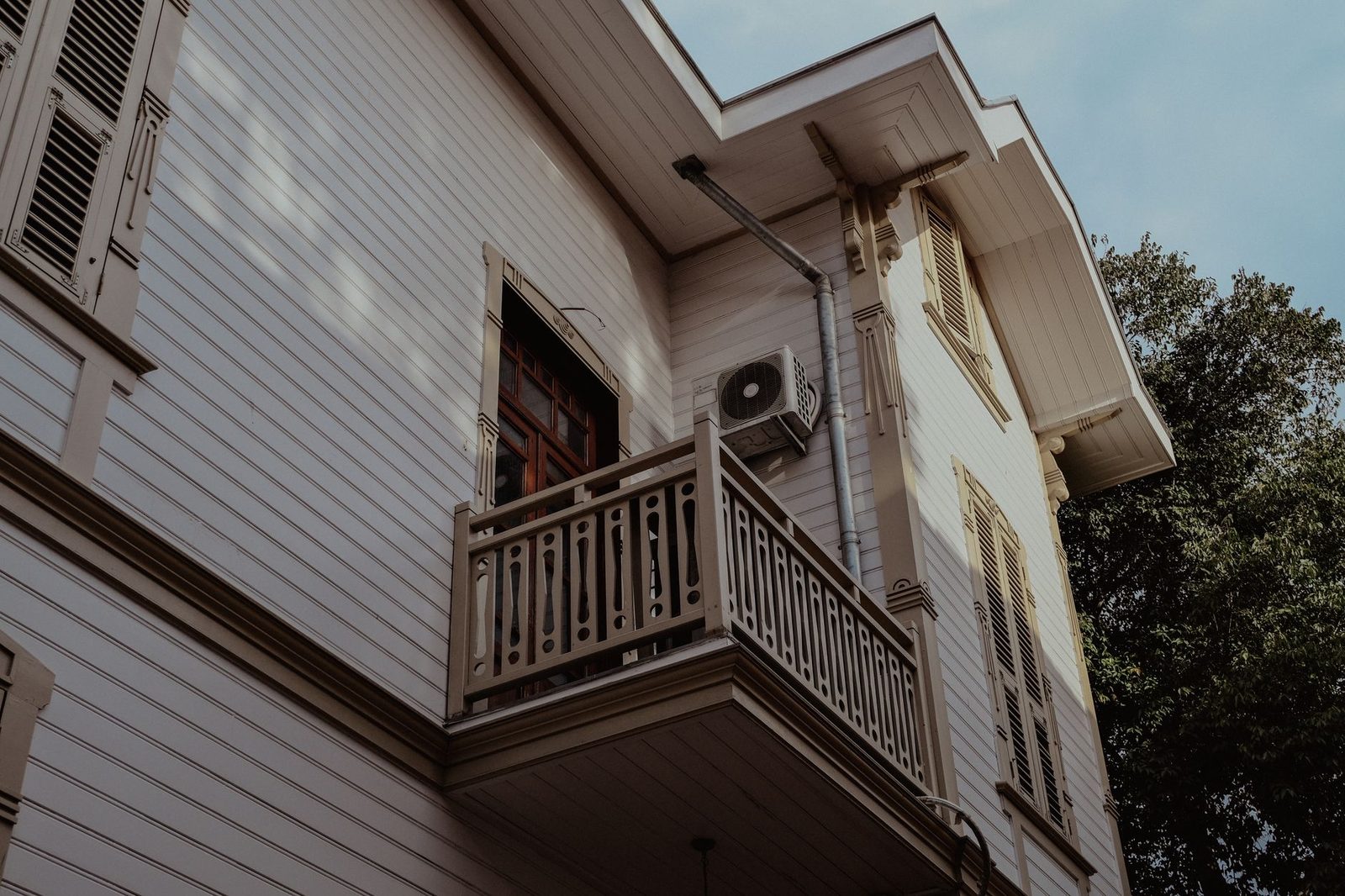
The outdoor unit deserves the same attention: fins blocked by poplar fluff, leaves piled up against the grille, or worse, a decorative enclosure that prevents hot air from escaping. A condenser recirculating its own hot air loses several points of efficiency.
5. Insufficient refrigerant charge
This is the least visible cause and the most expensive. An installation that has lost 10 to 15% of its R-32 charge through a micro-leak on a flare fitting will keep working — but with degraded efficiency and a compressor under constant strain. The classic symptom: a unit that "blows less cold" than in its first season, and never switches off.
A reminder of the legal framework: handling refrigerants is restricted to operators holding a capability certificate (articles R.543-99 et seq. of the French Environment Code), and equipment containing at least 5 tonnes of CO₂ equivalent is subject to periodic leak testing. For a domestic R-32 split, that threshold is reached at around 3.4 kg of charge — most residential installations stay below it, but the professional monopoly on intervention applies regardless of the charge.
Shifting, not just reducing: the tariff argument
Cutting consumption is one thing. Shifting the time of day you consume is another — and since the overhaul of off-peak time slots rolled out in 2026, it deserves a close look.
The logic behind the new summer slots is to make the most of periods of high photovoltaic output, i.e. part of the afternoon, at the expense of the traditional night-time windows. In practice, for a household on the peak/off-peak option, this opens up a pre-cooling strategy: bring the home's temperature down during the afternoon off-peak window, then raise the setpoint in the evening and let the building's thermal mass do the work.
This approach only works in homes with sufficient thermal mass — heavy masonry, concrete slab. In a lightweight build or a converted loft, the temperature climbs back within an hour and the benefit evaporates. Check your own time-of-use schedule on your bill or in your customer area before building a routine around it: the slots have been redistributed customer by customer.
To manage this without thinking about it, a smart programmable plug works for portable units, while recent fixed splits come with a manufacturer app or an optional Wi-Fi module allowing time scheduling. On older models with no connectivity, a universal smart infrared controller replicates the remote control's commands and lets you create time-based scenarios — a solution costing a few tens of euros that saves you replacing a perfectly functional machine.
The annual picture: don't judge your air-to-air heat pump on summer alone
One last point, often forgotten when you're staring anxiously at the August bill.
If your equipment is a reversible air-to-air heat pump, summer is only half the story. The same machine provides heating in winter, with a coefficient of performance (SCOP) generally between 3.8 and 4.8 on today's residential market. Over a full year, the savings made in winter compared with electric convector heaters vastly outweigh the cost of summer cooling.
Put another way: excess consumption of €80 to €250 in summer can be offset by €600 to €1,200 in heating savings over the cold season, depending on the system replaced. It's the annual cost that makes sense as a basis for judgement, not an isolated reading of the end-of-August statement.
If you want to track this seriously from one year to the next, keep a simple monthly log. A consumption log book or a spreadsheet is enough: twelve lines a year, and after two seasons you'll have a basis for comparison worth more than any forum debate.
Key takeaways
- Do the maths before drawing conclusions. The differential between a neutral month (May/October) and the summer months isolates the AC's share to within a few percent.
- A bedroom split costs €20 to €40 per summer. A whole house cooled continuously, €200 to €300. Beyond that, look for the cause.
- The setpoint is lever number one: 1 °C = roughly 7% of consumption. 26 °C remains the target.
- Clean filters, an unobstructed outdoor unit, external solar shading: this trio fixes most drift without heavy investment.
- A unit that blows less cold than it used to and never switches off needs to be seen by a refrigeration engineer holding a capability certificate: it's often a degraded refrigerant charge.
- Think in annual cost if your equipment is reversible: the winter side of the ledger completely changes the equation.
The consumption figures cited here draw on the benchmarks published by ADEME, the European regulatory energy labels (Regulation 626/2011 on air conditioners) and the regulated electricity sale tariffs. Always check the price per kWh shown on your own contract: that, not a national average, is what turns your kilowatt-hours into euros.
Need an air conditioning solution?