Moving house with your air conditioner: can you dismantle and reinstall a split system in 2026?

L'équipe Proclimo
18 Sep 2026 - 09 min read
"We paid €3,200 for that air conditioner two years ago — we're certainly not leaving it for the buyers." Refrigeration engineers hear this line every spring and every autumn, the two peak moving seasons. And it sounds like plain common sense: the unit is recent, it works, and it cost as much as a cheap second-hand car. Why abandon it?
Except that between deciding to take your split system with you and the moment it blows cool air into your new living room, there's an obstacle course: murky legal status, a regulatory obligation to recover the refrigerant, refrigerant lines that can't simply be coiled up like a garden hose, and a cumulative bill that often comes close to the price of brand-new equipment. Let's sort it out.
First question: does the unit still belong to you?
Before even discussing the technical side, there's a point of law that many people discover far too late — sometimes in the notary's office.
The "fixture by destination" trap
The French Code civil (articles 517 and following) distinguishes movable property from immovable property. A split air conditioner, fixed to the wall on mounting plates, wired into the electrical installation, with pipework passing through the facade and an outdoor unit bolted to a bracket, ticks just about every box that case law uses to define an immeuble par destination (a fixture by destination): a movable item attached to the property "in perpetuity", which cannot be detached without causing damage.
In practice, when a home is sold:
- if nothing is specified in the preliminary sale agreement, the air conditioning is presumed to be sold with the property;
- if the seller wants to keep it, the clause must be set out in black and white in the preliminary agreement and then in the deed of sale, specifying who makes good the drilled holes and the facade;
- removing it after the event, once the contract is signed, exposes the seller to a claim for proper delivery of the property, or even for a reduction in price.
The same reasoning applies in reverse to tenants. Article 7 f of the French law of 6 July 1989 prohibits altering the property without the landlord's written consent; conversely, article 7 e provides that alterations carried out without consent may be retained by the landlord without compensation. A tenant who has installed air conditioning without authorisation therefore has no guarantee of being able to take it away — and may even be required to restore the property to its original state.
Simple rule: in both sales and tenancies, anything not put in writing before installation or before the preliminary agreement will be settled against the person who wants to dismantle.
The case of jointly owned buildings
If the outdoor unit is fixed to the facade, to a balcony or on the roof, it occupies a common area. The general meeting authorisation obtained at the time was personal and attached to the lot. Removal itself doesn't require a new vote, but it does require making good the facade: sealing the drilled holes, repairing render or paintwork, removing the bracket and anchors. The managing agent is perfectly entitled to demand this work, and failing that to deduct the cost from the works fund or issue a formal notice.
Second question: does the law allow you to dismantle it yourself?
This is the central regulatory point, and it leaves no room for ambiguity.
A split air conditioner contains a refrigerant — R-32 in the vast majority of units sold since 2018, R-410A in older models, R-290 in the latest generations. European Regulation (EU) 2024/573, known as the "F-Gas" regulation, which replaced Regulation 517/2014, and its French transposition in articles R. 543-75 and following of the Code de l'environnement require any refrigerant recovery operation to be carried out by an operator holding a certificate of competence (attestation de capacité), using personnel who hold a certificate of ability (attestation d'aptitude) in the appropriate category.
In other words:
| Operation | Can a private individual do it? |
|---|---|
| Disconnecting the unit electrically | Yes (excluding work on the consumer unit) |
| Removing the indoor unit from its mounting plate | Yes, once the circuit has been emptied |
| Recovering the refrigerant in the outdoor unit | No — certified professional required |
| Cutting the refrigerant lines while charged | No — that constitutes venting, which is prohibited |
| Vacuum pull-down and recharging on reinstallation | No — certified professional required |
Deliberately releasing refrigerant into the atmosphere carries penalties: article L. 173-1 of the Code de l'environnement provides for up to two years' imprisonment and a €75,000 fine for operating installations in breach of the applicable requirements, and simple venting is punishable by the fines set out in article R. 543-81. Beyond the penalty, the environmental impact is enormous: the global warming potential (GWP) of R-32 is 675, and that of R-410A is 2,088. Emptying the circuit of a 3.5 kW split containing 1 kg of R-410A is equivalent to releasing more than two tonnes of CO₂.
The "pump down" method
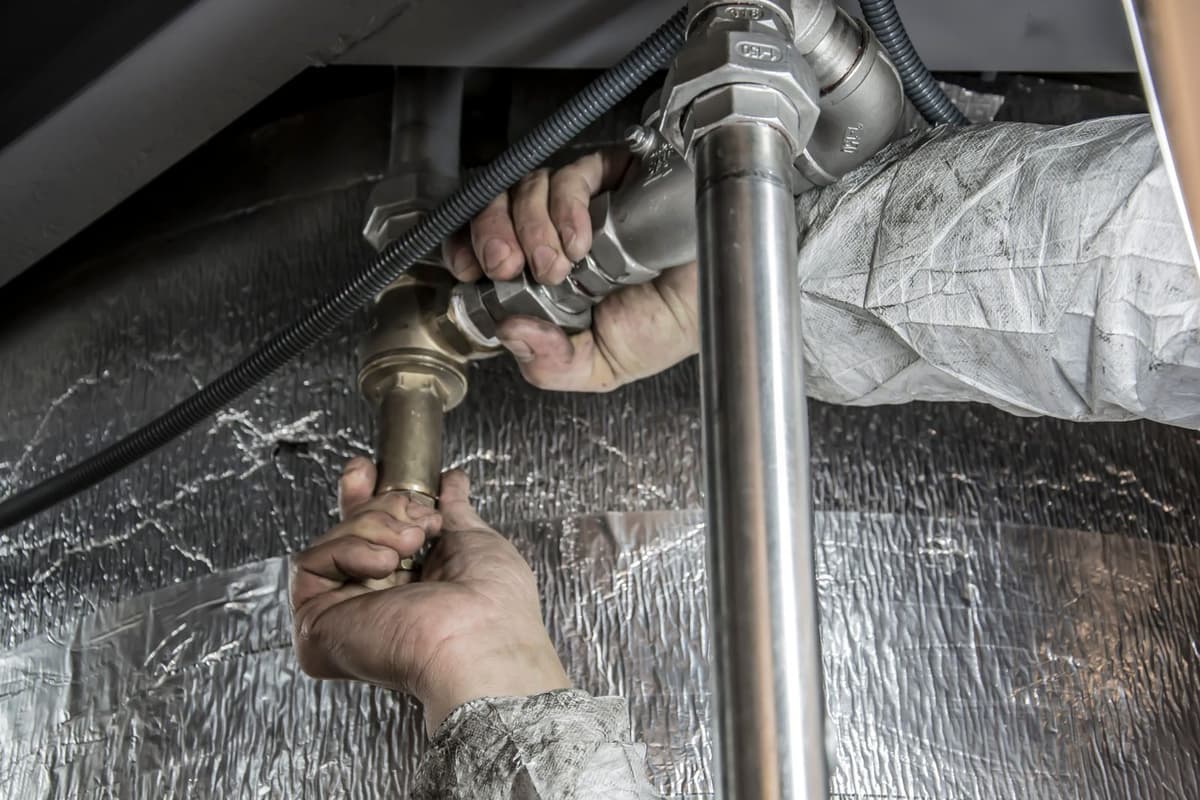
A refrigeration engineer doesn't "empty" the air conditioner into a cylinder for a straightforward removal. Instead, they perform a pump down, drawing the charge from the indoor unit into the outdoor unit: they close the liquid valve, run the compressor for a few minutes to bring the charge back into the condenser, then close the gas valve. All the refrigerant stays sealed inside the outdoor unit, which then becomes transportable.
The operation takes twenty minutes, calls for a set of refrigeration manifold gauges and, above all, know-how: run it too long and the compressor operates in a vacuum and is damaged; too short and refrigerant escapes into the atmosphere when the lines are cut. It's precisely this step that justifies calling in a professional rather than improvising.
Third question: will the equipment survive the journey?
Let's assume the legal framework is settled and the refrigeration engineer is booked. That still leaves the physical reality of the hardware.
Refrigerant lines are almost never reusable
The copper pipes linking the two units are bent during installation, flared at each end and cut to a precise length. Removing them leaves you with:
- pipes that are too short or too long for the new configuration — the length between units determines the refrigerant charge, and a manufacturer such as Daikin or Mitsubishi Electric requires additional charge beyond a nominal length (often 5 to 7.5 m);
- worn flares, which have to be cut back and remade;
- insulation crushed or torn where it passes through the wall;
- a risk of moisture ingress if the ends aren't capped immediately.
In 90% of cases, the engineer starts afresh with a new refrigerant line set at the new property. Budget €25 to €45 per linear metre, installation included, depending on the diameter.
Moisture, the circuit's number one enemy
A refrigerant circuit left open to the air for a few hours absorbs moisture. Mixed with the compressor oil, this forms acids that attack the windings. That's why reinstallation requires a deep vacuum pull-down (down to roughly 500 microns) with a vacuum pump, held long enough to evaporate any residual water. An installer who skips this step is condemning the compressor in the medium term.
The transport itself deserves a few precautions. The outdoor unit must travel upright, never lying down, to stop the oil migrating into the circuit; if it has been tilted, leave it standing vertically for several hours before powering it up. Wide ratchet straps and a thick moving blanket will prevent knocks to the condenser fins, which are extremely fragile.
The warranty almost always lapses
A point rarely anticipated: most manufacturer warranties (5 years on parts, sometimes 3 years on the compressor) are conditional on professional installation and on the system remaining in place. Removal and reinstallation, even carried out by the book, frequently means losing the benefit of the warranty — or at best having it taken over by the installer who refits the system, meaning a two-year warranty on labour under contractual liability, and nothing at all on parts.
What does it really cost? The awkward arithmetic
Here are the typical figures seen in 2026 for a 2.5 to 3.5 kW wall-mounted single-split unit in mainland France.
| Item | 2026 price range |
|---|---|
| Removal with refrigerant recovery (pump down) | €250 – €450 |
| Sealing the facade and making good the old property | €80 – €250 |
| Transport and storage | €0 – €150 |
| New refrigerant line set (4 to 6 m) | €120 – €270 |
| Reinstallation, vacuum pull-down, commissioning, refrigerant top-up | €500 – €900 |
| New bracket or support, dedicated electrical supply | €100 – €350 |
| Total | €1,050 – €2,370 |
Compare that with the price of a new single-split unit supplied and fitted, €1,800 to €2,800 in 2026 — and above all with the tax treatment. Since the reduced rate was extended to air-to-air heat pumps, supplying and installing a new unit in a property completed more than two years ago qualifies for VAT at 5.5%. A pure removal-and-reinstallation service, by contrast, falls depending on the case under the 10% rate applicable to home improvement work, or even 20% on certain pure handling services.
The maths is different for a multi-split or ducted system
With a multi-split (one outdoor unit, three to five indoor units), the value of the equipment climbs to €6,000–€9,000. At that point, removal and reinstallation becomes a genuine option — provided the new property offers a comparable configuration: the same number of rooms to treat, compatible line lengths, and somewhere to put the outdoor unit. With a ducted system, however, forget it: the ductwork, plenums and grilles are made to measure for a given ceiling and simply don't transfer.
The six cases where you shouldn't take your air conditioner with you
- The unit is more than seven years old. The efficiency gains of recent generations (SEER above 8, SCOP above 4.6) will wipe out the savings within a few seasons.
- It runs on R-410A or R-22. R-22 has been banned since 2015; R-410A, with its GWP of 2,088, is becoming scarce and its price per kilo is soaring under the F-Gas quotas. Any future intervention will be expensive.
- You're selling the property. Working air conditioning is a selling point with quantifiable value, especially after two scorching summers.
- The new property has different needs. A 2.5 kW unit sized for a north-facing studio will be undersized in a 40 m² south-facing living room — and an undersized unit runs constantly, wears out and consumes more.
- You're a tenant without written consent. The balance of power is against you; negotiate compensation at the check-out inventory instead.
- The gap between the two properties is more than a few weeks. A unit stored uncapped in a damp garage will deteriorate.
If you're taking it anyway: the step-by-step plan
Two months before. Dig out the original invoice, the manual and, above all, the commissioning certificate. Check the exact model reference and the refrigerant charge shown on the outdoor unit's rating plate. Photograph the routing of the lines and the wall penetration.
Six weeks before. Get two separate quotes, from the same professional if possible: one for removal, one for reinstallation. Insist that the quote mentions refrigerant recovery, the company's certificate of competence number and the vacuum pull-down on reinstallation. At the same time, request a quote for a new unit supplied and fitted at 5.5% VAT: it's the only way to make an honest comparison.
One month before. If your new home is in a jointly owned building, submit your application for works authorisation to the managing agent: the agenda for a general meeting is finalised weeks in advance, and without a vote there'll be no facade installation.
On the day. Be there for the removal. Check that the ends of the lines and the unit connections are capped immediately (plastic caps or sealing tape), that the outdoor unit stays vertical, and that the indoor units travel in a lined box. A padded protective cover for appliances does the job perfectly for a wall-mounted unit.
At reinstallation. Ask to see the vacuum reading on the gauge before the valves are opened, and the amount of any refrigerant top-up. Get a new commissioning certificate: it determines whether your home insurance will cover you in the event of water damage from condensate or an electrical fire.
And afterwards? Don't forget servicing
A reinstalled system starts a fresh cycle. Remember that above 2 kg of refrigerant (or 5 tonnes of CO₂ equivalent), periodic leak testing by a certified professional is mandatory — which rules out most domestic single-splits, but does apply to multi-splits and ducted systems. For everything else, decree no. 2020-912 requires a periodic inspection every two years for air conditioning systems and reversible heat pumps with a rated output above 70 kW, and an annual service visit remains recommended by ADEME to maintain performance.
Day to day, cleaning the filters every two to four weeks during the season is enough to maintain airflow: a simple cordless handheld vacuum and lukewarm water will do the job, and a disinfectant cleaning spray for air conditioners applied to the evaporator once or twice a year will limit musty smells at start-up. And if you want hard evidence on how the move went — is the unit using as much power as before? — a plug-in energy meter connected for a few days to the dedicated circuit will give you a definitive answer.
In summary
Taking your air conditioning with you when you move is legal, provided you use a company holding a certificate of competence for the refrigerant recovery. But the exercise only makes financial sense in a minority of cases: recent equipment, a valuable multi-split, a comparable configuration at the new property, and above all prior written agreement on ownership of the unit.
In most situations — a single-split more than five years old, the sale of a property, a tenant without formal authorisation — the air conditioner is better off staying where it is. Between 5.5% VAT on new equipment, the leap in performance of the latest generations and an intact manufacturer's warranty, the maths almost always comes down on the same side.
Sources: Code de l'environnement (art. R. 543-75 to R. 543-123, L. 173-1); Regulation (EU) 2024/573, known as F-Gas; Code civil (art. 517 et seq.); law no. 89-462 of 6 July 1989 (art. 7); decree no. 2020-912 of 28 July 2020; ADEME documentation on air-to-air heat pumps.
Need an air conditioning solution?