Air Conditioning Condensate Drainage: The No. 1 Cause of Water Damage (and How to Avoid It)

L'équipe Proclimo
4 Oct 2026 - 08 min read
The mark first appears as a faint ring, about fifty centimetres below the indoor unit. Then the paint blisters, the skirting board swells, and six months later you discover that the plasterboard behind the furniture has turned black. In air conditioning damage claims, the refrigerant circuit is almost never the culprit: water is. Condensation water, the kind the machine silently produces every time it cools or defrosts, and whose drainage is the most neglected part of the entire installation.
The figure often comes as a surprise: a 3.5 kW wall-mounted split running in cooling mode in a humid room easily produces 1 to 2 litres of water per hour of operation. In heating mode, the outdoor unit in turn produces water with every defrost cycle — several litres over a cold, damp day. That water has to go somewhere, by gravity or by pump, and that's where everything is decided.
Where this water comes from, and why it causes trouble
The physical principle is the same as the mist on a bottle taken out of the fridge. Room air, laden with water vapour, passes over an exchange coil whose surface is held at around 5 to 10 °C. Below the dew point, the vapour condenses into droplets that run down the fins and fall into the condensate tray located beneath the heat exchanger.
From there, three configurations are possible:
- gravity drainage: a pipe with a continuous slope carries the water outside, to a floor drain, a wastewater network or an inspection chamber. This is the most reliable solution;
- condensate pump: a small float detects the rising water and triggers a micro-pump that pushes the condensate up to a high point. Essential when no slope is possible, but it is a wear part with an electromechanical component;
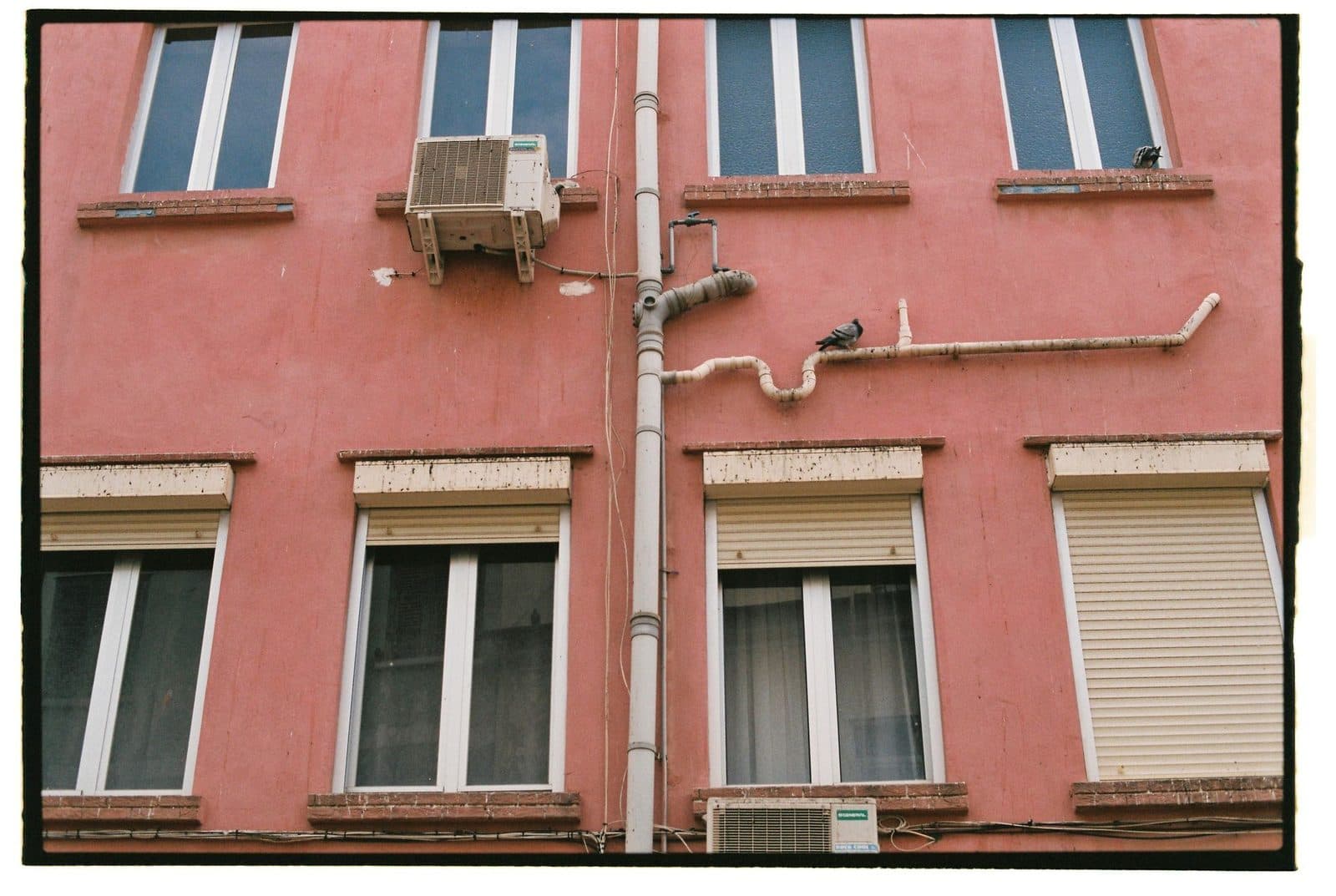
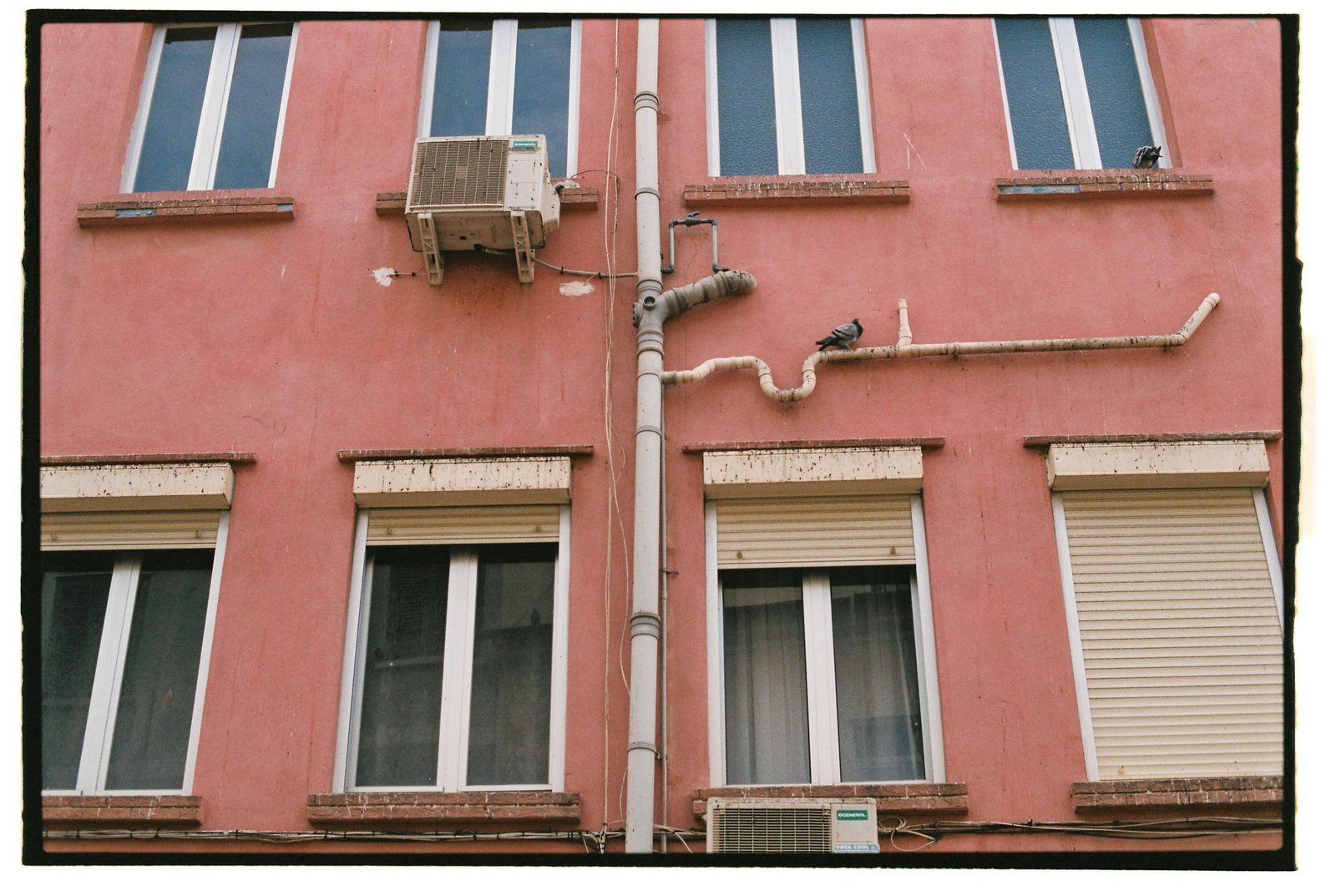
- no dedicated drainage on the outdoor unit, with defrost water simply running onto the ground.
Heating mode completely changes the picture compared with what many homeowners have in mind. In winter, it is the outdoor unit that condenses and ices up. Its periodic defrost cycle releases water in quantity, often at the foot of a wall, on a terrace or in a walkway. In sub-zero temperatures, this water refreezes: it is one of the most common causes of a localised patch of black ice in front of a front door, and incidentally a source of disputes when the outdoor unit is installed on a property boundary or on a shared walkway in a block of flats.
The seven installation faults that end in water damage
In the vast majority of leaks observed under an indoor unit, the diagnosis falls into one of these categories.
1. Insufficient slope or back-fall
Gravity drainage requires a steady slope, typically a minimum of 1 to 2 cm per metre, with no low point. A flexible pipe sagging between two clips creates a pocket of standing water: in the short term it clogs with biofilm, in the medium term it backs up into the tray.
2. Pipe crushed inside the trunking
The condensate hose often runs through the same trunking as the refrigerant lines and the power cable. Over-tightened by a clip, bent at 90° where it exits the wall, it loses a good part of its cross-section.
3. No trap on the wastewater connection
A direct connection to a wastewater pipe without a trap lets sewer odours rise into the room — a symptom frequently and wrongly blamed on the unit itself — and can let in air that breaks the flow.
4. Clogged condensate tray
This is the most common case on an installation that has simply aged. Organic dust, pollen, skin flakes: the inside of the tray becomes lined with a slimy deposit that eventually blocks the outlet nozzle. The tray overflows at the side and water runs into the partition wall.
5. Condensate pump never serviced
The float jams in the low position (the pump no longer starts) or the impeller fouls up. Decent models include a safety switch that shuts down the air conditioner before overflow. Many budget installations lack it, or the switch was never wired up.
6. Condensate discharged in the wrong place
A pipe that empties into a poorly ventilated crawl space, against a wall base, into a planter or onto the neighbour's façade: the water leaves the appliance but creates a problem elsewhere. In a block of flats, discharging condensate onto a common area or onto a balcony below is a classic source of litigation.
7. Indoor unit installed out of level
A unit tilted by a few millimetres the wrong way is enough to shift the flow to the side opposite the outlet nozzle. The fault sometimes only shows up months later, on the day air humidity rises.
Symptoms you shouldn't let drag on
| Symptom | Likely cause | Urgency |
|---|---|---|
| Regular dripping under the indoor unit | Clogged tray, blocked pipe, unit out of level | Switch the unit off, prompt call-out |
| Lapping or gurgling noise | Water pocket in the drain, trap siphoned dry | Have it checked |
| Continuous humming behind the unit | Condensate pump running without priming | Call-out |
| Sewer smell while running | Missing or dried-out trap | Not urgent but needs fixing |
| Musty smell on start-up | Biofilm in the tray and on the exchanger | Cleaning |
| Air conditioner shutting down unexpectedly | Condensate pump safety switch cutting out | Diagnosis |
| Staining or blistered paint near the unit | Old leak that has already seeped in | Priority |
The key point: a condensate leak does not stop on its own. Unlike a refrigerant fault, which degrades performance without harming the building, water works away at the wall continuously. In a recent home with plasterboard and mineral wool insulation, water migrates by capillary action into the lining and the damage quickly costs more than the installation itself.
What you can do yourself, and where the limit lies
Cleaning the filters and visually inspecting the lower part of the indoor unit are part of routine user maintenance. Nothing involving the refrigerant circuit is yours to touch: any work on the refrigerant is reserved for holders of a certificate of competence, in accordance with F-Gas regulations and the framework set by European Regulation 2024/2573. Condensate, on the other hand, is water — you are entitled to deal with it.
A realistic routine, to be carried out twice a year (end of the cold season, before winter):
- Cut the power supply to the unit at the dedicated circuit breaker, not just with the remote control.
- Remove and wash the filters in lukewarm water, and let them dry completely before refitting. A still-damp filter immediately restarts microbial colonisation.
- Inspect the visible tray behind the air outlet flap, using a torch. A handheld vacuum with a narrow nozzle lets you remove dry deposits without forcing anything.
- Check the flow: slowly pour half a glass of water into the tray and go and check that the water comes out at the outdoor discharge point within seconds. It's the most informative test there is and nobody does it.
- Rinse the accessible exchanger with an air conditioner cleaning spray of the self-draining foam type, following the instructions strictly. Never spray towards the electronic board.
- Check the outdoor discharge point: leaves, moss, insects. A blockage at the end of the pipe is enough to send water backing up along its entire length.
For trays that are hard to reach, a small condensate vacuum, or failing that a manual drain pump, saves you from flooding the floor during the operation. And for installations fitted with a condensate pump, manufacturers sell cleaning tablets to place in the tray: they limit biofilm build-up between services, without removing the need for mechanical cleaning.
The one move that makes all the difference before winter
Before the first real spell of frost, find out where the outdoor unit discharges its defrost water. If the trickle crosses a footpath, a step or a doorway threshold, it needs diverting — a simple channel drain, a pipe extension or a bed of draining gravel is often enough. In regions where temperatures stay below zero for long periods, manufacturers offer a frost-protection heating cable to fit on the outdoor tray's drain; on an air-to-air heat pump used as the main heating system, it's an accessory that avoids the vicious cycle of "frozen tray → ineffective defrost → collapsing performance".
Regulations and insurance: who pays for what
Condensate discharge is not unrestricted
Condensate from a domestic air conditioner is considered non-polluted water, but its discharge remains regulated. Two practical rules worth knowing:
- discharge onto a public road or onto a neighbouring property can be penalised and constitutes an unreasonable nuisance to neighbours, in the same way as noise from the outdoor unit;
- connection to the wastewater network is allowed under most mains drainage regulations, provided a trap is fitted. Connection to a stormwater network is sometimes prohibited by local service regulations — it is the local authority or the drainage board that sets the rule, and it can be looked up in the municipal drainage regulations.
In a block of flats, the drain almost always passes through a common area (façade, floor slab, service duct). It therefore depends on the authorisation granted by the general meeting at the time of installation, and the description of the route should normally appear in the resolution adopted. An improvised discharge onto a balcony or a shared downpipe exposes the owner to having to restore things at their own expense, regardless of how long the installation has been in place.
In the event of water damage
Water damage caused by overflowing condensate is in principle covered by the water damage cover in a home insurance policy, which compensates for damage caused by a leak from an internal installation. But three caveats come up every time:
The insurer looks for the cause. If the assessor concludes there has been obvious lack of maintenance — tray never cleaned, pump out of service for a long time, old staining — compensation may be reduced, and damage to the appliance itself is generally not covered.
The two other points to watch:
- a non-compliant installation or one carried out without qualifications (fitted by someone without a certificate of competence, improvised electrical connection) gives the insurer very solid grounds for dispute;
- liability towards the neighbour below falls under your public liability cover. If the leak passes through the floor, it is your policy that is called upon, and an agreement between insurers organises the handling of the claim without waiting for the debate over the cause to be settled.
If the installation is less than ten years old, the installer's ten-year structural warranty may be invoked where the drainage fault makes the works unfit for their purpose or damages the building fabric. Keep the itemised invoice, the structural warranty insurance certificate provided with the quote and photos of the drainage route: without those three documents, the discussion is very difficult. An installation document folder stored with the manual, the model references and the maintenance log is well worth the hour you spend on it.
The right questions to ask before installation
Everything is decided at the quotation stage, because badly designed drainage can only be corrected by opening up the wall again.
- Where exactly does the water go? Have the route drawn on a plan or a photo of the room, including the discharge point.
- Gravity or pump? If a pump is needed, ask for it to be accessible without removing the casing, and for its safety switch to be wired up so it shuts the machine down before overflow.
- Is a trap included if the connection is to the wastewater network?
- Is the outdoor discharge clear of walkways and of the property boundary?
- Is the outdoor unit raised on feet or a bracket, with enough space under the tray for defrost water to drain freely? A unit sitting flat on a slab ends up standing in its own water in winter.
- Does the maintenance contract include cleaning the tray and the condensate circuit? Many cheap packages are limited to the filters and a pressure check.
Annual servicing of an installation containing more than two kilos of refrigerant, or whose cooling capacity exceeds 4 kW, is also a regulatory obligation: it gives rise to a certificate that you must keep. Use that visit to explicitly insist on the flow test described above — it's two minutes' work and it's what will save you from opening up a wall.
Key takeaways
Condensate drainage is the cheapest and least visible part of an air conditioning installation, and statistically it is the one that causes the most material damage. Three habits are enough to eliminate most of the risk: know where the water goes, do the glass-of-water test twice a year, and refuse any condensate pump whose safety switch isn't wired up. Beyond that, a clean tray and a dry filter do more for the longevity of your air-to-air heat pump than any remote-control setting.
Need an air conditioning solution?