Air Conditioning Noise and Neighbours in 2026: What the Law Says and How to Avoid a Dispute

L'équipe Proclimo
18 Aug 2026 - 09 min read
The summer of 2026 broke every installation record: never before have so many outdoor units for reversible air conditioning and air-to-air heat pumps been fitted in France in a single season. And inevitably, never before have town halls, court-appointed conciliators and judges had to deal with so many neighbourhood noise complaints linked to this equipment.
The scenario is almost always the same. Someone has air conditioning installed in the spring, everything goes smoothly for a few weeks, then the first real heatwave arrives: the compressor runs all night, the fan revs up, and the neighbour sleeping with the window open three metres from the unit discovers they won't be sleeping any more. Three months later comes a registered letter, sometimes a formal notice, sometimes an order to remove the unit.
The good news is that almost all of these conflicts are avoidable — and when they do arise, they can be solved technically in the vast majority of cases. But you need to know the rules of the game, which are not the ones most people imagine.
The real legal test isn't a decibel figure
This is the first misunderstanding, and it is a huge one. Many owners assume there is an absolute "threshold" that must not be exceeded, something like 45 dB(A) or 55 dB(A). That is not how French neighbourhood noise law works.
The reference text is Article R. 1336-5 and following of the Public Health Code, which governs behavioural noise and activity noise. For individual equipment such as a heat pump or an air conditioner, the criterion applied is sound emergence: the difference between the ambient noise level measured with the appliance running and the residual noise level measured without it.
The emergence limits are as follows:
| Period | Maximum permitted emergence |
|---|---|
| Daytime (7 a.m. – 10 p.m.) | 5 dB(A) |
| Night-time (10 p.m. – 7 a.m.) | 3 dB(A) |
These values are subject to correction terms that take into account the cumulative duration of the noise: the shorter the noise, the greater the tolerance. A compressor running continuously all night obviously benefits from no favourable correction whatsoever.
The consequence is crucial and counter-intuitive: the quieter your surroundings, the tighter the constraint. An outdoor unit at 42 dB(A) installed in a quiet suburban housing estate at night — where residual noise drops to 28 dB(A) — is clearly in breach. The same unit, beside a ring road with a background level of 45 dB(A), will cause no legal problem at all. It is not the machine that is judged, but the difference it creates.
Key point: emergence is measured inside the complainant's home (with windows open, then closed) and at the property boundary. A single measurement exceeding the thresholds is enough to establish the breach.
Prefectural decrees add a local layer
Above the Public Health Code, each département has a prefectural decree on combating neighbourhood noise. Some go further than the national text: restricted operating hours for technical equipment, a declaration requirement in dense urban zones, minimum installation distances from property boundaries.
Some municipalities also include requirements in their local planning scheme (PLU): a ban on installing outdoor units on street-facing façades, an obligation to conceal them behind an architectural screen, a minimum setback of 2 or 3 metres from the neighbouring property. Before any installation, checking the PLU at the town hall — or on the Géoportail de l'urbanisme — takes ten minutes and can save years of litigation.
Where the noise from an outdoor unit actually comes from
Understanding the sources helps you choose the right countermeasure. An outdoor unit emits three very different families of noise.
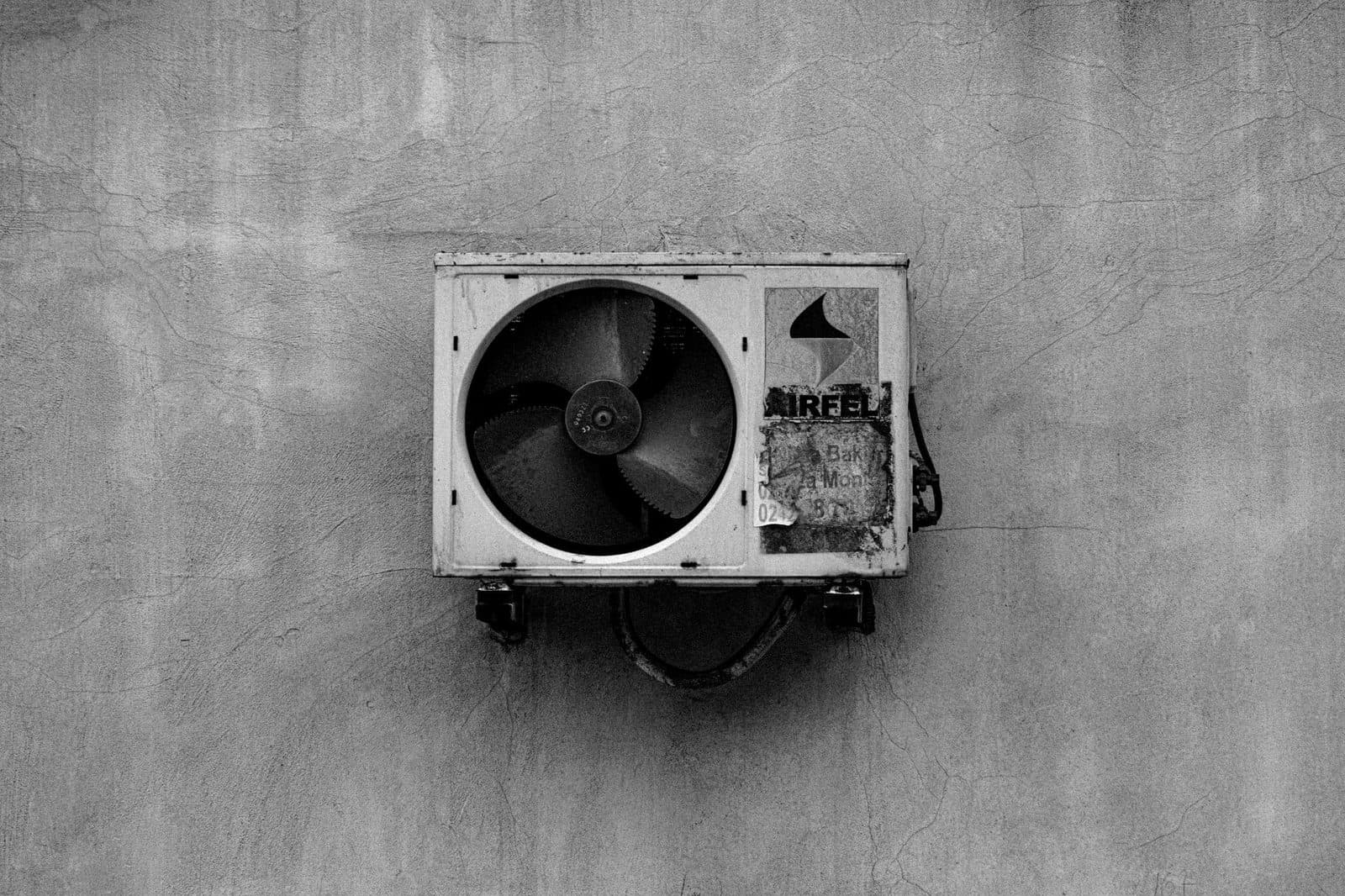
Aerodynamic noise, produced by the fan blade churning the air. It is a broadband rush of sound, relatively well attenuated by obstacles, which increases sharply when the machine switches to maximum speed — typically during a heatwave or a winter defrost cycle.
Compressor noise, lower-pitched, more penetrating, often described as a hum or a drone. Low frequencies are the problem: they pass through walls, bend around barriers, and are precisely the ones the human ear finds most disturbing at night.
Structure-borne vibration, transmitted through wall brackets or the ground-level base into the building structure. This is the most underestimated source: a unit that is perfectly quiet through the air can make the bedroom on the other side of the load-bearing wall it is bolted to completely uninhabitable. In apartment blocks and semi-detached houses, it is by far the leading cause of disputes.
Manufacturers quote a sound power level (Lw, in dB) and sometimes a sound pressure level at 1 metre. The two figures are not comparable, and only sound power allows a serious propagation calculation. A unit rated at 60 dB(A) sound power will produce roughly 42 dB(A) of pressure at 3 metres in free field, and more if it is tucked into a reflecting corner.

The siting mistakes behind 80% of disputes
Where you put the unit matters more than which model you choose. A few configurations should be ruled out systematically.
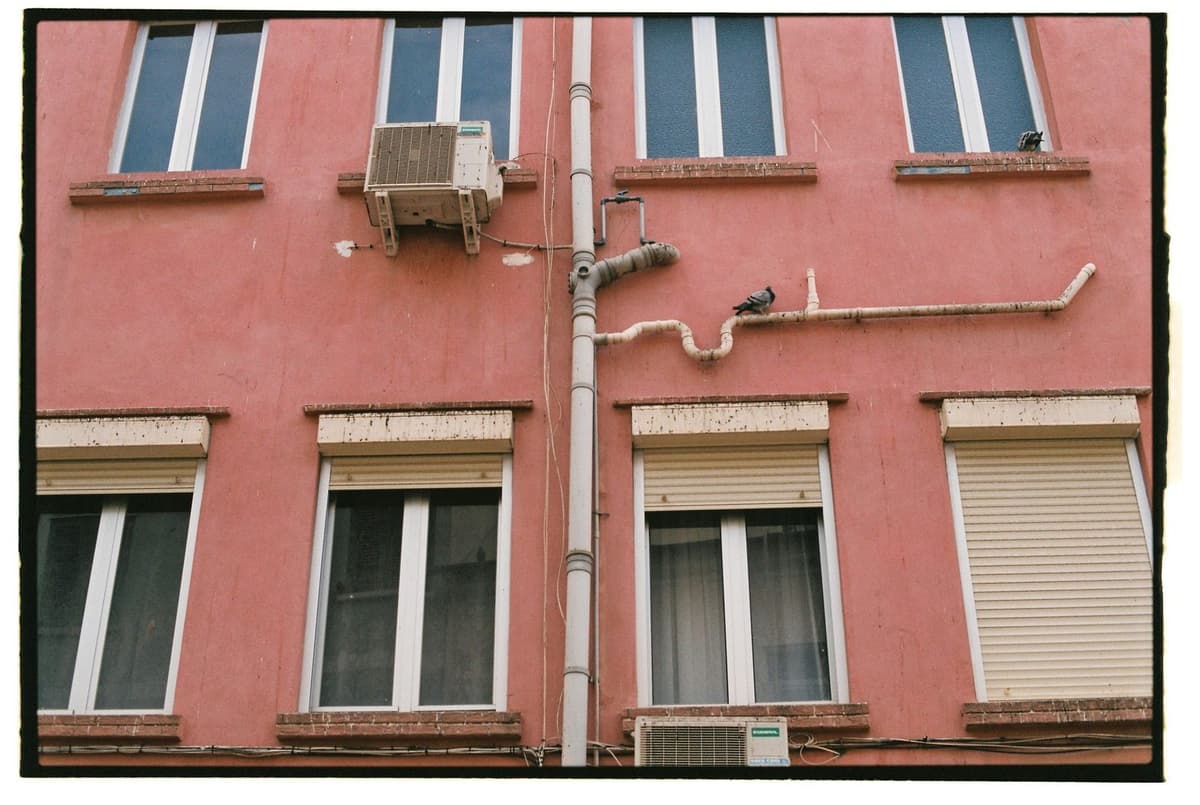
- The internal corner between two walls. Placing a unit in a corner doubles sound reflection and can add 5 to 6 dB(A) compared with a free-field installation. It is the worst possible choice, and also the most common, because the corner is the "discreet" nook of the house.
- The enclosed courtyard or patio. Sound bounces between the walls without ever escaping. A small building courtyard literally amplifies the unit and spreads the noise to every flat overlooking it.
- The façade facing the neighbour's bedroom. Three metres of setback is not enough if the air discharge points straight at a window. The direction of the airflow matters as much as the distance.
- Direct fixing to a partition wall or a lightweight stud wall. The wall becomes a vibrating membrane. Absolutely to be avoided without suitable anti-vibration mounts.
- Balcony installation with no decoupling. The slab transmits vibration throughout the floor structure, and therefore to the flat below.
Best practice is to favour a ground-level installation on a decoupled concrete pad, well away from any property boundary, with the airflow directed towards your own land rather than your neighbour's. Where wall mounting is unavoidable, it must be on a thick load-bearing wall, never on a partition, and with complete mechanical decoupling.
The technical solutions that genuinely work
When the unit is already installed and the complaint has arrived, several levers are available, from the cheapest to the most involved.
Vibration decoupling: the best value for money
This is the first thing to address, and often the only one needed. Fitting anti-vibration mounts for heat pumps between the chassis and its support eliminates structure-borne transmission. For a wall-mounted installation, add rubber-lined rails and check that no screw touches the masonry directly without an elastic interlayer.
Watch out for the refrigerant and electrical connections: if the copper pipes are rigidly clamped against the wall, they will keep transmitting vibration even if the unit itself is perfectly decoupled. A flexible loop on the refrigerant lines and rubber-lined clips solve the problem.
Acoustic screening, provided it is done properly
A screen is only effective if it breaks the direct line of sight between source and receiver, if it is solid (no slatted gaps) and dense enough — at least 10 kg/m². A simple open-slatted wooden fence attenuates nothing: it is visually reassuring, and that is all.
Off-the-shelf air conditioner covers must strictly respect the manufacturer's clearance distances, otherwise recirculated air will cut performance and push the fan to higher speeds — and therefore more noise. The general rule is at least 30 cm at the rear and 1 metre in front of the air outlet. An absorbent acoustic panel designed for outdoor units, with an absorbing face towards the machine, delivers far better results than a bare screen that simply bounces the sound elsewhere.
The software settings people so often forget
Most brands now offer a quiet night-time operating mode, sometimes called Night Quiet Mode or Silent Mode, which limits fan speed and caps compressor frequency between 10 p.m. and 7 a.m. The loss of cooling capacity is real but modest — of the order of 10 to 15% — while the acoustic gain frequently reaches 3 to 5 dB(A). In a night-time emergence dispute, that is very often enough to drop back below the threshold.
Oversizing is the other silent enemy. An overpowered machine multiplies on/off cycles, and it is compressor start-ups that wake people, far more than continuous running. A correctly sized appliance operating at low Inverter output is almost always more discreet than an oversized model.
Measure before you talk
Before starting a tense conversation with a neighbour, having figures changes everything. A digital sound level meter obviously does not replace a regulatory acoustic survey — only a measurement carried out to standard NF S 31-010 by a qualified acoustician has evidential value — but it does let you put objective numbers on the situation, identify the problem time slots and verify the effect of any change.
A sound level data logger running over 24 hours is even more revealing: it shows exactly when the emergence appears, which immediately points the diagnosis towards defrost cycles, the early-morning start-up or the afternoon ramp-up.
What to do if you are the affected neighbour
The procedure is staged, and skipping steps is strongly discouraged.
- Direct conversation. In most cases, the owner has absolutely no idea their installation is causing a nuisance. Many conflicts are settled by switching on a night mode and fitting anti-vibration mounts, for a few tens of euros.
- A registered letter with acknowledgement of receipt. It establishes a date, describes the nuisance precisely (times, type of noise, rooms affected) and requests compliance. It becomes the first document in any subsequent case file.
- Evidence gathering. A day-by-day nuisance log, time-stamped recordings and, if possible, written statements from other residents build a solid body of evidence.
- The town hall or municipal police. Sworn officers can formally record the offence. The mayor holds policing powers over neighbourhood noise and can serve formal notice on the owner.
- The court conciliator. Free of charge, mandatory before going to court for low-value disputes, and successful in a significant number of cases.
- The judicial court. As a last resort, on the grounds of abnormal neighbourhood disturbance. The judge can order soundproofing work, restricted operating hours, or even the outright removal of the installation, along with damages.
The Centre d'information et de documentation sur le bruit (CIDB) and the French Ministry for Ecological Transition publish practical guides on these procedures, freely available. Service-public.fr also sets out the complaints procedure for noise nuisance and disturbance.
The special case of apartment blocks
In a co-owned building, the noise question is compounded by an authorisation question. Installing an outdoor unit on a façade or on common property — including a balcony for private use, which in most building regulations remains legally common property with exclusive right of enjoyment — requires the approval of the general meeting of co-owners.
The co-ownership rules almost always include a "quiet enjoyment" clause prohibiting nuisances exceeding the normal inconveniences of neighbourhood life. On that basis, the managing agent can serve formal notice on a co-owner to put an end to the disturbance, and the general meeting can authorise legal action.
One point that is often overlooked: authorisation from the general meeting does not confer acoustic immunity. A co-owner authorised to install a heat pump remains fully liable if the installation generates emergence above the regulatory thresholds. The authorisation relates to appearance and to interference with common property, not to noise.
Plan ahead at the quotation stage: the questions to ask
The best time to deal with acoustics is before installation. Three requirements to set out in writing with your installer:
- The unit's sound power level in dB(A), not the pressure at 1 metre. Ask for the manufacturer's technical data sheet.
- A propagation calculation up to the property boundary and to the most exposed neighbouring façade. A serious professional will know how to produce one, or will know when an acoustician is needed.
- Details of the planned anti-vibration measures: type of mounts, decoupling of the support, treatment of the refrigerant connections.
On the equipment side, the 2026 ranges have made genuine progress: several domestic models drop below 55 dB(A) sound power in night mode. The gap between an entry-level unit and an acoustically well-designed model is often a few hundred euros — infinitely less than legal proceedings and a forced removal.
A programmable smart thermostat is a useful addition: it automatically shifts cooling to hours when the nuisance is nil, pre-cools the home in the late afternoon and sharply reduces night-time demand, in line with the new summer off-peak tariff periods.
Key takeaways
Air conditioning noise is not inevitable, and it is not simply a question of which model you buy. It is above all a question of siting, mechanical decoupling and settings. Three extra metres of setback, four rubber mounts and an activated night mode resolve the vast majority of situations for a trivial cost.
Conversely, taking the "easiest" route — installing in a corner, bolted to the partition wall of the neighbour's bedroom — turns a comfort investment into a lasting source of conflict, with, at the end of the chain, a judge who can order the removal of an installation that cost several thousand euros. In a country where the number of air conditioners and heat pumps keeps growing at a brisk pace, neighbourhood acoustics is no longer a technical detail: it is the very condition for the equipment to be accepted at all.
Need an air conditioning solution?