Humidity, Condensation and Air Conditioning: Why Dehumidifying Doesn't (Always) Replace an AC Unit in 2026

L'équipe Proclimo
22 Aug 2026 - 07 min read
There's one question installers hear every year at the end of summer, and it comes up without fail after the heavy, thundery spells of late August: "I set the AC to 24 °C, it's 24 °C in the room, and we're still stifling. Is that normal?" Yes, it is normal. And no, the problem is almost never the temperature.
Perceived thermal comfort doesn't depend on the thermometer alone. It depends on four factors: air temperature, wall surface temperature, air velocity and — the one everyone forgets — relative humidity. A home at 28 °C with 45% humidity is perfectly liveable. That same home at 28 °C with 75% humidity becomes clammy, sweat no longer evaporates, and sleep quality drops.
With the surge in installations across French homes since VAT on reversible air conditioners was cut to 5.5%, hundreds of thousands of households are discovering this topic at the same time. And many buy the wrong appliance, or use the right one on the wrong setting. Let's sort it out.
The target humidity range: between 40 and 60%, and nothing else
The recommendations all converge, whether they come from ANSES, the Agence qualité construction or indoor air quality standards: relative humidity in a home should sit between 40% and 60%, with a summer comfort band closer to 45–55%.
Below 40%, the air becomes irritating to the mucous membranes — a typical winter problem, made worse by dry heating. Above 60%, you enter the zone that encourages:
- the growth of dust mites, which thrive beyond 55% relative humidity;
- the spread of mould on thermal bridges and behind furniture, starting at around 70% humidity at the wall surface;
- a marked decline in perceived comfort in summer, as perspiration can no longer evaporate;
- long-term damage to the building fabric (paint, plaster, timber joinery).
The absolute first step, before buying any equipment, is therefore to measure. A simple indoor thermometer and hygrometer, placed in the living room and in the bedroom, costs a few euros and prevents decisions worth several thousand. Take readings in the morning, in the afternoon and at night for a week: the average matters more than the peak.
A single figure means nothing. A bathroom at 85% twenty minutes after a shower is perfectly healthy if it drops back to 55% within the hour. It's the persistence that's the problem, not the peak.
What air conditioning actually does to humidity
Many homeowners don't realise that an air conditioner is also a dehumidifier — it's in fact an unavoidable physical consequence of how it works.
When the warm, humid air from the room passes over the cold evaporator of the indoor unit, it is cooled below its dew point. The water vapour in the air condenses on the fins, drips into a tray, and drains away through the condensate pipe. That's the water you see running outside, and it can amount to several litres a day during muggy spells.
In other words: an air-to-air heat pump running in cooling mode dehumidifies mechanically, whether you ask it to or not. It's one of the reasons a home with air conditioning feels more comfortable than one that's merely ventilated at the same temperature.
"Dry" or "Dehumidify" mode: useful, but widely misunderstood
Every remote control offers a mode marked with a water droplet symbol. The principle: run the compressor at low speed with reduced fan output, so as to maximise condensation while minimising the drop in temperature.
It's a genuinely useful mode in two situations:
- muggy but not scorching days (26–28 °C, heavy air after a storm), when you're not looking to cool down but to dry out;
- at night, when many people can't tolerate a direct blast of cold air but sleep badly in saturated air.
That said, two common misconceptions need correcting:
- Dry mode doesn't use "next to nothing". The compressor runs. Consumption is generally lower than full-power cooling mode, but it's still real — reckon on 30 to 50% of cooling-mode consumption depending on the model.
- Dry mode still cools. The temperature drops by 1 to 3 °C. On some units, leaving Dry mode on all night leaves the room at 21 °C by morning, which wasn't the goal.
Standalone dehumidifier: when it's the right tool
A portable dehumidifier — usually a compressor model, sometimes a desiccant one for cold spaces — tackles humidity without tackling heat. Worse: it generates heat. The thermodynamic cycle releases the extracted heat back into the room, plus the motor's own heat. A dehumidifier typically raises the room temperature by 1 to 3 °C.
The direct consequence: during a heatwave, a dehumidifier on its own makes comfort worse. It is, however, the right tool in specific cases:
| Situation | Right equipment | Why |
|---|---|---|
| Hot, humid room in summer | Air conditioner (cooling or Dry mode) | Handles heat and humidity at the same time |
| Damp cellar, garage or utility room year-round | Dehumidifier | The heat it gives off isn't a problem |
| Laundry dried indoors in winter | Dehumidifier + mechanical ventilation | Occasional but massive moisture source |
| Condensation on windows in winter | Mechanical ventilation / airing | An air renewal issue, not an appliance issue |
| Recurring mould in a wall corner | Building survey | Thermal bridge or water ingress, not humidity levels |
The key point: a 20-litre air dehumidifier placed in a living room in August to "improve comfort" is an energy contradiction. That same appliance in an underground cellar at 16 °C with 80% humidity does a job nothing else will do.
If the need is seasonal and modest — a walk-in wardrobe, an under-stairs cupboard, a motorhome in storage — refillable moisture absorbers (hygroscopic salts, no electricity) are more than enough and cost a few euros a month. They're useless for a whole living space: their extraction capacity is measured in tens of millilitres a day, against several litres for an electrical appliance.
The great forgotten factor: ventilation
In the majority of French homes, excess humidity isn't a machine problem but an air renewal problem. A household of four produces between 10 and 15 litres of water vapour a day: breathing, showers, cooking, drying laundry, plants. If that vapour isn't extracted, no appliance can compensate for it in the long run.
The French decree of 24 March 1982, still in force, requires general and permanent ventilation in homes. In practice:
- air inlets in window frames (bedrooms, living room) must never be blocked, not even in winter, not even "just for this winter";
- extraction vents (kitchen, bathroom, WC) must be dusted regularly — a clogged vent easily loses 30 to 50% of its airflow;
- the ventilation unit must run continuously: a system switched off at night or during the holidays is a useless system.
The simplest test to check whether a vent is still extracting: hold a sheet of toilet paper against it. If it stays put on its own, the airflow is fine. If it falls, it needs cleaning — or the unit needs checking.
Doubts about real performance? A hot-wire anemometer measures air velocity at the vent outlet and lets you check regulatory flow rates (for example 30 m³/h in the kitchen at reduced flow for a three-bedroom flat). It's the kind of instrument people happily share between neighbours or within a building association.
Summer: ventilate, yes — but at the right time
The rule changes in hot weather. Throwing the windows open at 3 p.m. when it's 34 °C outside with heavy air means letting in heat and humidity. Best practice is still night-time purge ventilation: open up wide between 10 p.m. and 7 a.m., when the outdoor temperature drops below the indoor one, then close up and shade the windows during the day.
Watch out for one well-documented special case: during very humid spells, outdoor night air can be at 95% relative humidity. Ventilating in those conditions lowers the temperature but raises the indoor absolute humidity. That's precisely the situation where the air conditioner's Dry mode wins out over an open window.
Condensate: the most common humidity-related fault
The irony of the subject: the leading cause of water damage linked to air conditioning is... the water the air conditioner pulls out of the air.
A wall-mounted indoor unit commonly produces 1 to 3 litres of condensate a day in sustained summer operation, more in humid regions. That water drains by gravity through a flexible pipe, or via a condensate pump where natural drainage isn't possible.
The classic failures:
- Clogged tray. Dust and biofilm block the drain opening. Water overflows and runs down the wall beneath the unit.
- Back-fall in the pipe. A badly fitted connection creates a low point where water stagnates, then blocks.
- Failed condensate pump. The float sticks, and the unit either shuts down on safety or overflows.
- Frozen pipe in winter on poorly insulated outdoor installations, with overflow when it thaws.
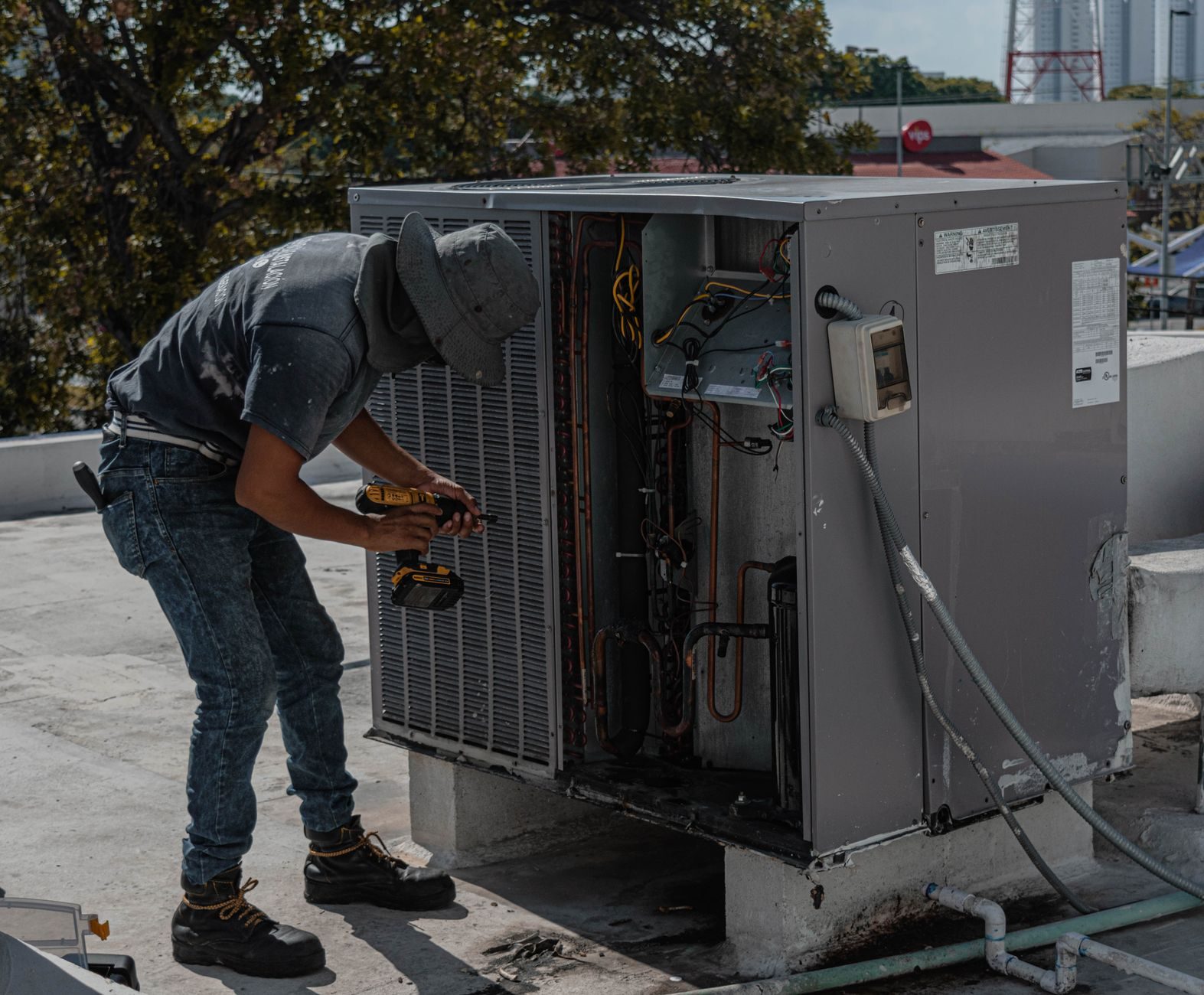
An annual service always includes cleaning the tray and checking the condensate line. Between visits, an air conditioner cleaning spray applied to the indoor unit's heat exchanger limits fouling and the "damp sock" smell characteristic of a colonised tray. This doesn't replace professional maintenance, but it spaces out the incidents.
Smells, filters and air quality: the link with humidity
An air conditioner that smells bad on start-up is almost always one whose heat exchanger stays wet after shutdown. Residual condensation, combined with dust trapped in the filters, creates an ideal environment for bacterial and fungal growth.
Two habits are enough to solve 90% of cases:
- Clean the filters every 2 to 4 weeks during the season — lukewarm water, fully dried before refitting. A saturated filter reduces airflow, hence dehumidification efficiency, hence comfort.
- Activate the automatic drying function (often called Clean, Dry Keep or Self Clean) if your unit has one: the fan keeps running for a few minutes after the compressor stops, to dry out the heat exchanger.
For anyone wanting hard data on air quality beyond humidity alone, an indoor air quality sensor measuring CO₂, fine particles and humidity gives a far more reliable reading than gut feeling. CO₂ is in fact the best indicator of air renewal: sustained levels above 1,000 ppm in a bedroom mean ventilation is inadequate — and humidity will follow the same path.
What to keep in mind before buying anything at all
Let's recap the decision-making logic, in order:
- Measure relative humidity for a week, in at least two rooms.
- Track down the source if the level stays above 60%: laundry dried indoors, no extractor hood, ventilation system out of order, rising damp, water ingress.
- Fix the ventilation before buying anything: it's the cheapest and most durable lever.
- Choose equipment according to the season of the problem: air conditioning if the discomfort is summery and thermal, a dehumidifier if the humidity is permanent and confined to an unheated room.
- Maintain it: filters, condensate tray, ventilation vents.
One final point often overlooked in shared buildings and rented accommodation: chronic humidity with mould can, depending on the case, fall under the French "decent housing" decree of 30 January 2002 and may engage the landlord's liability if it stems from a ventilation defect or a structural fault. Conversely, a tenant who blocks air inlets or switches off the ventilation system may be held liable. In either case, a documented record of humidity readings over several weeks is worth more than ten letters.
Humidity isn't a secondary comfort parameter: it's often the parameter. And the good news is that it can be measured for the price of a lunch, long before you commit to the price of an installation.
Need an air conditioning solution?