Air Conditioner Outdoor Unit Noise: What the Law Says and How to Avoid a Neighbour Dispute

L'équipe Proclimo
6 Oct 2026 - 08 min read
The letter rarely comes as a surprise. First a comment at the front gate, one summer. Then a note in the letterbox. Then a registered letter from the managing agent, or from the neighbour's solicitor, referring to "abnormal noise nuisance" and demanding the removal of the outdoor unit installed two years earlier. At that point, owners often discover two things at once: that the noise from an air conditioning unit falls under a very precise regulatory framework, and that their installer never mentioned it.
The issue is growing mechanically along with the installed base. The more air-to-air heat pumps and air-to-water heat pumps there are in dense suburban areas or apartment blocks, the more outdoor units end up three metres from a neighbour's bedroom window. And contrary to popular belief, the dispute does not hinge on a decibel figure printed in a brochure, but on a far more subtle concept: noise emergence.
The legal framework: no absolute threshold, but an emergence value
French regulations on neighbourhood noise are set out in articles R. 1336-4 to R. 1336-13 of the Public Health Code. Domestic air conditioning is classed there as "behavioural" noise or activity noise depending on the context, and the offence is not defined by exceeding a raw noise level but by exceeding an emergence value: the difference between ambient noise with the appliance running and residual noise without it.
The thresholds to remember:
| Period | Maximum permitted emergence |
|---|---|
| Daytime (7 a.m. – 10 p.m.) | 5 dB(A) |
| Night-time (10 p.m. – 7 a.m.) | 3 dB(A) |
On top of these values comes a correction term based on the cumulative duration of the noise: the longer the source runs, the smaller the tolerance. A heat pump running continuously for twelve hours a night in the depths of winter gets no favourable correction at all. Conversely, highly intermittent noise can benefit from a correction of several decibels.
Two points that change everything in practice:
- the measurement is taken at the complainant's property, indoors with the window open and closed, or at the property boundary depending on the layout — not at the foot of the appliance;
- the thresholds only apply if the residual noise exceeds 25 dB(A). In a very quiet hamlet at night, where background noise drops to 22 dB(A), the legislation provides for a special regime, and the slightest machine becomes audible. It is precisely in these quiet rural or residential areas that disputes are most frequent.
The classic owner's mistake: replying "my air conditioner is rated at 48 dB(A), that's quieter than a conversation". The manufacturer's figure is a sound power level measured in a laboratory at part load. It says nothing about the sound pressure level perceived at 3 metres, in a façade corner, at full load, on a January evening.
Beyond the Public Health Code
Three other legal grounds often apply in combination:
- abnormal neighbourhood nuisance (trouble anormal de voisinage), a case-law doctrine now codified in article 1253 of the Civil Code by the Act of 15 April 2024. It allows compensation to be obtained even where the regulatory emergence value is not exceeded, if the nuisance is deemed excessive given the surroundings;
- the building's co-ownership rules and the departmental public health regulations, which may impose additional constraints (ban on façade installation, permitted hours, appearance);
- the local planning plan (PLU), which increasingly regulates the installation of outdoor units visible from the public highway, sometimes with mandatory minimum setbacks.
Contrary to what is often read, no national legislation sets a minimum distance between an outdoor unit and the property boundary. The "mandatory 3 metres" sometimes quoted does not exist at national level: it comes from local planning plans or co-ownership rules. That said, the absence of a rule protects no one: a unit installed on the boundary is legally permitted and acoustically suicidal.
Why an outdoor unit becomes noisy
A new, correctly sized appliance is rarely noisy in itself. The nuisance almost always stems from the installation or the context.
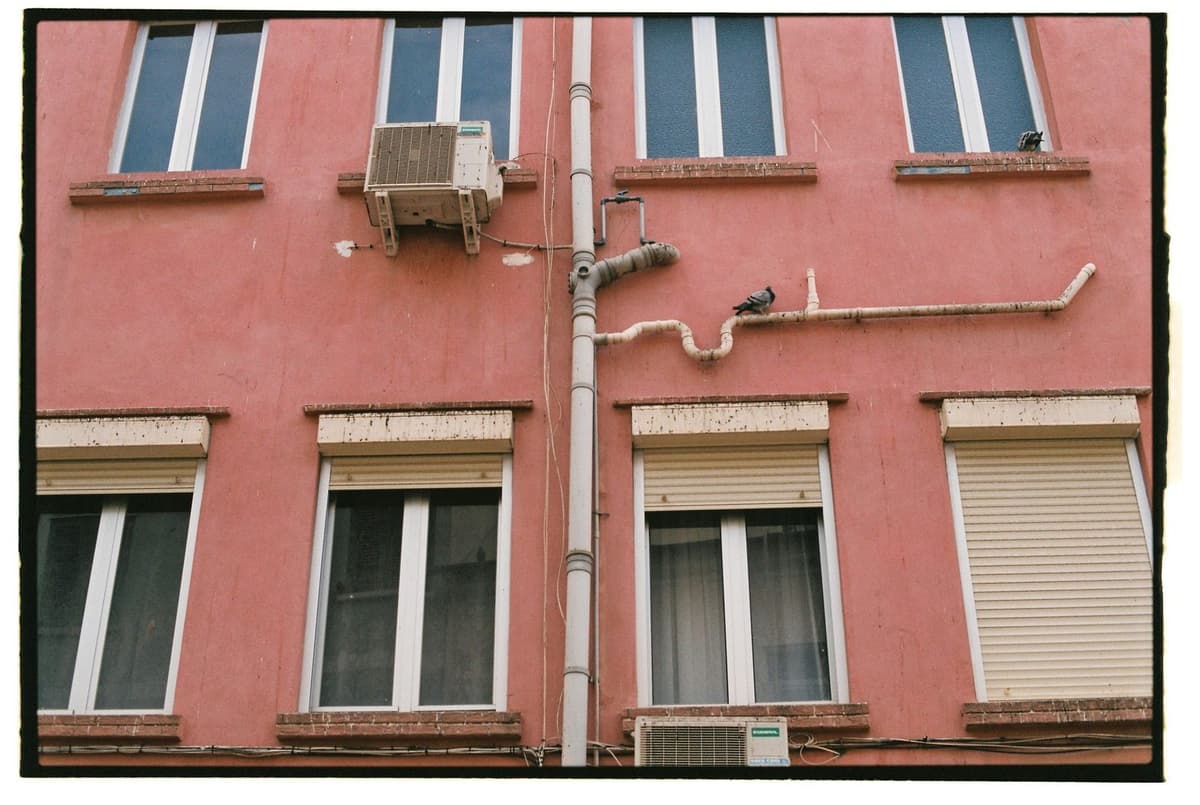
Reflection off surfaces. A unit placed in a recessed façade corner, between two walls, or under a balcony sees its perceived level rise by 3 to 6 dB(A) through reflection. That is the acoustic equivalent of doubling, or even quadrupling, the sound power. The same appliance moved two metres out into open space becomes discreet.
Structure-borne transmission. This is the most underestimated cause. A unit bolted directly onto a wall bracket transmits compressor vibrations into the structure. The neighbour does not hear a "whoosh" but a low-frequency hum that travels through walls and that no background noise can mask. Low frequencies are the most problematic: they travel far, pass through partitions, and are very poorly attenuated by lightweight screening.
Defrost cycles. In heating mode, the outdoor unit frosts up and triggers defrost cycles. During these phases, the fan stops abruptly then restarts, the four-way valve clacks, the compressor changes speed. These sudden variations are perceived as far more annoying than continuous noise at the same level — this is the phenomenon of impulsive emergence.
Incorrect sizing. An oversized machine multiplies on/off cycles. An undersized one runs permanently at full fan speed. In both cases, you leave the range in which inverter technology knows how to be quiet.
Fouling. An outdoor coil clogged with leaves, plane-tree seeds or tumble-dryer lint forces the fan to speed up. A simple clean with a soft brush and a low-pressure jet is often enough to recover 2 or 3 dB(A). An air conditioning coil cleaner in foaming spray form, applied with the power off and then rinsed, deals with greasy fouling without dismantling anything.
Measure before you argue
Before any escalation, you need objective data. For complainant and owner alike, turning up with figures radically changes the tone of the conversation.
A class 2 sound level meter is more than enough for a first assessment. It will never match an official regulatory measurement, but it tells you whether you are looking at 2 dB(A) of emergence or 12. Smartphone apps, on the other hand, are useless: a phone's microphone filters out low frequencies, precisely where the problem lies.
The minimum protocol, to be repeated identically on two consecutive evenings:
- measure the residual noise with the appliance switched off, for at least 10 minutes, at the point of nuisance (neighbour's bedroom window, terrace, property boundary);
- measure the ambient noise with the appliance running at full load, in the same spot, for the same duration;
- note the time, the outdoor temperature, the machine's operating mode, and whether windows are open or shut;
- work out the difference: that is the approximate emergence.
For a serious case file, only a measurement by an acoustic consultant or by the municipal hygiene and health service (SCHS) counts as official evidence. The French national agency for food, environmental and occupational health safety (ANSES) regularly points out in its work on the effects of noise on sleep that the levels involved are far from trivial: the World Health Organization recommends not exceeding 40 dB(A) outside bedrooms at night. The Centre d'information sur le bruit (CIDB), France's leading association on the subject, publishes practical guides on amicable and contentious procedures.
Technical solutions, from the most effective to the most decorative
1. Relocate the unit
This is the most effective solution and the one nobody wants to hear. Moving the outdoor unit to the opposite side of the building, or simply out of a recessed corner, can save 5 to 10 dB(A) — more than any acoustic enclosure in the world. The cost is real (extending the refrigerant lines, vacuum pull-down, possible recharge, a refrigeration engineer holding the required certification) but often less than that of a legal dispute.
Siting rules to remember:
- never in a recessed corner or in a lightwell;
- airflow directed outwards, not towards the neighbour's façade or a wall less than a metre away;
- at ground level rather than upstairs: noise at height travels unobstructed;
- as far as possible from bedroom windows, your own as well as the neighbours'.
2. Decouple it mechanically
Before considering a screen, you need to tackle structure-borne transmission. Anti-vibration mounts for air conditioning in rubber or with springs, fitted between the unit's feet and its support, cut the transmission of low frequencies into the structure. It is an intervention costing under fifty euros that resolves a surprising proportion of complaints about "humming in the wall".
Three points to watch:
- always prefer ground installation on a decoupled slab over a wall bracket;
- add flexible sleeves or an anti-vibration loop on the refrigerant lines where they leave the unit, so the copper pipes don't transmit the vibrations themselves;
- check the tightness of the fixings: a loose screw or a vibrating casing panel generates a very localised parasitic whistle.
3. Get the acoustic screen right
A screen is only useful if it meets three conditions: it must be massive (at least 10 kg/m²), gap-free (no openings between slats) and tall and wide enough to break the direct line of sight between the fan and the point of nuisance. A decorative slatted screen does absolutely nothing, except hinder airflow.
Conversely, a properly designed acoustic cover for an outdoor unit — absorbent lining on the inside, generous air passage area, deflector — delivers 5 to 8 dB(A) without noticeably degrading performance. Beware: anything that restricts airflow raises the discharge pressure, degrades the COP and can trigger safety shutdowns. An acoustic gain bought at the price of 15% extra consumption is not a good trade-off.
4. Make use of the machine's settings
Most modern units have a quiet mode or "night mode" that caps fan speed and compressor frequency, at the cost of 10 to 20% of output. Scheduled from 10 p.m. to 7 a.m., it is often enough to get back below the 3 dB(A) night-time emergence limit.
Other free levers:
- raise the cooling setpoint from 24 °C to 26 °C: less load, less noise, less consumption;
- shift operating periods outside sensitive hours, taking advantage of the home's thermal inertia;
- in winter, avoid abrupt morning start-ups: a steady setpoint puts less strain on the compressor than repeated stops and restarts.
What to do when you are the affected neighbour
The sequence matters, because a judge always looks at whether the amicable route was tried.
- Talk to them directly, in writing if possible, describing the nuisance factually (times, type of noise, room affected). Many owners have absolutely no idea their machine is audible next door.
- Keep a dated nuisance log, with sound level meter readings and possibly a portable audio recorder left in the bedroom overnight. It is not regulatory evidence, but it is a formidably persuasive element in mediation.
- Contact the town hall: the mayor holds general policing powers over neighbourhood noise, and the municipality can instruct its SCHS or the municipal police to carry out an official assessment.
- Use a court conciliator (conciliateur de justice), free of charge and often a mandatory preliminary step for disputes of this kind.
- Have an acoustic measurement carried out by a consultancy before any legal action. This is the investment that determines everything else.
In an apartment block, you should also check whether the unit was installed with the approval of the general meeting. A unit fixed to a façade or a balcony — common parts under most building rules — without a prior vote can be challenged on that ground alone, regardless of the noise.
For owners: plan ahead at the quotation stage
Prevention costs infinitely less than correction. Three requirements to set out before signing:
- ask the installer for a calculation note or an estimate of the sound pressure level at the most sensitive neighbouring point, not just the product datasheet;
- have the quotation state the exact location of the unit, the type of support and the presence of anti-vibration mounts;
- at equal output, favour the models with the lowest stated sound power — the gap between two 5 kW machines commonly reaches 6 to 8 dB(A), i.e. a factor of 4 in perceived sound energy.
For installations close to a window, an acoustic window sealing strip on the neighbour's side can usefully complement treatment at source, especially on older frames with poor sound insulation.
The right move before work starts: warn your neighbour, show them the planned location, and agree to shift it by a metre if they ask. An extra metre of refrigerant line costs a few tens of euros. Proceedings for abnormal neighbourhood nuisance, with an expert report and possible removal of the unit, run into thousands.
Key takeaways
The noise from an outdoor unit is not an unavoidable technological fact: it is almost always down to poor siting or inadequate decoupling. French regulations do not reason in absolute decibels but in terms of emergence — 5 dB(A) by day, 3 dB(A) at night — which makes quiet areas far more exposed to litigation than lively neighbourhoods. And because abnormal neighbourhood nuisance can be upheld even without a regulatory breach, the best defence remains an installation thought through from the quotation stage: away from corners, away from bedrooms, floor-mounted on anti-vibration pads, with a scheduled night mode. Three quarters of disputes would be settled with fifty euros' worth of rubber and two metres of setback.
Need an air conditioning solution?