Air Conditioner Noise and Your Neighbours in 2026: What the Law Says and How to Avoid a Dispute

L'équipe Proclimo
4 Sep 2026 - 09 min read
Every summer since 2023, town halls and conciliation officers have observed the same phenomenon: the curve of noise nuisance complaints climbs in step with air conditioner sales. In 2026, with a French installed base well beyond 10 million units and a VAT rate cut to 5.5% accelerating installations further, neighbourhood conflict over outdoor unit noise has become one of the most common disputes in the thermal comfort sector. The paradox is a cruel one: your installation is perfectly legal, your installer is RGE-certified, your equipment is brand new — and yet your neighbour can still obtain a court order to shut down or relocate your outdoor unit. Here is exactly what the law says, how air conditioner noise is measured, and the technical solutions that make all the difference.
The legal framework: air conditioner noise is not like other noise
Behavioural noise versus activity noise
French law has long distinguished between two families of noise nuisance. Behavioural noise (a party, a barking dog, a power drill at 10 p.m.) falls under article R. 1336-5 of the Public Health Code: it is assessed fairly subjectively, on the criteria of intensity, duration and repetition.
The noise from an air conditioning or heat pump outdoor unit does not fall into that category. It is classified among activity and neighbourhood noise arising from equipment, governed by articles R. 1336-6 to R. 1336-9 of the Public Health Code. And that changes everything: impressions are no longer up for debate — the noise is measured.
Noise emergence: the only figure that counts
The key concept is emergence. It does not measure the absolute noise of your machine, but the difference between the ambient sound level with the appliance running and the residual sound level without it.
The regulatory thresholds are as follows:
| Period | Maximum permitted emergence |
|---|---|
| Daytime (7 a.m. – 10 p.m.) | + 5 dB(A) |
| Night-time (10 p.m. – 7 a.m.) | + 3 dB(A) |
Correction terms linked to the cumulative operating time of the noise apply to these values: the longer the appliance runs during the measurement period, the smaller the tolerance. An inverter air conditioner running continuously all night therefore benefits from the least favourable tolerance.
In practical terms: if the background noise on your street is 32 dB(A) at 2 a.m., your outdoor unit must not push the level above 35 dB(A) at your neighbour's property, measured at the property boundary or inside their home with windows open and then closed.
This detail is decisive: in a quiet residential neighbourhood, night-time residual noise can drop to 25–30 dB(A). A machine advertised as "silent" at 45 dB(A) at one metre then becomes a potential offence, whereas the same installation in a city centre, where night-time background noise hovers around 45 dB(A), will raise no regulatory issue at all.
Prefectoral and municipal by-laws
On top of this national baseline, each prefecture publishes an order on combating neighbourhood noise, and many municipalities add their own restrictions — notably rules on the siting of outdoor units in Local Urban Plans (PLU): bans on street-facing façades, mandatory concealment, minimum distances from property boundaries. In Paris, Lyon, Bordeaux and Nice, several sets of rules now require the outdoor unit to be architecturally integrated.
The reflex to have before requesting any quote: consult your municipality's PLU and, in a protected area, the opinion of the Architecte des Bâtiments de France. An installation placed in breach of the PLU can be subject to a removal order, quite independently of any noise question.
How many decibels does an outdoor unit really produce?
Reading a technical datasheet correctly
This is where most misunderstandings begin. Manufacturers publish two very different quantities, and marketing happily maintains the confusion.
- Sound power (Lw): the total sound energy emitted by the machine, independent of distance. This is the figure to compare across models. It is expressed in dB(A) and generally ranges between 58 and 68 dB(A) for a residential split system.
- Sound pressure (Lp): what an ear actually hears at a given distance (often 1 m in a free field). This is the attractive figure printed on brochures, around 45 to 55 dB(A).
Remember the order of magnitude: sound pressure drops by roughly 6 dB(A) each time the distance doubles in a free field. A unit at 50 dB(A) at 1 m will therefore theoretically be at 44 dB(A) at 2 m, 38 dB(A) at 4 m, and 32 dB(A) at 8 m. In practice, reflections off walls, courtyard corners and balconies seriously degrade this calculation: a building courtyard can add 3 to 6 dB(A) through reverberation.
"Night" mode is not a gimmick
Almost every recent model from Daikin, Mitsubishi Electric, Toshiba, Atlantic or LG offers a quiet mode ("Night Quiet", "Silent Mode") that limits fan speed and compressor frequency. The real-world gain is 3 to 6 dB(A), which is far from trivial: 3 dB(A) is half the sound energy.
The trade-off is a 10 to 20% drop in output, acceptable at night when there is no solar gain. On many machines this mode must be explicitly activated in the installer settings or via the remote control — it is not automatically enabled at commissioning.
The real causes of noise: it is almost never the compressor
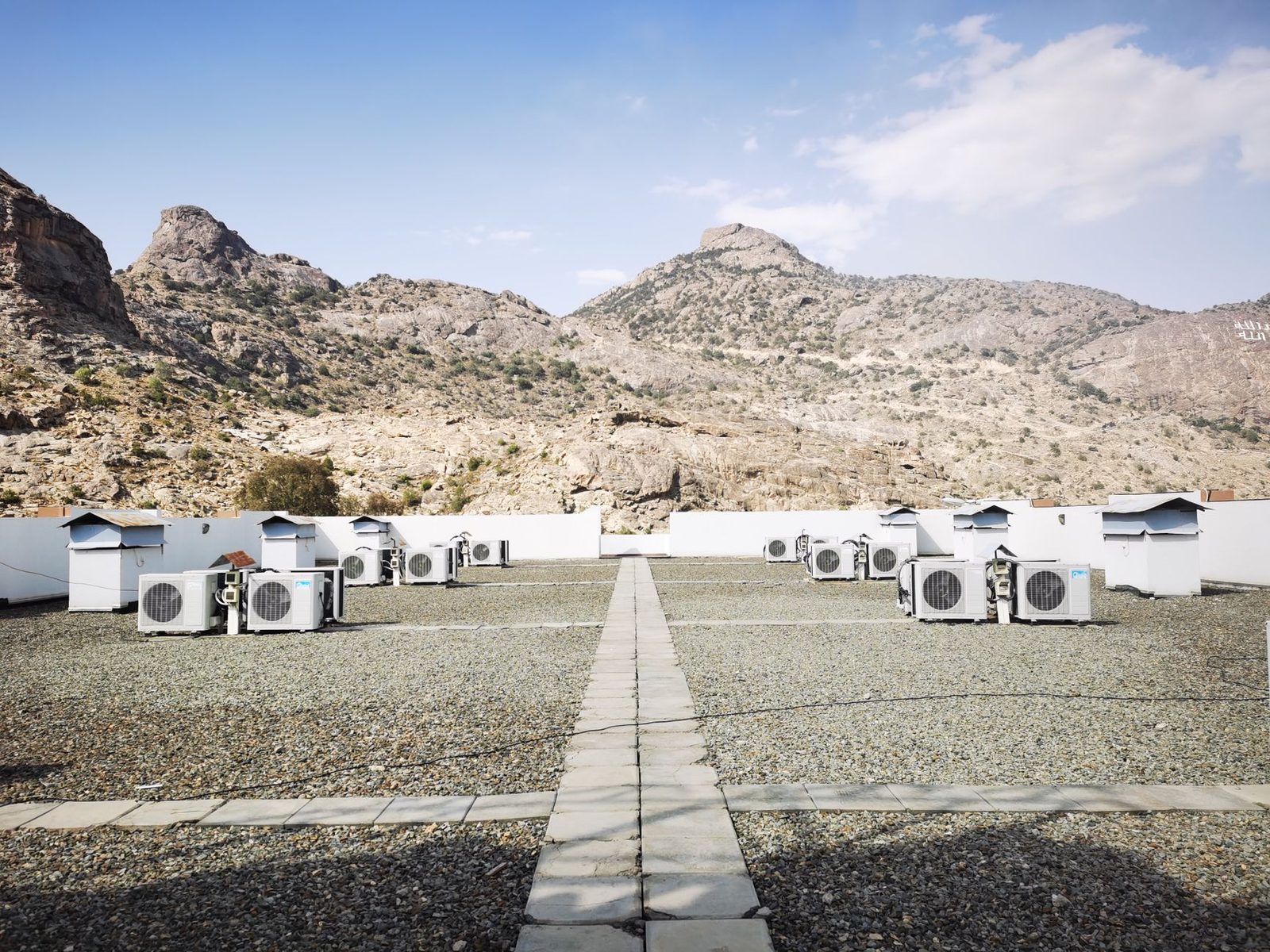
In the vast majority of disputes we see reported, the problem is not the machine but the way it was installed. A correctly sited outdoor unit rarely triggers a complaint; a badly installed one does so within a few months.
Vibrations transmitted into the structure
This is cause number one. The compressor generates low-frequency vibrations which, when transmitted to a poorly decoupled wall bracket, travel through the load-bearing wall and re-emerge at your neighbour's as a dull droning. That kind of noise passes through walls far more effectively than fan whistle, and it is particularly unbearable at night.
The remedy is simple and inexpensive: fit rubber anti-vibration mounts between the unit's chassis and its support, and favour ground mounting on an isolated slab rather than fixing to the façade. On a cavity wall or timber frame, wall mounting should be avoided altogether.
Resonance of supports and connections
A steel bracket that is too thin behaves like a resonating chamber. Refrigerant lines pressed rigidly against the wall also transmit vibrations: they must be secured with rubber-lined clips and include a flexible loop where they leave the machine.
Fouling and ageing
A unit that grows noisier over time almost always signals a maintenance failure: a fouled condenser (the fan works harder and speeds up), a worn fan motor bearing, or an impeller unbalanced by an impact or a build-up of leaves. An annual cleaning of the outdoor coil with a soft condenser brush and a low-pressure rinse is often enough to restore the original noise level. It is also the perfect opportunity to check that nothing is vibrating against the casing.
The wrong location
Three classic mistakes:
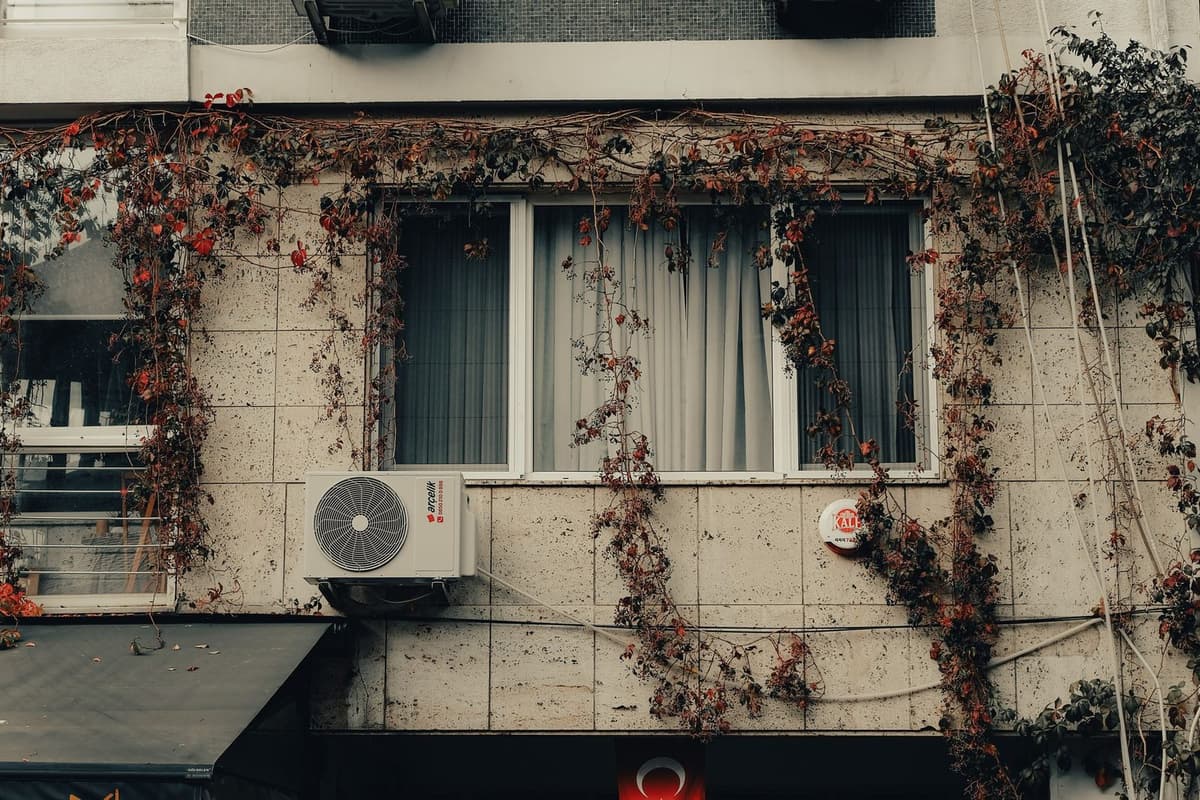
- The unit placed in a courtyard corner or between two walls: reverberation effect, up to +6 dB(A) for free.
- The fan blowing straight at the neighbour's window: an outdoor unit's radiation is highly directional on the discharge side.
- Full enclosure: trying to "hide" the machine in a sealed box degrades airflow, increases fan speed… and therefore noise, while reducing performance.
What to do when a dispute breaks out
You are the owner of the air conditioner in question
The worst strategy is to ignore your neighbour's letter. Litigation over abnormal neighbourhood disturbance is judged on the basis of article 1240 of the Civil Code and the settled case law of the Cour de cassation: the judge may order the removal or relocation of the installation, with a daily penalty payment, even in the absence of fault and even if regulatory thresholds are only marginally exceeded.
The recommended sequence:
- Reply and offer a visit. Many conflicts defuse themselves once the complainant sees that the matter is being taken seriously.
- Activate night mode and adjust the programming to avoid start-ups between 10 p.m. and 7 a.m.
- Have the installation checked by your installer: anti-vibration mounts, tightness of fixings, support.
- Put numbers on the noise level. A class 2 sound level meter gives you a first indication cheaply, but it carries no evidential weight before a court.
- Commission a regulatory measurement by an acoustic consultancy (emergence measurement in accordance with standard NF S 31-010) if the discussion hardens.
You are the one suffering a neighbour's air conditioner noise
The approach is a graduated one, and the steps matter: a judge takes a dim view of a lawsuit filed without any prior attempt at an amicable settlement.
- An informal letter, then a registered letter with acknowledgement of receipt setting out precisely the times and the nature of the disturbance.
- Keeping a nuisance log: dates, times, duration. This is a form of evidence judges appreciate.
- Referral to the mayor, who holds policing powers over neighbourhood noise, or to the municipal hygiene and health department (SCHS) where the municipality has one. The Regional Health Agency can also be called upon.
- A conciliation officer, free of charge, and now a mandatory preliminary step for many neighbourhood disputes before bringing a case to the judicial court.
- A bailiff's report and acoustic measurement as a last resort.
The Centre d'information et de documentation sur le bruit (CIDB) and the Ministry of Ecological Transition publish very clear guides on this procedure; ADEME also issues fact sheets on heat pump siting. These are useful references to attach to a letter.
The special case of co-ownership
In an apartment building, two extra layers of rules are added to ordinary law.
General meeting authorisation
The outdoor unit is fixed to a façade, a balcony or a roof: these elements are in principle common parts, even where the balcony is subject to exclusive private use. The installation therefore requires authorisation from the general meeting, voted under the majority rule of article 25 of the law of 10 July 1965 (works affecting the external appearance of the building).
Installing without a vote exposes you to an action for restoration to the original state — one that, in certain configurations, remains available for as long as the structure exists. Many managing agents make their favourable opinion conditional on an acoustic commitment: maximum sound power level, night mode activated, mandatory anti-vibration mounts.
The co-ownership rules
Some sets of rules include a "peace and quiet" clause prohibiting any equipment generating noise perceptible from other units. This contractual clause may be stricter than national regulations, and it is enforceable.
The right reflex in a co-ownership: have the machine's precise characteristics recorded in the minutes of the general meeting (sound power in dB(A), location, type of fixing). That protects the installing co-owner just as much as their neighbours.
Choosing and installing a "dispute-proof" system: the checklist
If you are still at the planning stage, a few simple choices reduce the risk to almost zero.
| Measure | Indicative acoustic gain | Cost |
|---|---|---|
| Choosing a model with Lw ≤ 60 dB(A) | 4 to 8 dB(A) vs entry level | €0 to €400 |
| Moving the unit 2 m further away | 4 to 6 dB(A) | Cost of refrigerant lines |
| Anti-vibration mounts + ground mounting | 3 to 8 dB(A) on structure-borne noise | €30 to €80 |
| Perforated landscaped acoustic screen | 3 to 5 dB(A) | €150 to €600 |
| Night mode activated | 3 to 6 dB(A) | €0 |
A few common-sense principles round out the table:
- Never aim the discharge air towards a property boundary or a neighbour's bedroom; direct it towards your own garden or an open area instead.
- Respect the manufacturer's clearance distances (often 30 cm at the rear, 1 m at the front). An appliance recirculating its own hot air will speed up and become noisy.
- Prefer a perforated acoustic screen to a closed enclosure. A timber slatted panel or an outdoor acoustic panel placed between the machine and the source of annoyance blocks direct radiation without choking the airflow.
- Programme it intelligently. A connected thermostat for air conditioning lets you smooth the setpoint and avoid noisy on/off cycles in the middle of the night — an air conditioner restarting at 3 a.m. wakes people far more than one running continuously at low speed.
- Document the installation. Photos of the fixings, the appliance datasheet, the certified installer's invoice: in the event of a dispute, that file is worth its weight in gold.
Should we expect the rules to tighten?
The question comes up with every heatwave. The current baseline — 5 dB(A) emergence by day, 3 dB(A) at night — has been stable for years, and there is currently no draft national legislation lowering those thresholds. Two underlying trends, however, are very real:
- The proliferation of local rules. More and more PLUs include requirements on the siting and integration of outdoor units, particularly in historic centres and dense urban areas.
- The move upmarket in equipment. European energy labelling already displays outdoor sound power: manufacturers are turning it into a selling point, and the gap between entry-level and premium models is widening.
In other words, the constraint will probably not come from a new law, but from your town hall and your neighbour. That is reason enough to address acoustics at the quotation stage, rather than after the first night in August.
In summary
- Air conditioner noise is judged in terms of emergence, not absolute decibels: + 5 dB(A) by day, + 3 dB(A) at night.
- An appliance that is "silent" on paper may be unlawful in a quiet neighbourhood, and perfectly compliant in a city centre.
- The real causes of complaints are installation (vibration, reverberation, discharge direction) far more than the machine itself.
- In a co-ownership, the installation requires general meeting authorisation: never skip this step.
- The amicable route — documented and swift — remains vastly less costly than litigation over abnormal neighbourhood disturbance, which can end in outright removal.
Need an air conditioning solution?