Air conditioning condensate: where your split system's water really goes, and what the law says in 2026

L'équipe Proclimo
19 Sep 2026 - 09 min read
"There's a puddle under the living room window, and it isn't rain." Every summer, this is one of the most common call-outs for refrigeration engineers — just behind a loss of cooling. And every time, the customer is equally surprised: nobody had told them their air conditioner makes water. Quite a lot of water.
A 3.5 kW split unit running for ten hours on a muggy day can produce 2 to 5 litres of condensate, sometimes more in a humid region such as the Atlantic coast or the Rhône valley in August. That water has to go somewhere. Where exactly, under what regulatory constraints, and at what cost when things go wrong: that is the subject of this article, and it is probably the least well explained part of an air conditioning quote.
Where this water comes from, and why there's so much of it
The principle is the same as a glass of iced water sitting on a table in summer. The indoor unit of an air conditioner circulates a very cold refrigerant through a heat exchanger; the warm, humid air from the home passes over it, and the water vapour it contains condenses on contact with the cold surface. This is called dehumidification, and it accounts for a large share of the comfort you feel: air at 26 °C with 45% humidity is far more bearable than air at 26 °C with 70%.
The volume depends on three factors:
- the relative humidity of the air: the higher it is, the more water there is to extract;
- how long the unit runs;
- the temperature differential being requested.
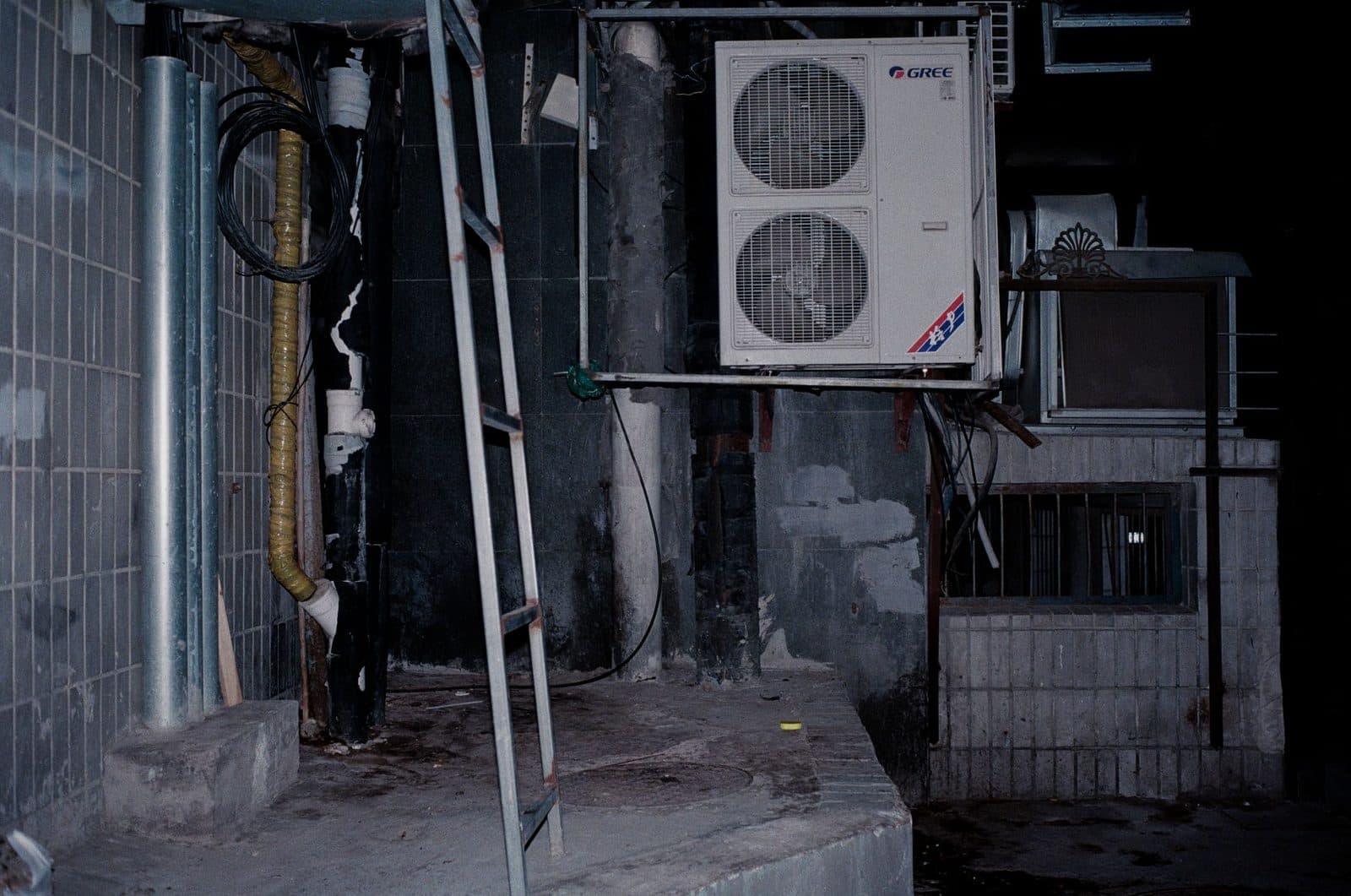
In heating mode, the phenomenon reverses: it is the outdoor unit that frosts over and produces condensate during defrost cycles. Hence those famous puddles under outdoor units in January, often mistaken for a refrigerant leak. Rest assured: refrigerant does not run out in visible drops, it evaporates instantly. If something is dripping, it's water.
A simple rule to remember: in summer, the water comes from the indoor unit. In winter, it comes from the outdoor unit. Both need a properly planned drain.
What the regulations say in 2026
There is no "condensate law" as such. The framework is a stack of different texts, and that is precisely what leaves homeowners lost.
Departmental public health regulations, the most frequently used text
This is the cornerstone. Every French department has a règlement sanitaire départemental (RSD), issued by prefectoral decree on the basis of the model public health regulation published by the Ministry of Health. Its Article 99 (in virtually every departmental version) prohibits any discharge of waste water or rainwater onto the public highway, as well as any discharge liable to create a nuisance or a hazard.
In practice, a condensate pipe dripping onto the pavement, onto a balcony below or onto a neighbour's terrace is in breach of the rules. The mayor has policing powers to put a stop to the nuisance, and the applicable fine falls into the 3rd class (up to €450).
Municipal by-laws
More and more towns — Paris, Lyon, Bordeaux, Nice, Montpellier — have adopted planning or highway regulations that explicitly govern outdoor units on façades and require condensate to be collected into an authorised drainage system. In Paris, the departmental public health regulation combined with the local plan (PLU) requires careful integration of equipment on street-facing façades, condensate included.
Before any installation visible from public space, the reflex is always the same: consult the town hall's planning department, and file a prior declaration of works (déclaration préalable de travaux) whenever the façade is being altered.
Connecting to the sewer: watch out for local rules
Condensate is very weakly mineralised water, slightly acidic, and practically free of organic matter. It is not "domestic" waste water in the strict sense. Most sewerage services tolerate discharging it into the foul water system via a trap, but discharge into the stormwater system is sometimes prohibited in municipalities with separate systems, and the opposite applies elsewhere. Your local authority's sewerage service regulations are the deciding document.
One non-negotiable point in every case: the connection must go through a trap or a water seal. Without one, sewer odours travel back into the home through the condensate pipe — a classic sign of a botched installation, which reveals itself as an inexplicable drain smell in the living room as soon as the air conditioning starts up.
In apartment buildings
The building's co-ownership rules and general meeting decisions add another layer on top of all this. Many recent sets of rules allow air conditioning on condition that condensate is connected to an existing drain within the unit (washing machine trap, waste stack) and not discharged onto the façade. Discharging directly onto common property constitutes a nuisance that the owners' association can act against.
The four ways to drain condensate, from best to worst
1. Gravity drainage into an existing outlet
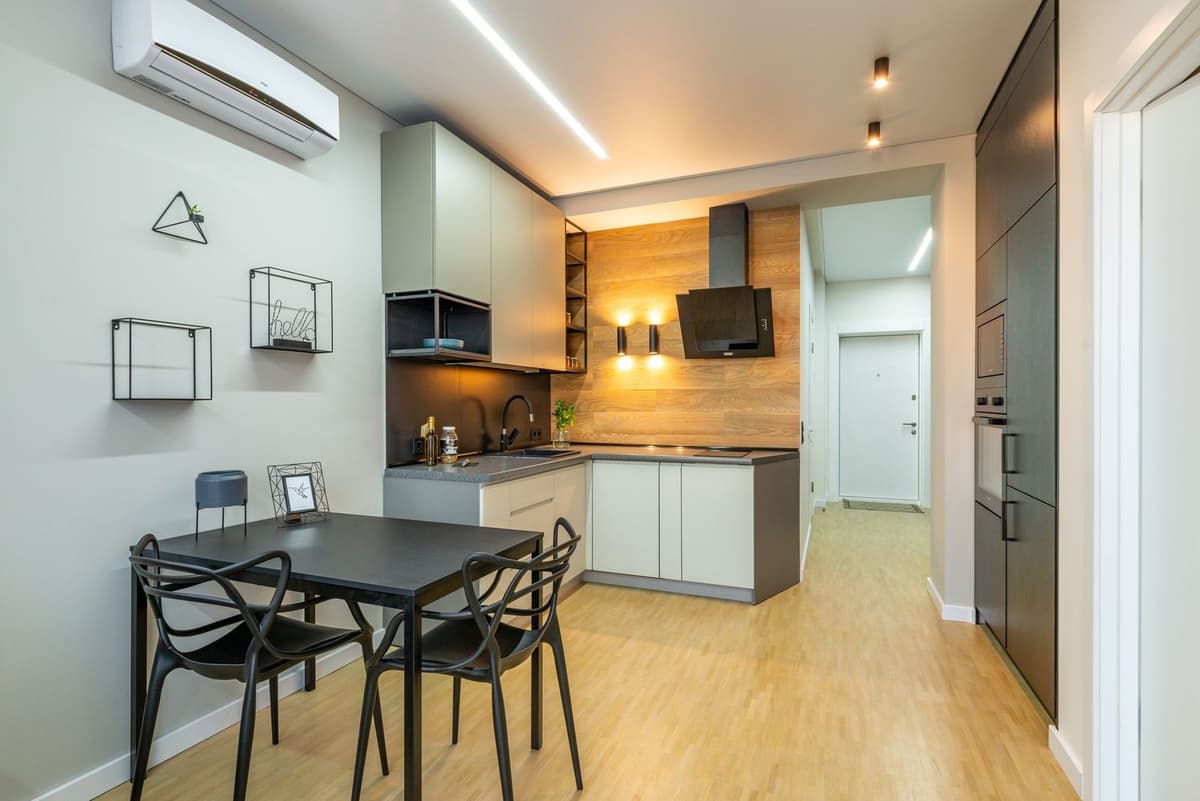
This is the ideal solution: the pipe leaves the indoor unit with a steady fall of at least 1 to 2 cm per metre, with no back-fall or low point, and joins an existing trap. No moving parts, no noise, nothing to break down. When the layout allows it — a wall-mounted unit fitted high up, with a bathroom or kitchen drain nearby — you should insist on it.
Insufficient fall is the number one cause of malfunction. A conscientious installer checks the run with a laser spirit level, which avoids back-falls that are invisible to the naked eye behind trunking.
2. The condensate pump
When the drain is higher than the unit, or too far away, a condensate lift pump is installed. A small reservoir fitted with a float detects the water level and triggers a micro-pump that lifts the condensate up to 5, 8 or 10 metres depending on the model.
Two families coexist:
| Type | Location | Noise level | Typical use |
|---|---|---|---|
| Integrated pump (mini-pump) | In the trunking or behind the unit | 20-25 dB(A) | Wall-mounted split in a home |
| Pump with remote tank | Below the unit, in a false ceiling or cupboard | 30-45 dB(A) | Ducted, cassette, floor console |
The key thing to watch is the alarm contact: any decent condensate pump has a safety device that shuts down the air conditioning if the water level rises abnormally (failed pump, blocked pipe). If that safety feature isn't wired in — and it isn't in a worrying number of installations — the air conditioner keeps making water while the tank overflows. This is the most frequent cause of stained ceilings in the flat below.
Ask your installer explicitly, quote in hand, whether the alarm contact is wired. It costs nothing, takes five minutes, and prevents a four-figure claim.
3. Drainage into a soakaway or drainage bed
For a detached house with no connection available, condensate can be allowed to soak into the ground, away from the foundations (allow at least 3 metres), through a gravel bed. Be careful: condensate is slightly acidic and demineralised, and it is not ideal at the foot of a wall or on a tiled terrace, where it eventually creates greenish staining.
4. Discharging straight onto the façade: to be avoided
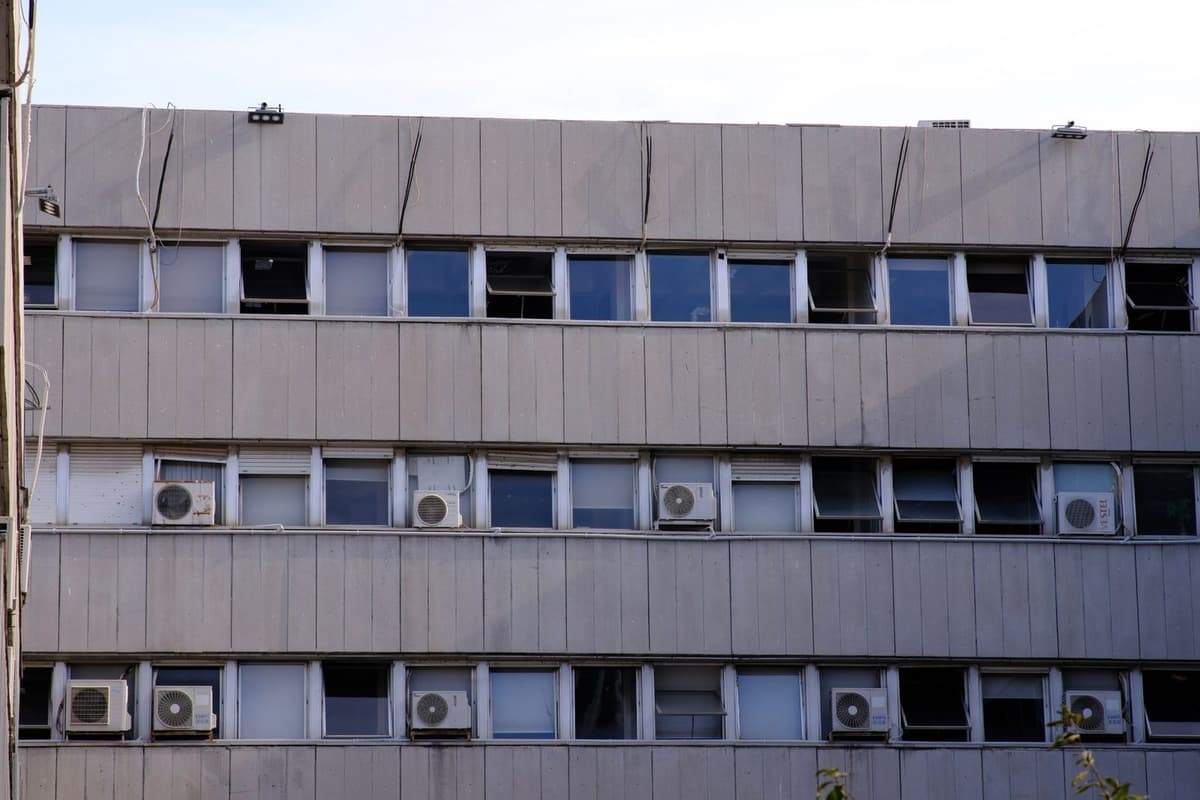
A pipe that pokes out of the wall and drips into thin air is unfortunately still the standard for low-cost installations. Beyond breaching the RSD mentioned above, it causes:
- streaks and lasting stains on the render;
- moss and algae on the surfaces below;
- in winter, patches of black ice on a pavement or steps — with civil liability triggered if someone falls;
- deteriorating relations with the neighbours.

When it drips indoors: a five-minute diagnosis
An indoor unit dripping onto the sofa isn't necessarily a disaster. In nine cases out of ten, one of these causes is to blame.
The condensate tray is dirty. Dust, pollen and biofilm form a plug at the entrance to the pipe. The water then overflows the tray. This is cause number one, and it is directly linked to a lack of cleaning.
The filters are clogged. A blocked filter reduces airflow over the heat exchanger, which then gets too cold, ices up, and thaws abruptly, releasing more water than the tray can drain. Cleaning the filters every two to four weeks at the height of the season is enough to avoid it — with lukewarm water, and fully dried before refitting.
The pipe is blocked or has a back-fall. A drain hose crushed behind a piece of furniture, deformed trunking, an insect nest in the outdoor end: a visual inspection of the entire run often solves the problem.
The condensate pump has failed. Full tank, motor noise with no flow, or total silence.
The pipework insulation is defective. Here it isn't the tray overflowing: it's the refrigerant line itself condensing along its whole length because the insulating sleeve is split, badly joined or missing. Water is then seen falling well away from the unit, including inside a ceiling. An insulating sleeve for refrigerant pipework in elastomeric foam plus the appropriate tape will fix the weak point — but if the line runs inside a sealed duct, you need to call a professional.
Maintenance: what you can do, and what you must not do
Let's set out the framework: Decree no. 2020-912 on the maintenance of thermodynamic systems requires a maintenance visit every two years for equipment rated between 4 and 70 kW, carried out by a professional. That visit covers, among other things, the condition of the condensate drainage circuit. It obviously does not replace routine care between visits.
What you can handle yourself
- Cleaning the indoor unit's filters every two to four weeks during the season;
- Checking, outside, that the end of the condensate pipe is not blocked by a nest, leaves or mud;
- Clearing the area around the outdoor unit so that defrost water can drain away;
- Treating the accessible tray with anti-bacterial condensate tray tablets, which limit the biofilm responsible for blockages and odours;
- Vacuuming dust from the grilles with a brush attachment.
For installations that are hard to reach at height, many homeowners buy an endoscopic inspection camera for a few tens of euros: it lets you see the real condition inside the tray or a pipe before calling someone out, and avoid a pointless call-out charge.
What to leave to the refrigeration engineer
Anything touching the refrigerant circuit — that is, the connections, the refrigerant charge, the valves — falls exclusively to a professional holding a certificate of competence issued under the F-Gas Regulation. Dismantling the indoor heat exchanger for a deep clean is part of that, as is pressure-clearing a concealed drain.
The insurance angle: who pays when the neighbour's ceiling buckles?
This is the part everyone discovers too late. An overflow of condensate is classed as water damage by insurers. Two classic scenarios:
Installation carried out by a professional. If the cause is a workmanship defect (reversed fall, alarm contact not wired in, missing trap), the installer's ten-year structural warranty or professional liability insurance may be called upon, depending on whether or not the defect affects the soundness and intended use of the works. Keep the quote, the invoice and the company's insurance certificate: without these documents, proving your case becomes very difficult.
Installation done by yourself or by an unqualified person. Your home insurer may invoke a lack of maintenance or a non-compliant installation to reduce, or even refuse, cover. The IRSI convention, which organises the settlement of water damage claims under €5,000 between insurers, never releases the occupant from their maintenance obligations.
The move that saves the day when the layout is risky (false ceiling, ducted system, converted loft): fit a connected water leak detector under the unit or in the backup tray. A smartphone alert at 2 litres prevents a 200-litre disaster.
What to insist on in a quote in 2026
With VAT at 5.5% and simplified procedures, the installation market is booming — and workmanship quality is becoming highly variable. Under the "condensate drainage" heading, a serious quote must state in black and white:
- The drainage method chosen: gravity or condensate pump;
- The exact discharge point (bathroom trap, foul water stack, outdoor inspection chamber) — not just "existing drain";
- The pump reference if one is planned, with its lift height;
- The wiring of the alarm contact to the machine's terminal block;
- The presence of an anti-odour trap;
- The route of the pipe (trunking, concealed, surface-mounted) and its insulation.
If the quote simply says "full installation of 3.5 kW split", ask for the details in writing. An installer who refuses to specify these six points is implicitly telling you what they plan to do: stick a pipe through the wall and forget about it.
To keep on top of drainage maintenance on multi-unit installations — a house with three or four indoor units — a condensate circuit cleaning kit with a blow-out bulb and flexible brushes remains a small but useful investment between professional visits.
In summary
Condensate drainage is neither a technical detail nor an optional extra: it is the part of the installation that generates the most neighbour disputes and the most insurance claims. It costs a few tens of euros more at the time of installation, and several hundred when it has to be fixed after the fact.
Three questions to ask before signing: where does the water go, is there a pump, and is its alarm wired in? The answers take three sentences, and they will tell you everything about the quality of the professional in front of you.
Sources and texts cited: model règlement sanitaire départemental (Ministry of Health, Article 99); Decree no. 2020-912 of 28 July 2020 on the maintenance of thermodynamic systems; Regulation (EU) 2024/573, known as F-Gas; Code civil (Articles 1240 et seq., abnormal neighbourhood disturbances); IRSI convention (France Assureurs); ADEME, guides on summer comfort and thermodynamic equipment.
Need an air conditioning solution?