How Much Electricity Does Air Conditioning Really Use? Calculating Your 2026 Power Bill

L'équipe Proclimo
24 Sep 2026 - 07 min read
"So how much does my AC actually use?" It's probably the question installers hear most often, and the one that gets the vaguest answers. Between the output printed on the label, the famous SEER rating and the number of hours the unit really runs, two households with identical equipment can end up three times apart. The good news: the maths is simple, and it comes down to three numbers. Here's the method, examples in euros, and the levers that really move the needle.
The three numbers that determine your bill
To estimate the consumption of an air conditioner or an air-to-air heat pump, you just need to combine:
- Cooling capacity (in kW): this is the amount of cooling produced, not the electricity consumed. A split unit rated at 3.5 kW of cooling does not draw 3.5 kW from the meter.
- SEER (Seasonal Energy Efficiency Ratio) in cooling mode, or SCOP in heating mode: this is the seasonal efficiency. A SEER of 7 means the unit delivers 7 kWh of cooling for every 1 kWh of electricity consumed.
- The number of operating hours over the season.
The formula is as follows:
Annual consumption (kWh) = Cooling capacity (kW) ÷ SEER × Hours of use
Then, to get a cost: Consumption × price per kWh.
These SEER and SCOP figures don't come out of thin air: they are measured according to the European standard and must appear on the product's energy label, governed by European Commission Regulation (EU) 626/2011. It is the only document that lets you compare two models on the same basis.
Beware the rated-output trap
Many homeowners confuse cooling capacity with power input. On a spec sheet, you'll often see two separate lines:
| Figure | Example | What it means |
|---|---|---|
| Cooling capacity | 3.5 kW | Cooling delivered into the room |
| Power input | 1.0 kW | Electricity actually drawn from the grid |
| SEER | 7.2 | Average efficiency over the season |
It is the power input that spins the meter. And it varies constantly: an Inverter unit modulates its output between 15% and 100% depending on the temperature difference, which is why instantaneous readings are misleading.
What does it actually cost in 2026?
Let's take the average price per kWh under the regulated electricity tariff, around €0.20 including tax on the base option in 2026 (rates are published by the Commission de régulation de l'énergie and revised in February and August). Here are three realistic scenarios.
Scenario 1: a single split unit in a bedroom
- Cooling capacity: 2.5 kW
- SEER: 7.0
- Usage: 3 hours per night, 60 summer nights → 180 hours
Consumption: 2.5 ÷ 7.0 × 180 = 64 kWh Cost: 64 × 0.20 = ≈ €13 per summer
Yes, you read that right. Targeted night-time use in a single bedroom costs about the same as two cinema tickets.
Scenario 2: a multi-split unit in a living room + 2 bedrooms
- Total cooling capacity: 6.5 kW
- SEER: 6.5
- Usage: 8 hours per day, 70 days → 560 hours
Consumption: 6.5 ÷ 6.5 × 560 = 560 kWh Cost: 560 × 0.20 = ≈ €112 per summer
Scenario 3: a 110 m² house cooled continuously
- Cooling capacity: 9 kW
- SEER: 6.0
- Usage: 14 hours per day, 80 days → 1,120 hours
Consumption: 9 ÷ 6.0 × 1,120 = 1,680 kWh Cost: 1,680 × 0.20 = ≈ €336 per summer
Three households, a ratio of 1 to 25. It isn't the machine that drives the bill, it's how you use it.
tip
To move beyond estimates and find out your real consumption, a plug-in electricity usage monitor plugged into the supply of a single split unit gives you the exact figure within a few days. On a fixed installation wired into the consumer unit, a clamp meter takes the same reading without touching the wiring.
What about heating mode? The numbers change scale
This is where reversible air conditioning gets interesting — and where the amounts become serious. In winter, we no longer talk about SEER but SCOP, and above all about a far higher number of operating hours.
Take a well-insulated 100 m² house with a heating demand of around 9,000 kWh of thermal energy per year:
| System | Efficiency | Electricity (or gas) consumed | Estimated annual cost |
|---|---|---|---|
| Electric convector heaters | 1.0 | 9,000 kWh | ≈ €1,800 |
| Air-to-air heat pump, SCOP 4.0 | 4.0 | 2,250 kWh | ≈ €450 |
| Air-to-air heat pump, SCOP 4.6 | 4.6 | 1,957 kWh | ≈ €391 |
The gap between a convector heater and a high-performance air-to-air heat pump exceeds €1,300 a year on this profile. That is precisely why public authorities have focused on air-to-air heat pumps, which have been eligible for the reduced 5.5% VAT rate since summer 2026.
One caveat, though: SCOP is an average calculated over a typical season. In very cold weather (-7°C), the instantaneous efficiency of an air-to-air heat pump often drops to between 2 and 2.5, and the unit triggers defrost cycles that consume energy. On the harshest days, your bill won't follow the advertised average.
The factors that inflate (or reduce) consumption
1. The temperature setpoint
This is lever number one. Every degree gained in summer represents roughly 7% less consumption, an order of magnitude regularly highlighted by ADEME. The agency recommends not going below a 5 to 7°C difference with the outdoor temperature, both for your bill and to avoid thermal shock. In practice: at 34°C outside, aim for 26°C rather than 21°C.
An indoor thermometer and hygrometer placed in the main room helps put numbers on how things feel: at 26°C with 45% humidity you're comfortable; at 26°C with 70%, far less so. Often it's the humidity that needs tackling, not the temperature.
2. Sizing the unit
An oversized air conditioner reaches the setpoint too quickly, shuts down, restarts, and multiplies short cycles — the most energy-hungry and the hardest on the compressor. An undersized unit runs flat out constantly. Either way, consumption goes up.
The usual rule of thumb for a properly insulated home is 80 to 100 W of cooling capacity per m², to be adjusted according to orientation, glazed area, ceiling height and floor level. A heat load calculation carried out by a professional remains the only reliable method — and it also underpins the equipment warranty.
3. Clogged filters and outdoor unit
A filter clogged with dust reduces airflow, forces the compressor to run longer and can push consumption up by 5 to 15%. Cleaning the filters is something anyone can do: remove them, vacuum, rinse in lukewarm water, dry completely. Do it every 2 to 4 weeks during peak season.
Keeping an air conditioner cleaning kit on hand (disinfectant foam, fine brush, collection bag) stops you putting the job off. The outdoor unit deserves the same attention: leaves, pollen and plant fluff stuck to the heat exchanger directly degrade heat transfer.
4. Uncontrolled heat gains
Cooling a room whose windows catch the full afternoon sun is like bailing out a boat with a hole in it. External shading (shutters, blinds, brise-soleil) blocks solar radiation before it passes through the glazing; interior curtains, by contrast, only stop part of the heat that has already come in. If you don't have shutters, an adhesive solar window film noticeably reduces heat gain on heavily exposed windows, at modest cost.
Don't forget internal gains either: an old fridge, a powerful desktop computer or halogen lighting continuously give off heat that the AC then has to remove.
5. The operating mode you choose
A few settings that genuinely matter:
- Automatic mode rather than fan at full blast: the compressor modulates better.
- Dehumidification (Dry) mode on muggy but not scorching days: it uses less than cooling mode for equivalent comfort.
- Scheduling: switch the AC off 30 minutes before leaving home; thermal inertia does the rest.
- Don't switch it on and off repeatedly: an Inverter heat pump is more efficient running continuously at low output than in abrupt cycles.
The myth of "AC costs a fortune"
This received wisdom comes from three clearly identifiable sources.
Older units. A portable single-block air conditioner, still widely sold, typically has a SEER between 2.6 and 3.5, compared with 6 to 9 for a fixed split unit. It also expels hot air through a hose running out of a partly open window — which lets hot outside air in to compensate. Its real consumption is therefore two to three times higher than a split unit of equivalent capacity. If you have no other option, a window sealing kit for portable air conditioners at least limits this effect.
Peak power draw. An air conditioner starting up puts a heavy load on your supply contract. On a 6 kVA contract with an electric hob and water heater, the main breaker can trip. The answer isn't to give up, but sometimes to upgrade to 9 kVA — a few dozen euros more on the annual standing charge.
The "discovering comfort" effect. In the first season, you cool everything, all the time. In the following ones, usage settles down naturally.
Tracking your consumption day to day
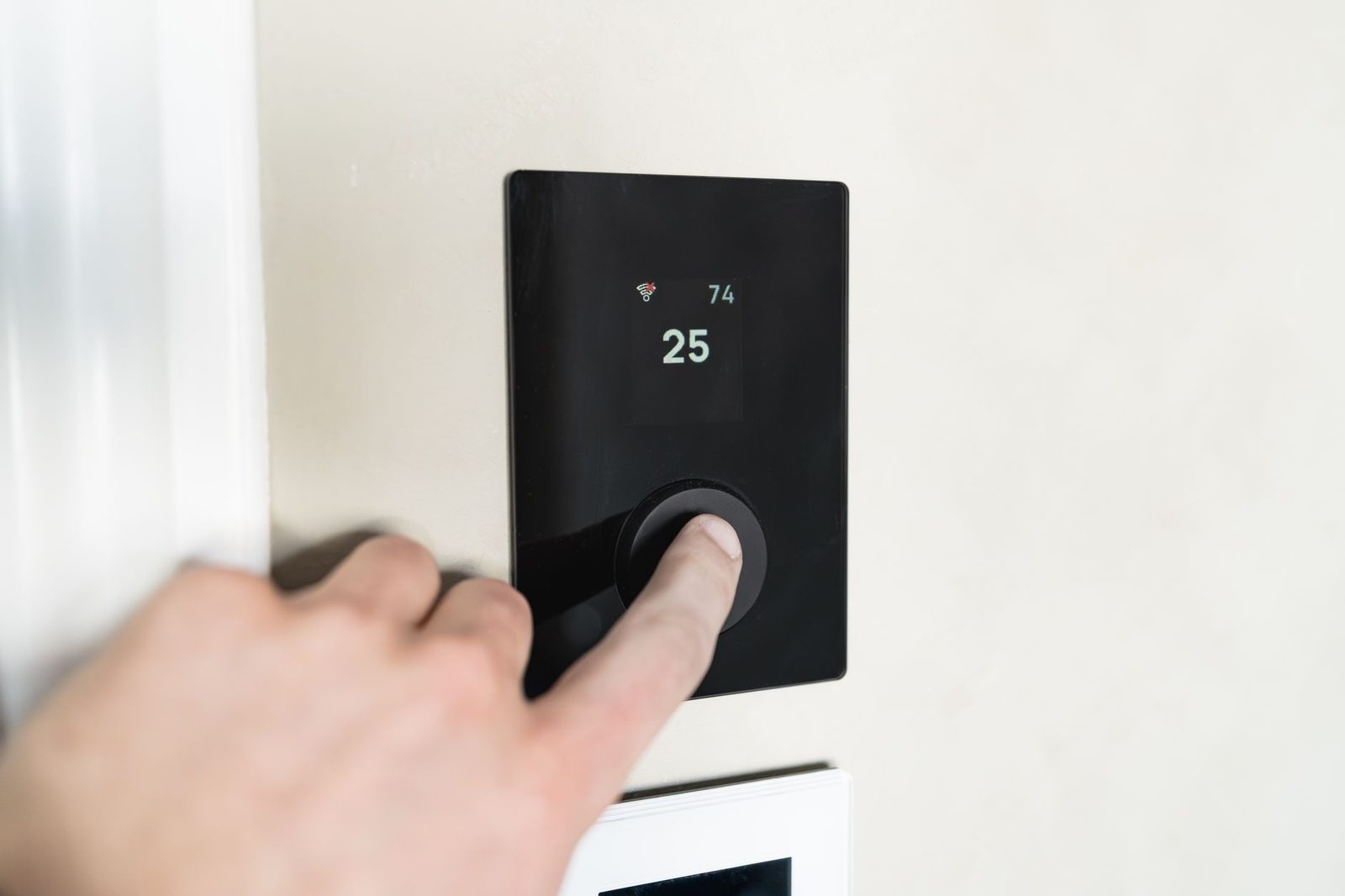
Since the widespread rollout of the Linky meter, every household can view its hourly load curve through their supplier's customer account or the Enedis portal. Enabling hourly consumption recording (a free option you have to tick explicitly) lets you see exactly what an evening of air conditioning costs.
Three complementary methods:
| Method | Accuracy | Cost |
|---|---|---|
| Linky curve via customer account | Good (hourly) | Free |
| Plug-in power meter | Excellent (per appliance) | Low |
| Manufacturer app (Wi-Fi) | Varies by brand | Included or optional |
Many recent air conditioners offer a Wi-Fi module displaying a consumption estimate in the manufacturer's app. Useful for tracking trends, but these figures are calculated, not measured: don't mistake them for a meter reading.
Should you run the AC during off-peak hours?
Following the overhaul of off-peak time slots undertaken in 2025-2026 by the Commission de régulation de l'énergie, part of the off-peak window shifts to the afternoon during the summer months, to match solar generation. In practice, on some contracts it becomes worthwhile to pre-cool the home in the early afternoon, when the kWh is cheaper, and then let thermal inertia do the work in the evening.
This strategy only makes sense if your home has enough thermal mass (heavy walls, good insulation) and if your contract actually includes a peak/off-peak option. Check your exact time slots on your bill before programming anything.
Key takeaways
- Consumption is easy to calculate: cooling capacity ÷ SEER × hours of use.
- Targeted night-time use in one bedroom costs a few dozen euros per summer; a continuously cooled house, several hundred.
- In heating mode, an air-to-air heat pump with a good SCOP cuts the bill by a factor of 3 to 4 compared with electric convector heaters.
- The real levers are the temperature setpoint, correct sizing, clean filters and controlling solar gains.
- Portable single-block air conditioners remain, by far, the most energy-hungry solution per kWh of cooling delivered.
Before committing to any project, ask your installer for a quantified estimate of annual consumption based on your specific home, not a generic range. A serious professional can produce one — and that is often the best indicator of how serious they are.
Sources: ADEME (guides "Se rafraîchir sans se ruiner" and energy labelling), Regulation (EU) 626/2011 on energy labelling of air conditioners, Commission de régulation de l'énergie (regulated tariffs and off-peak time slots), Enedis (Linky consumption data).
Need an air conditioning solution?