Air Conditioner Noise: What the Law Says and How to Avoid a Neighbour Dispute

L'équipe Proclimo
26 Sep 2026 - 07 min read
Noise is by far the leading cause of air conditioning disputes in France. Not breakdowns, not the electricity bill: the humming of the outdoor unit at 11 p.m., right below the neighbour's bedroom window. And contrary to a widespread belief, this is not merely a matter of good neighbourly manners: noise from air conditioning equipment or an air-to-air heat pump is governed by the Public Health Code, with quantified thresholds, official measurement methods and penalties. Here's what the regulations actually say, and how to solve the problem before it ends up in court.
Why does an outdoor unit make noise?
Three sources add up, and they are not addressed in the same way.
- The fan: this is the dominant airborne noise, a broadband rush of air. It increases sharply when the machine runs at full power (heatwaves, or defrosting in winter).
- The compressor: a lower-pitched, more "mechanical" noise. On recent Inverter models it modulates its speed and stays discreet most of the time; it becomes audible on start-up and at maximum load.
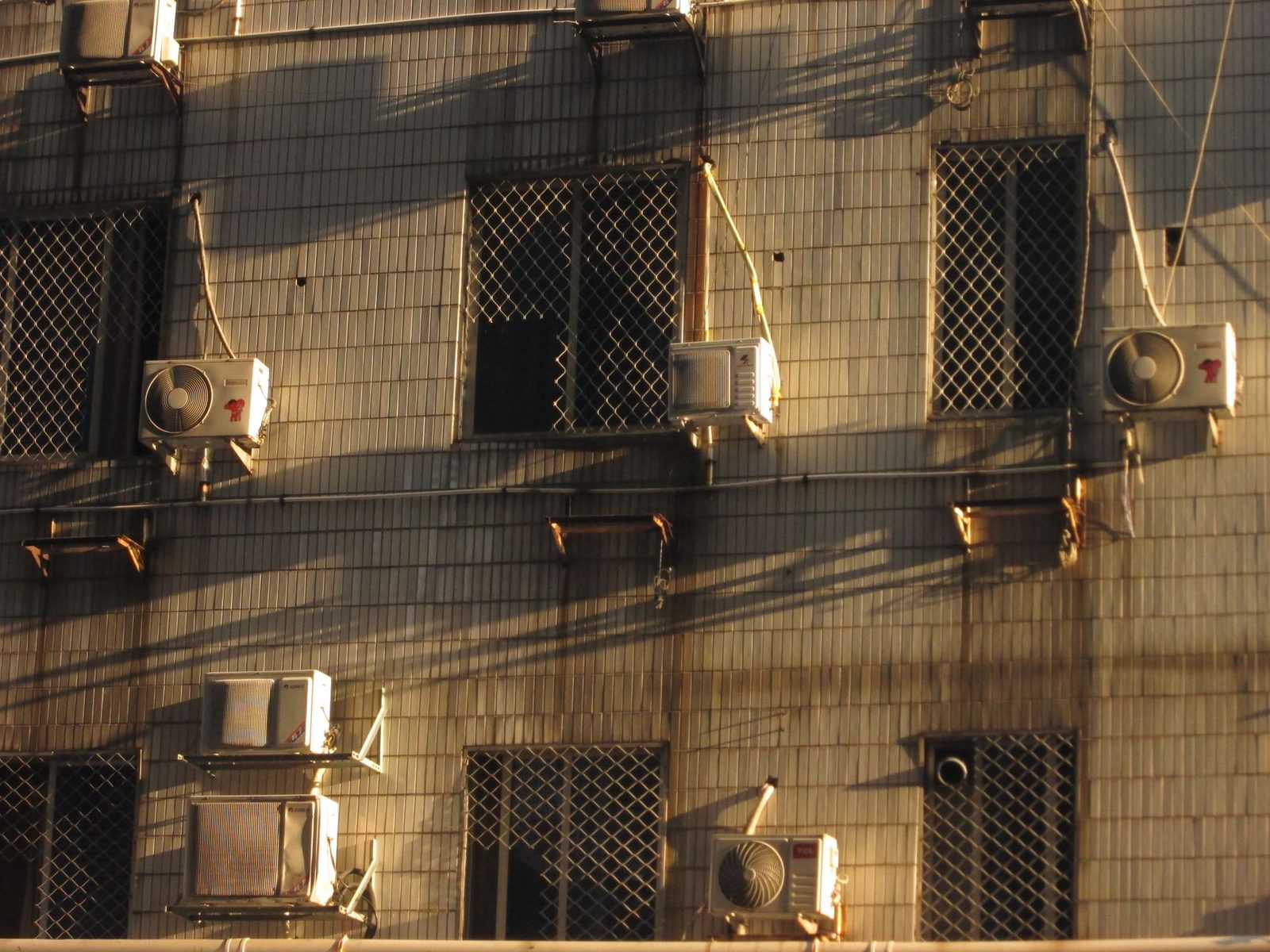
- Vibrations transmitted to the structure: this is the most insidious one. The unit vibrates, the vibration passes into the brackets, then into the wall, then into the floors. The neighbour doesn't hear a "rush of air" but a dull droning that is impossible to locate, and which travels through partitions far better than airborne noise.
Technical datasheets generally state a sound pressure level (for example "48 dB(A) at 1 m") and sometimes a sound power level ("62 dB(A) Lw"). The two are not comparable: the first depends on the measurement distance, the second characterises the machine itself. To compare two models, it's the sound power Lw you need to look at — it must appear in the technical documentation under the European ecodesign regulation applicable to air conditioners.
Remember the rule of thumb: airborne noise drops by roughly 6 dB(A) every time the distance doubles. A unit at 50 dB(A) at 1 m theoretically falls to around 38 dB(A) at 4 m, and 32 dB(A) at 8 m. That's why a few extra metres of setback change everything.
What the law says: noise emergence, not the decibel count
This is the point almost everyone gets wrong. French regulations do not set a maximum number of decibels for an outdoor unit. They work in terms of emergence: by how much does your machine raise the ambient noise level?
Articles R. 1336-4 to R. 1336-13 of the Public Health Code govern neighbourhood noise, including noise from an activity or a piece of domestic equipment. For noise arising from an activity (professional, sporting, cultural) and, by extension as applied by the courts, for technical equipment such as heat pumps and air conditioners, an offence is established when the overall emergence exceeds:
| Period | Maximum permitted emergence |
|---|---|
| Daytime (7 a.m. – 10 p.m.) | 5 dB(A) |
| Night-time (10 p.m. – 7 a.m.) | 3 dB(A) |
On top of this come correction terms that tighten the rule when the noise is intermittent: the shorter the duration of the noise, the slightly greater the tolerance — but continuous operation, the typical case with air conditioning, earns no leniency at all.
How emergence is measured in practice
The measurement is taken at the complainant's home, with windows open or closed depending on the configuration, and compares two values:
- the ambient noise level: machine running;
- the residual noise level: machine switched off.
The difference is the emergence. In other words: on a busy street at 55 dB(A), an air conditioner may be perfectly legal; in a quiet hamlet at 28 dB(A) at night, the same machine becomes an offence. It isn't the air conditioner's power output that matters, it's the contrast with the surrounding silence.
Since 2021, the Public Health Code has also introduced the notion of spectral emergence for noise containing marked tonal components (a whistle, a drone at a specific frequency): an exceedance in a single octave band can be enough to establish the nuisance, even if the overall level remains moderate. That is exactly the profile of a poorly decoupled compressor.
The special case of ICPE installations and shared buildings
For a large collective installation (air conditioning for a shop, a building's chiller unit), you may fall under the regime of installations classified for environmental protection (ICPE), with limit values at the property boundary set by the order of 23 January 1997. For a private individual, this is almost never the case.
In a jointly owned building, a third layer of rules applies: the co-ownership regulations, which frequently prohibit any installation on the façade or balcony without approval from the general meeting, and sometimes impose their own acoustic requirements. An air conditioner installed without authorisation can be ordered removed, even if it is silent.
Before installation: the six decisions that determine everything
An acoustic dispute is 90% decided on the day of installation. Here are the parameters to settle with your installer before signing the quote.
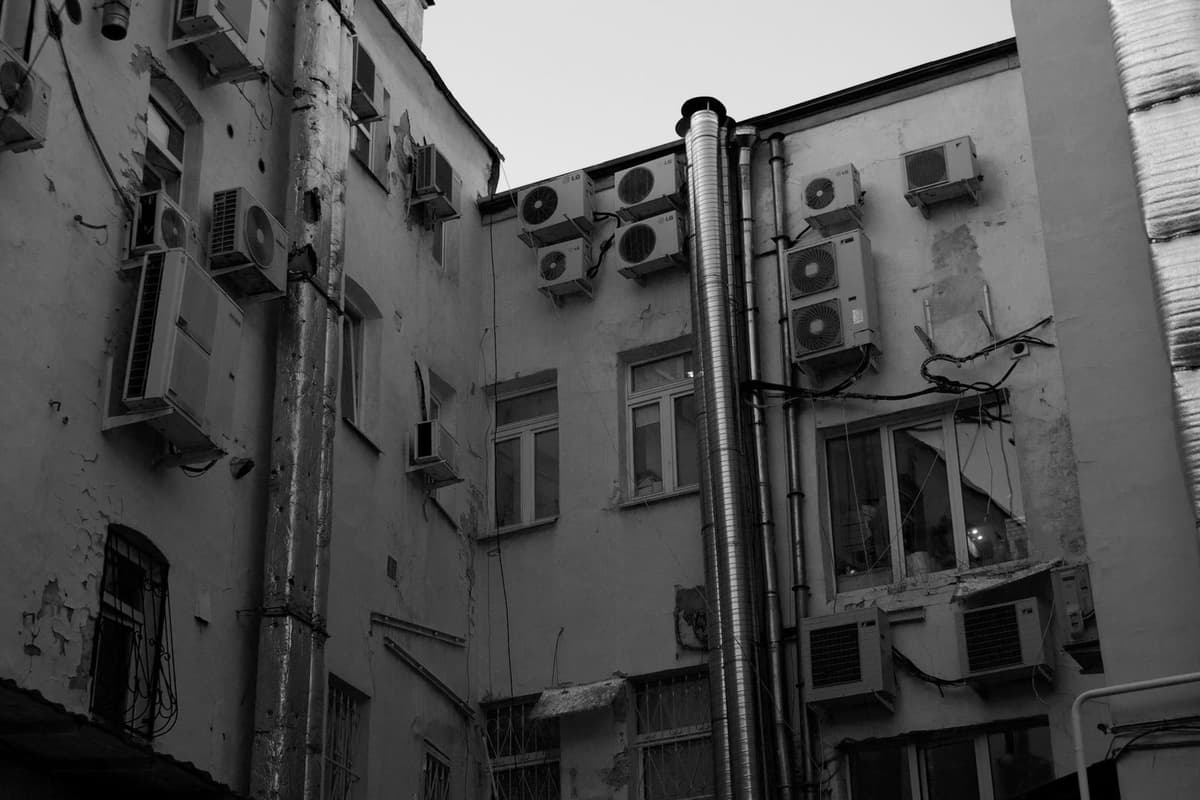
1. Location. Keep the unit away from neighbouring openings, bedrooms above all. Avoid wall corners and interior courtyards: two nearby reflecting surfaces can add 3 to 6 dB(A) through reverberation. A ground-mounted unit in a garden, facing an open space, is almost always preferable to a solid-wall façade.
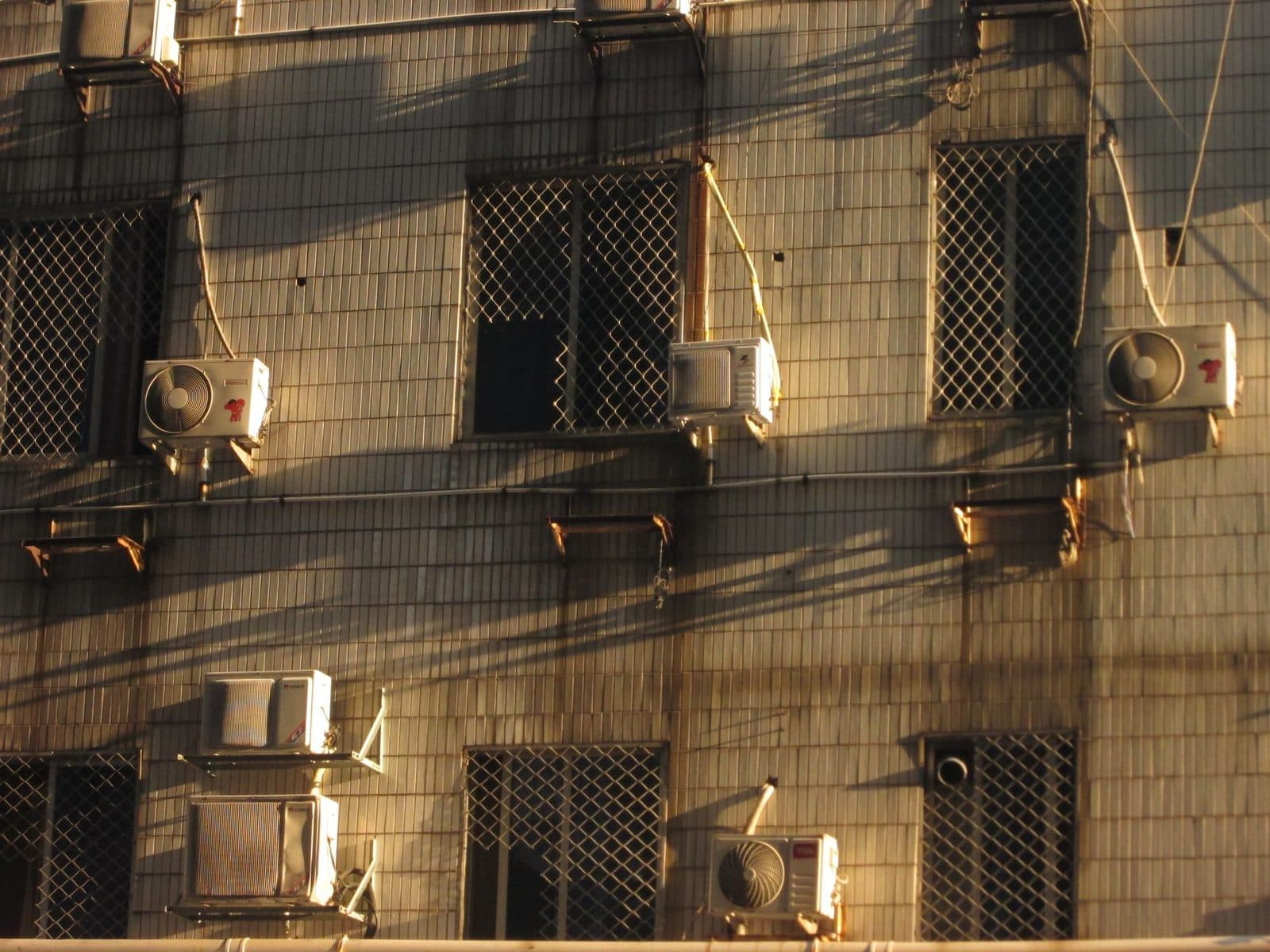
2. The mounting method. On a ground-mounted stand, structural transmission is low. On wall brackets, it is at its maximum — especially on a lightweight timber-frame façade or a balcony partition. If wall mounting is unavoidable, insist on rubber anti-vibration mounts between the chassis and the supports, and heavily oversized brackets (a flexible bracket vibrates).
3. Sizing the machine. An oversized heat pump runs in short on/off cycles: compressor start-ups are the noisiest moments. A correctly sized machine runs for long periods at low speed, and therefore quietly. Oversizing is the leading cause of avoidable noise.
4. Night mode. Almost all recent models offer a "silent", "quiet" or "night mode" function that limits fan speed and compressor frequency, for a typical gain of 3 to 6 dB(A). Check that it can be scheduled automatically, not just switched on from the remote control.
5. The refrigerant lines and duct penetrations. A refrigerant line rigidly fixed to the wall transmits compressor vibrations into the home. Penetrations should be made with flexible sleeves and rubber-lined clamps.
6. Acoustic screening or enclosures. An acoustic screen can gain 5 to 10 dB(A), provided it is solid, heavy and gap-free, and never obstructs airflow — otherwise efficiency collapses and the machine ramps up, and so does the noise. A fully closed enclosure is almost always a bad idea.
You're the affected neighbour: the steps to follow
The temptation is to go on the attack immediately. The courts, however, value a step-by-step approach.
Step 1 — Document
Keep a dated log: switch-on times, duration, perception (rushing air, droning), rooms affected. A simple smartphone measuring app has no legal value, but a class 2 sound level meter gives useful orders of magnitude to objectify what you're experiencing and to open a dialogue, especially if it can log levels over several hours. Also note the "machine off" values — it's the emergence that counts, not the raw level.
Step 2 — Talk, then write
Many situations are resolved with three adjustments: activating night mode, fitting anti-vibration mounts, shifting the scheduling. If dialogue fails, send a registered letter setting out the facts, the dates and the specific request. In a jointly owned building, write to the managing agent: the installation may well be non-compliant with the co-ownership regulations.
Step 3 — Official findings
You can contact:
- the town hall: council officers or the municipal police can formally record the offence under the Public Health Code; some large cities have a dedicated, properly equipped "noise" department;
- the Regional Health Agency (ARS);
- an acoustics consultant for an adversarial measurement, or a court conciliator (free, and now often a mandatory preliminary step before a hearing for small claims).
Failure to comply with emergence thresholds constitutes a 3rd-class offence, punishable by a fine, and can be compounded by a civil action for abnormal neighbourhood nuisance — a standalone legal basis allowing damages to be obtained and, where appropriate, the removal or relocation of the equipment, even where the installer is not at fault.
You own the air conditioner: how to defuse the situation
The defensive reflex ("my machine is compliant, it's certified") protects you from nothing: product compliance never exempts you from meeting on-site emergence limits. On the other hand, a few inexpensive measures resolve the vast majority of cases.
| Action | Indicative acoustic gain | Indicative cost |
|---|---|---|
| Activating night mode / night-time limiting | 3 to 6 dB(A) | €0 |
| Fitting anti-vibration mounts or silent blocks | 2 to 8 dB(A) on structure-borne noise | €30 to €120 |
| Switching from wall mounting to a ground stand | Highly variable, often decisive | €200 to €500 |
| Ventilated acoustic screen | 5 to 10 dB(A) | €300 to €900 |
| Relocating the unit | Up to 10–15 dB(A) | €600 to €1,500 |
| Cleaning the outdoor coil and balancing the fan | 1 to 4 dB(A) | Routine maintenance |
That last point is often overlooked. A fouled outdoor coil forces the fan to spin faster and throws the blade assembly off balance: the noise rises gradually, without anyone making the connection. An annual rinse with fresh water, with the fan stopped and the unit powered off, using a soft brush for heat exchanger fins, is usually enough to restore the original noise level. A unit installed under a lime or birch tree will clog up in a single season.
If the vibration is transmitted through the wall, an open-cell rubber anti-vibration mat placed under the stand, in addition to the mounts, effectively breaks the structure-borne path. One caveat, though: stacking flexible materials without regard to the system's resonant frequency can, in rare cases, amplify the phenomenon. Beyond the simple fixes, an acoustics consultant remains the right person to call.
Key takeaways
- It isn't the advertised decibel figure that counts, but the gap between your machine running and the ambient silence at the neighbour's home: 5 dB(A) by day, 3 dB(A) at night.
- Night-time is the critical period. An air conditioner tolerated during the day can become unlawful at 11 p.m. without a single setting having changed.
- An oversized unit is a noisy unit. Insist on a sizing calculation, not a finger-in-the-air estimate.
- Vibrations travel further than airflow noise. Mechanical decoupling is the best value-for-money investment you can make.
- In a jointly owned building, prior authorisation trumps everything. A silent but unauthorised machine can still be ordered removed.
- Get ahead of the conversation. Warning your neighbours before installation, and proactively offering night-time limiting, avoids the bulk of disputes.
To go further, articles R. 1336-4 et seq. of the Public Health Code (available on Légifrance) are the reference text, supplemented by documentation from the Centre d'information sur le bruit (CIDB) and the practical factsheets from ADEME on nuisances linked to thermal equipment. For those who want to understand the subject in depth before starting proceedings, a practical guide to building acoustics helps distinguish airborne noise from structure-borne noise — the key to almost every misunderstanding in this type of dispute.
An air conditioner that is well positioned, correctly sized and properly decoupled causes no neighbourhood problems whatsoever. A machine chosen purely on price, hastily screwed onto the most accessible façade, almost always does. Prevention costs tens of euros; litigation costs thousands.
Need an air conditioning solution?