Air conditioning condensate: where the water goes, what the law says and how to avoid damage

L'équipe Proclimo
28 Sep 2026 - 08 min read
Nobody asks where the water goes. People discuss output, SEER ratings, the price on the quote, where the outdoor unit will sit — and then they sign. Then, one July morning, a dark stain appears on the living room ceiling, or the neighbour downstairs discovers that their balcony is permanently damp. An air conditioner or an air-to-air heat pump in cooling mode doesn't just cool the air: it dehumidifies it. And that humidity turns into liquid water, in quantities most owners drastically underestimate. Here's what becomes of that water, what the regulations require, and the setups that stop a summer comfort upgrade from turning into an insurance claim.
Where does this water come from, and how much of it is there?
The principle is the same as a bottle taken out of the fridge that becomes covered in droplets. Inside an indoor unit in cooling mode, room air passes over a heat exchanger whose surface temperature drops below the dew point. The water vapour in the air then condenses on the fins, runs down, and is collected by a tray positioned beneath the exchanger.
The actual volumes often come as a surprise:
| Configuration | Condensate production (order of magnitude) |
|---|---|
| 2.5 kW wall-mounted split, night-time use in a mild summer | 0.3 to 0.8 L/day |
| 3.5 kW wall-mounted split, living room, heatwave | 1.5 to 3 L/day |
| 3-unit multi-split, continuously occupied home | 4 to 8 L/day |
| Ducted system in a coastal area (very humid air) | up to 10 L/day |
The more humid the air, the higher the production. On the Atlantic or Mediterranean coast in August, a ducted system can produce the equivalent of a bucket of water a day. That water has to be drained away continuously, either by gravity or by a pump.
Watch out for a common misconception: in heating mode, it is the outdoor unit that produces the condensate, not the indoor one. The outdoor exchanger drops below 0 °C, frosts up, then defrosts — releasing a far from negligible volume of water at the base of the unit with every cycle. Many installations fitted for summer use only reveal the problem during the first winter of heating: a puddle in front of the patio door, a sheet of ice on a terrace, water running into a cellar.
What the regulations say: no, you don't let it run onto the pavement
Contrary to a persistent belief, condensate drainage is not a free-for-all. Several sets of rules apply, and together they leave little room for manoeuvre.
Discharge onto public land
Departmental sanitary regulations and, above all, municipal highway regulations prohibit, in virtually every French municipality, any discharge of water from private property onto public land: pavement, roadway, passageway. The model departmental sanitary regulation, still widely adopted by prefectures, sets out this general principle banning discharge onto public thoroughfares.
In practical terms: a condensate pipe dripping over a pavement is in breach of the rules, and the risk is not merely theoretical. In winter, defrost water freezing on a pedestrian crossing point exposes the owner to civil liability if someone falls. This is one of the few areas where the town hall acts quickly once a complaint is filed.
Connecting to the waste water system
Connecting the condensate pipe to an existing waste water outlet (a basin trap, a bathroom stack, a washing machine outlet) is possible, but never directly. Two rules, derived from the public health code and plumbing standards, apply:
- there must be a water seal (trap) between the condensate circuit and the waste water system, otherwise sewer odours will travel back into the home through the indoor unit;
- any risk of water backing up towards the appliance if the stack becomes blocked must be eliminated.
That is precisely why manufacturers require the fitting of a dedicated condensate trap, either membrane or ball type, usually ultra-slim so it can slide in behind the unit. A pipe pushed straight into a waste outlet, with no trap, is the number one cause of "air conditioners that smell bad" — and the diagnosis is immediate: the smell is that of the sewer, not of the machine.
Rainwater drainage
Connecting to a rainwater downpipe is the simplest solution and the one most often accepted, provided the network is genuinely separate and the municipality does not prohibit it. Beware of municipalities with combined sewer systems, and of apartment buildings where rainwater downpipes are common property: drilling into a shared downpipe requires authorisation.
Remember: condensate starts out as clean water, but it very quickly picks up dust, bacteria and biofilm in the tray. It is not drinkable and is not considered reusable rainwater without treatment.
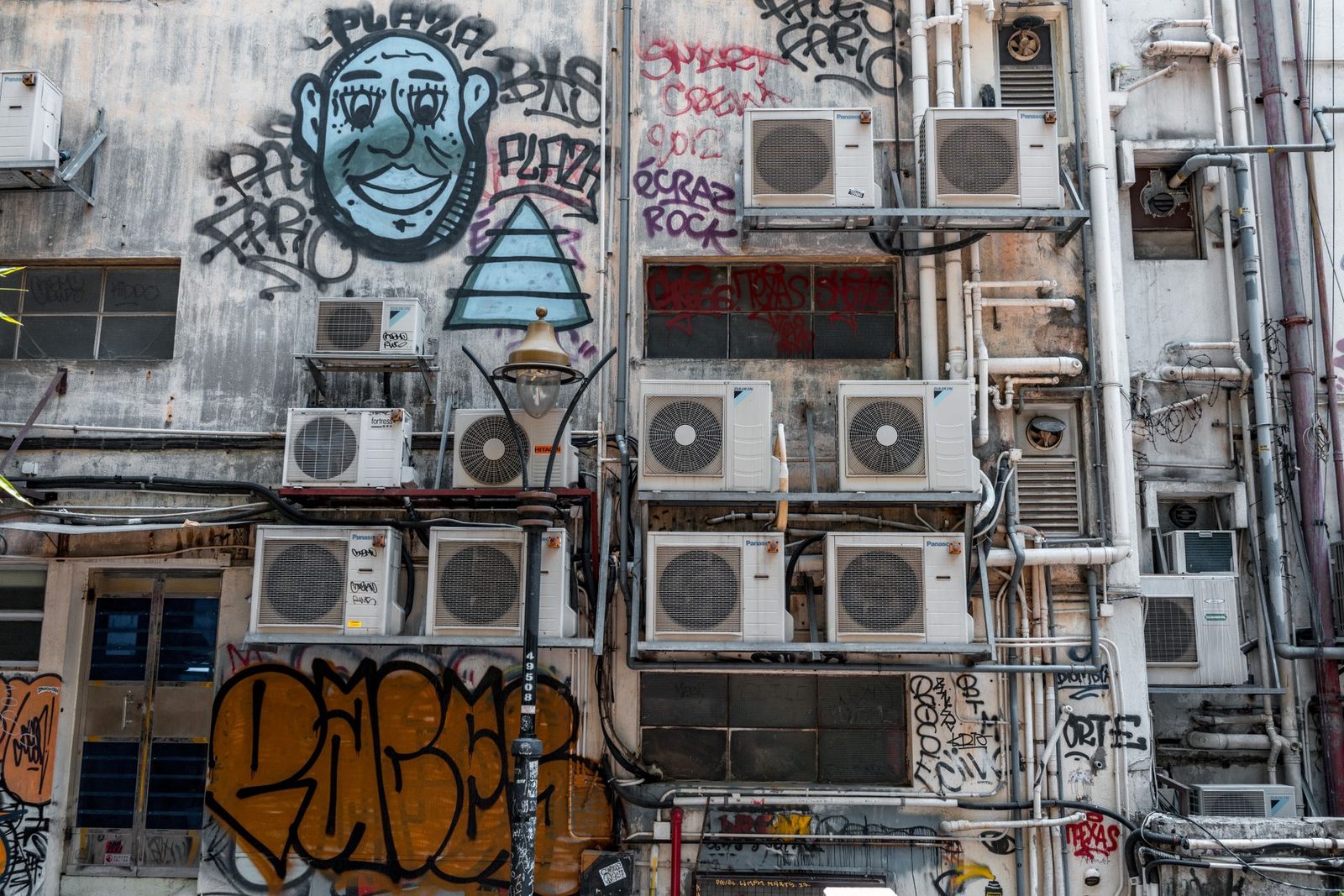
Apartment buildings: the biggest source of disputes
In multi-occupancy buildings, condensate is as frequent a source of conflict as outdoor unit noise, and disputes are often settled faster — and against the installer.
The problem configurations:
- The pipe that drips onto the balcony below. This is a clear-cut case of unreasonable nuisance to neighbours, and case law on this point is consistent: the appliance owner must rework the installation at their own expense.
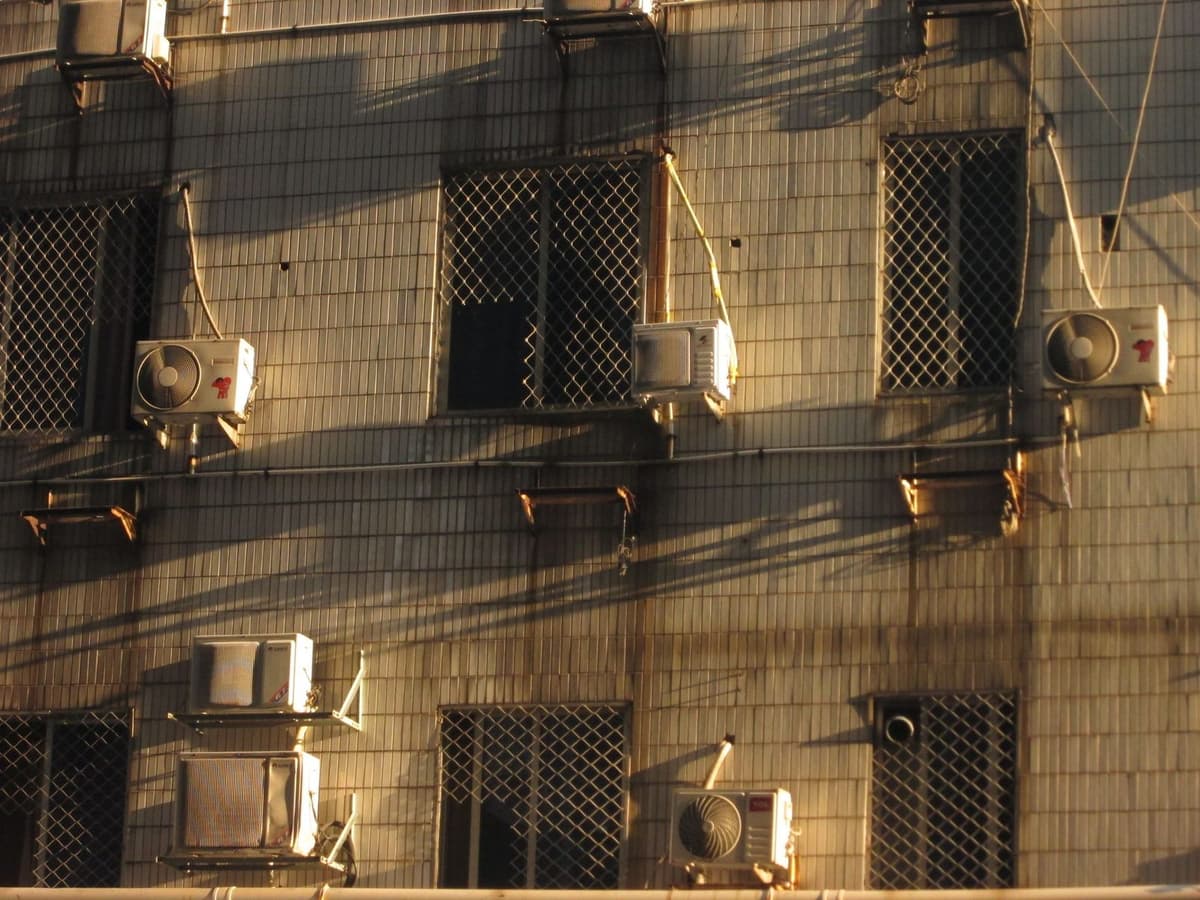
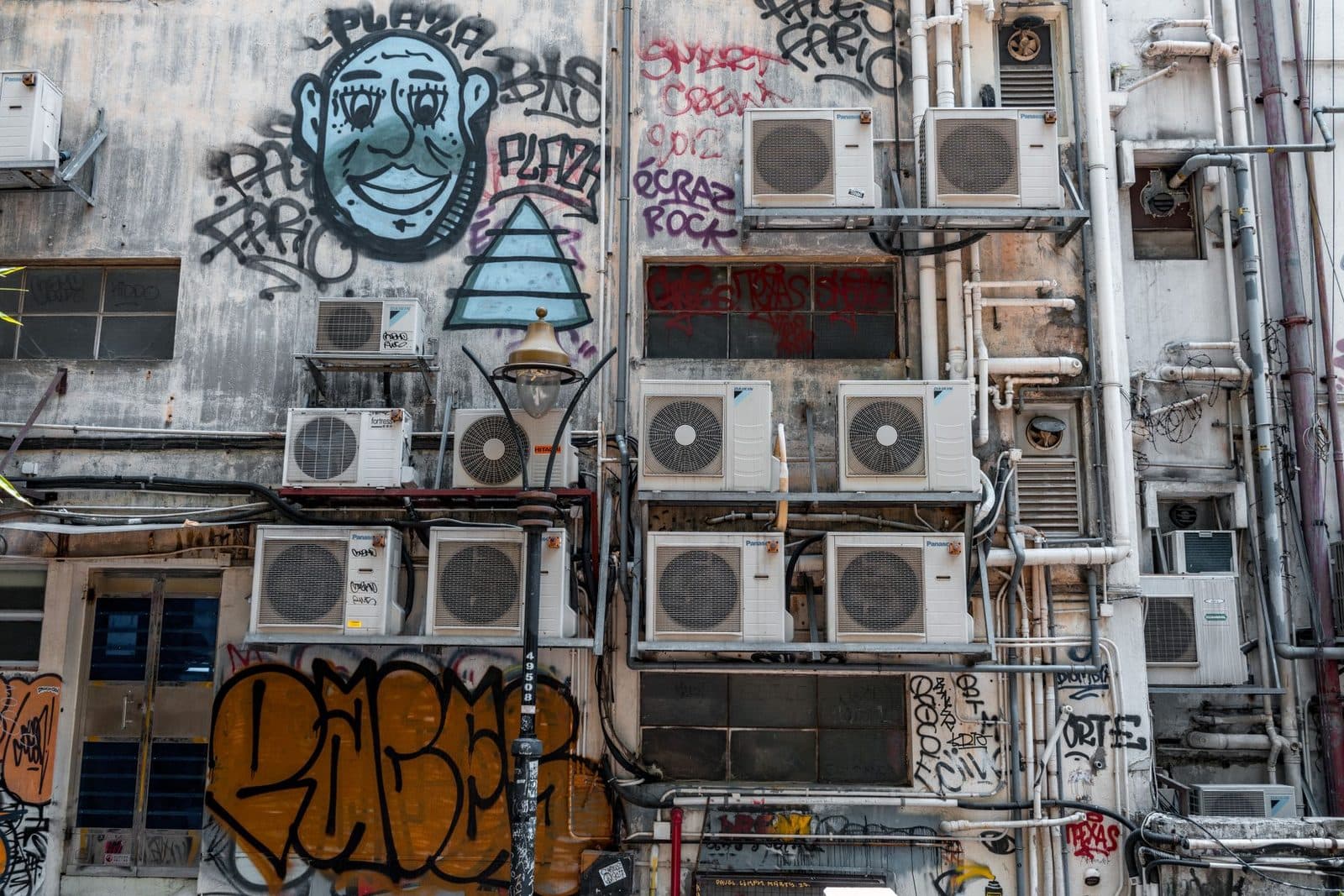
- Direct discharge down the façade. The water leaves limescale streaks and dirty marks on render or stonework. The managing agent can demand restoration of the façade, which is common property.
- Drilling into a shared downpipe without approval from the owners' general meeting: the building's owners can demand that the connection be removed.
- Discharge into an undersized gutter or roof channel, which overflows and causes water ingress.
Before any installation in an apartment building, the question "where does the condensate go?" must appear in black and white on the quote, and in the authorisation request submitted to the managing agent. It is a point that general meetings now examine as a matter of course, just like the visual impact of the outdoor unit.
Correct setups, from the simplest to the most technical
Gravity drainage
This is the benchmark solution: the pipe runs downhill with a continuous fall, with no counter-slope or low point, and a minimum gradient of 1 to 2 cm per metre. The indoor unit's tray must always sit higher than the discharge point.
The classic mistakes:
- a pipe that rises slightly and then falls again, creating a pocket of standing water → a biofilm blockage guaranteed within two seasons;
- a pipe crushed inside the trunking or pinched behind the unit;
- an excessive horizontal run with no supports, which eventually sags.
Checking this yourself on an existing installation is easy: a magnetic spirit level held along the trunking lets you confirm that the fall is downwards along the whole route. It's a two-minute check that explains half of all indoor unit leaks.
The condensate pump
When the discharge point is higher than the unit — typical of a wall unit fitted on a garden-level floor, in a basement, or on an internal wall with no way through to the outside — you need a condensate lift pump. Depending on the model, it sits in the tray, in a remote housing, or behind the unit, and pushes the water up several metres.
Two things to insist on:
- an overflow safety switch that shuts the appliance down if the pump can no longer keep up (it's that contact that prevents water damage);
- a noise level suitable for a bedroom: cheap models click loudly on every cycle.
A condensate pump is a wear part. Expect a service life of 5 to 10 years, and clean the float at every annual service.
Dealing with water at the base of the outdoor unit
For winter defrost condensate, there are three solutions depending on the configuration:
| Situation | Solution |
|---|---|
| Unit at ground level on soil / gravel | Gravel drainage bed, at least 30 cm deep beneath the unit |
| Unit on a terrace or slab | Drain tray under the unit + pipe to a discharge point |
| Wall-mounted unit above a walkway | Tray + drainage mandatory, never free dripping |
| Area with frequent frost | Tray + self-regulating heating cable on the drain line |
The condensate drain tray — a simple plastic pan sized to the width of the unit and fitted with a tubular outlet — is an accessory costing under €40 that solves most terrace installations. Yet its absence is one of the most common omissions on installations rushed through in peak season.
When it leaks: a five-minute diagnosis
An indoor unit that drips is almost never a refrigerant leak (R-32 is a gas, it doesn't run). It's water, and the cause lies in one of these five things, in order of frequency:
- Blocked drain pipe. Biofilm, dust, insects, leaves at the outdoor end. The tray overflows and the water comes out through the front panel of the unit. This accounts for 70% of cases.
- Counter-slope or pinched pipe. The water stagnates, then backs up.
- Fouled condensate tray. The internal drain hole is blocked by deposits.
- Clogged filters. Insufficient airflow lowers the exchanger temperature, which ices up locally, then thaws into a volume of water greater than the tray can hold.
- Failed lift pump or jammed float.
First thing to do: switch the appliance off, remove and clean the filters. A set of air conditioner cleaning brushes, with a fine brush for the fins and a flexible bottle brush, lets you reach the spots a vacuum cleaner can't. For the pipe itself, a manual vacuum pump for condensate drains — the small gun refrigeration engineers use to suck out or blow through the blockage from the outdoor end — clears the vast majority of blocked lines without dismantling the unit.
What not to do: blow compressed air from the outside towards the unit. You drive the blockage into the tray, and sometimes push water into the electronics housing.
If water is still running when the pipe is clear, or if the problem comes back every month, it's time to call in a professional: the tray needs removing, the exchanger needs a deep clean, or the fall may need reworking.
Maintenance, the real key to longevity
Condensate drainage is the part of the installation that fouls up fastest, because it combines the three conditions for bacterial growth: permanent moisture, mild temperatures and organic dust. That is also why ANSES, in its work on indoor air quality, recommends regular maintenance of air conditioning systems and their drainage circuits.
A sensible schedule:
- filters: clean every 2 to 4 weeks during the peak season of use;
- end of the outdoor pipe: visual check twice a year, before summer and before winter;
- tray and circuit: annual treatment, ideally during the equipment service;
- lift pump: annual float check.
Between visits, condensate tray treatment tablets — slow-release biocide pucks dropped into the tray — limit the formation of the biofilm behind blockages and odours. They are no substitute for cleaning, but they noticeably space out incidents on installations in humid regions.
Finally, a reminder of the general framework: since decree no. 2020-912, air conditioning and heat pump installations with an output between 4 and 70 kW are subject to mandatory maintenance every two years, and that visit includes checking all components, drainage included. For circuits containing more than 2 kg of refrigerant (or 5 tonnes of CO₂ equivalent), the annual leak test falls under the F-Gas regulation and may only be carried out by an operator holding a certificate of competence.
Can condensate be collected and reused?
The question comes up more and more as summer water restrictions become widespread. Technically, yes: several litres of water with very low mineral content leave the installation every day.
Reasonable uses:
- filling an iron or a humidifier: condensate water is naturally demineralised, which is in fact one of its few advantages;
- occasional watering of non-edible plants, after passing through a clean container;
- top-up water for outdoor cleaning.
Uses to rule out categorically: drinking water, watering a vegetable garden, filling an aquarium, topping up a swimming pool. The water has run over a dusty exchanger and sat in a tray: its microbiological load is unknown and potentially high. A water collection container with a tap placed at the pipe outlet is enough for acceptable domestic uses, provided you empty it regularly and never let the water sit for more than a few days.
The three questions to ask before signing a quote
This issue is settled up front, not after the first incident. On a quote for air conditioning or an air-to-air heat pump, insist that the following be set out explicitly:
- The condensate discharge point for each indoor unit, and the drainage method (gravity or lift pump, with the pump's reference).
- How defrost condensate from the outdoor unit will be handled: tray, drainage bed, connection.
- The presence of a trap if the connection is made to a waste water system.
These three lines cost almost nothing to install. Their absence costs, take your pick: a stained façade, a ceiling to redo, a tense owners' meeting, or a water damage claim form. For an item representing less than 1% of the total job, it's an easy call.
Need an air conditioning solution?