Ten-year guarantee for air conditioning or heat pump in 2026: what is covered, what has changed, and how to react in case of breakdown

The Proclimo Team
21 Jul 2026 - 09 min read
The summer of 2026 is breaking heat records — and air-conditioning breakdowns are multiplying. Beyond the inconvenience, a question arises for hundreds of thousands of households: is my installation still covered by the ten-year guarantee? Since the important ruling of the French Court of Cassation of 21 March 2024, the regime has evolved: a heat pump installed as a renovation on an existing building no longer automatically benefits from the ten-year guarantee. For a reversible air-conditioning system in new construction, on the other hand, cover remains full. Here is Proclimo's analysis of what is changing in 2026 — and, above all, how to react concretely when the AC breaks down during the guarantee period.
The three legal guarantees: what you need to understand
French law protects consumers through a stack of three guarantees after works. They do not all cover the same things and do not last the same amount of time.
1. The perfect completion guarantee (1 year)
Set out in article 1792-6 of the Civil Code, it requires the contractor to repair all defects reported by the client within the year following the acceptance of the works. It operates without any urgency condition: the slightest defect in workmanship, the slightest installation error, the slightest forgotten adjustment falls under this guarantee.
2. The two-year guarantee (biennial)
Also called the proper functioning guarantee, it covers for two years the separable equipment of the building: thermostat, remote control, electronic board, compressor (if accessible without breaking the structure). It is the guarantee that applies as a priority to elements that can be replaced without touching the structure.
3. The ten-year guarantee (decennial)
It is the best known, and the most powerful. Provided for in articles 1792 et seq. of the Civil Code, it engages the liability of the contractor for ten years for defects that:
- compromise the solidity of the structure, or
- render it unfit for its intended use.
For air conditioning, "unfit for its intended use" means, for example: a refrigerant leak due to a connection defect, a leak-tightness defect in built-in refrigerant lines, premature corrosion of the outdoor unit mounted on an unsuitable support, undersizing making it impossible to cool the room in the middle of a heatwave.
info
The starting point of the three guarantees is the date of acceptance of the works (report signed by both parties). Failing that, it is the date of commissioning or of payment of the balance that applies.
What changed with the Court of Cassation ruling of 21 March 2024
The reversal of case law
In a widely noted ruling of 21 March 2024, the 3rd civil chamber of the Court of Cassation carried out a major reversal: heat pumps installed as renovations on existing buildings no longer automatically benefit from the ten-year guarantee under article 1792.
The Court considered that a renovation heat pump is, in principle, not a constituent element of the structure: it has been added to a building that already worked without it. It is no longer an inseparable component of the building, but a retrofitted technical equipment, more comparable to a household appliance than to a frame.
Concretely: who is covered, who is no longer?
| Situation | Ten-year guarantee applicable? |
|---|---|
| Reversible heat pump integrated from the construction of a new house | ✅ Yes, classic |
| Wall-mounted split with lines built into a load-bearing wall | ✅ Yes, if inseparable from the structure |
| Ducted system hidden in a false ceiling | ✅ Yes, inseparable |
| Air-to-air heat pump installed as a renovation on an existing house | ⚠️ Uncertain — depends on the judge and the integration into the building |
| Mobile monobloc air conditioner | ❌ No — simple manufacturer's warranty |
| Air-to-water heat pump replacing an oil-fired boiler | ❌ No longer automatic — to be examined on a case-by-case basis |
Why this evolution?
The Fédération française du bâtiment (FFB) and several insurers have warned about the explosion in the cost of decennial insurance since 2020. The claims rate linked to heat pumps has exploded — hasty installation by unqualified installers, sizing errors, poor knowledge of refrigerants — to the point of making cover untenable for some companies. The Court of Cassation's reversal aims to refocus the ten-year guarantee on its core purpose: the solidity of the structure.
warning
For owners who installed a heat pump as a renovation after 21 March 2024, reading their structural defects insurance contract and the installer's decennial certificate is now essential. If the contract is silent, the dispute will be settled case by case before the judge.
What remains covered: the list of "classic" decennial claims
For fixed installations inseparable from the building (built-in splits, ducted systems, refrigerant lines crossing the wall), the ten-year guarantee continues to cover the following serious defects:
- Refrigerant leak due to a connection or brazing defect (the built-in lines are inside the wall);
- Water infiltration through the line passage if the sealing has not been properly carried out;
- Premature corrosion of the outdoor unit (unsuitable support, no anti-corrosion treatment);
- Installation defect rendering the unit unusable (vibrations, incorrect slope of condensate drains);
- Damage to the structure caused by the installation (cracking, fire, short-circuit of origin).
What is NOT covered by the ten-year guarantee
Three major situations fall outside the decennial cover, and it is important to know them to avoid disappointment:
- Normal wear and tear: a compressor that fails after 12 years of use falls under wear, not a defect. The ten-year guarantee runs for 10 years after acceptance; beyond that, it is out of cover.
- Lack of maintenance: if the maintenance log does not show the recommended annual service (see our article on mandatory maintenance in 2026), the insurer can invoke a guarantee exclusion for lack of maintenance. This is the most frequent cause of refusal.
- Natural disasters, vandalism, self-installation: the decennial cover does not cover these cases. For natural disasters (flood, drought), you need to turn to the natural disaster guarantee (law of 13 July 1982) with an excess of €1,520 in 2026.
The key role of the decennial insurer
The insurance certificate, to be checked BEFORE signing
Decennial liability insurance is mandatory for any construction or installation company subject to the decennial regime. Article L. 243-3 of the Insurance Code punishes the lack of insurance with a fine of €75,000 and 6 months' imprisonment for the company.
Before signing your quote, require the decennial insurance certificate in force, which mentions:
- the name of the insurer;
- the contract number;
- the period of validity;
- the company's SIRET number (to be verified on societe.com);
- the activity covered ("air-conditioning installation", "heat pump").
A serious RGE company provides it spontaneously. A company that refuses, changes the subject or is slow to produce it should alert you.
Structural-defects insurance, the essential complement
Structural-defects insurance (dommage-ouvrage) (article L. 242-1 of the Insurance Code) is taken out by the client (the owner). It allows you to be reimbursed quickly for repair works without having to wait for a court to designate the responsible party. It is mandatory for any new construction and strongly recommended for a major renovation.
In 2026, the average cost of a structural-defects insurance for a heat-pump project in an individual house is between €800 and €2,500 depending on the value of the structure and the excess chosen.
In case of breakdown: the 6-step procedure
1. Identify the applicable guarantee
Check the date of acceptance of the works and the nature of the equipment. For an installation after 21 March 2024, read the decennial certificate carefully to see if the heat pump is mentioned. For older installations, the decennial cover is in principle acquired.
2. Have a written diagnosis produced
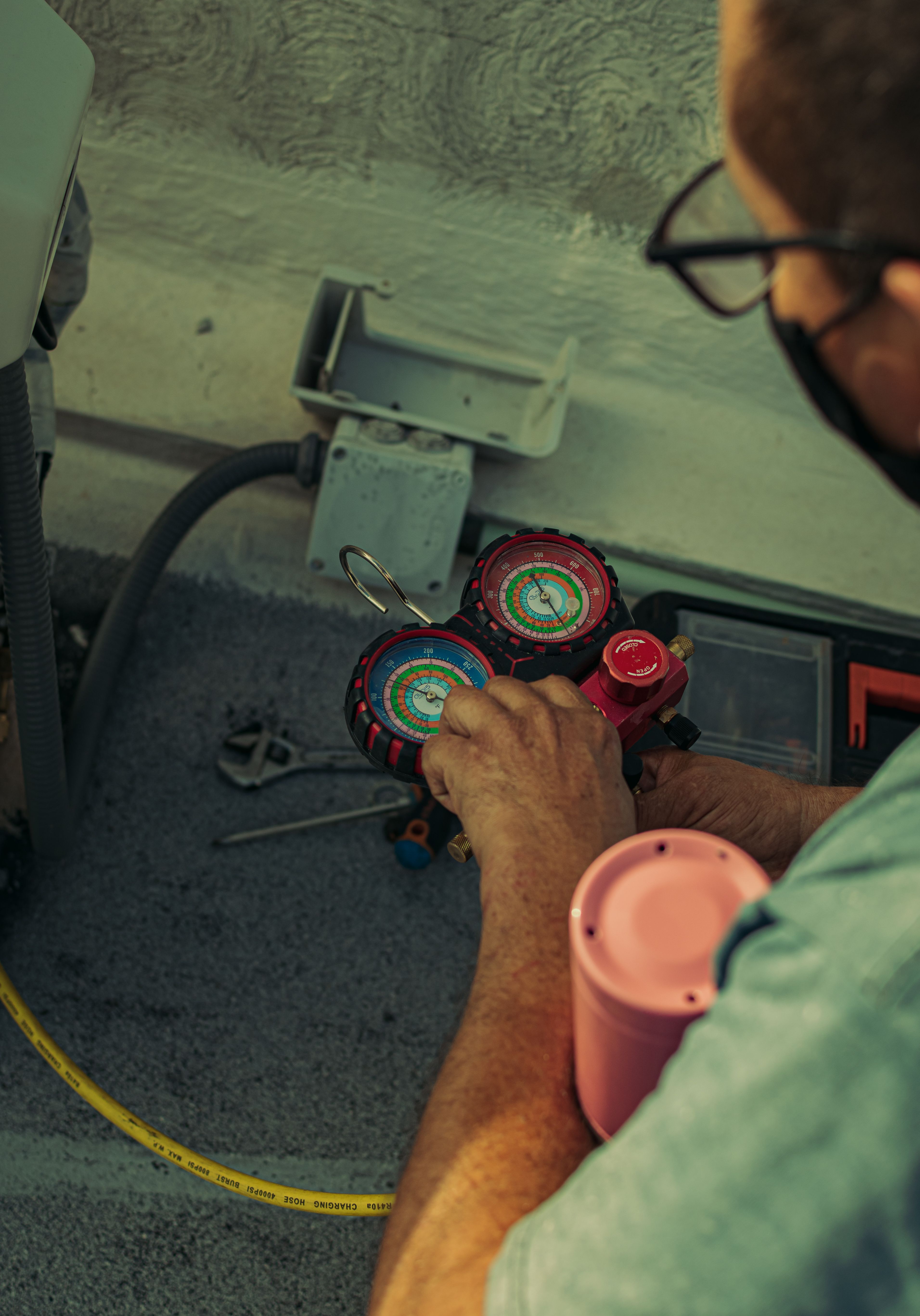
A qualified HVAC contractor (ideally RGE, see the 2026 RGE reform) must produce a detailed report: nature of the failure, probable cause, distinction between installation defect, maintenance failure and wear, photos, pressure and temperature measurements. This report is the central document of the file.
3. Send a registered letter to the installer and to their insurer
Within 5 business days of discovery of the loss, send a letter with acknowledgement of receipt to the installer, in copy to their decennial insurer. Attach:
- the repair quote;
- the HVAC contractor's diagnosis;
- photos of the loss;
- a copy of the decennial insurance certificate.
Keep the acknowledgement of receipt and the letter carefully.
4. Cooperate with the expert
The insurer appoints an expert within 60 days on average. Let them access the system, provide the supporting documents, and do not start final works before their visit. An emergency repair (for example, a provisional restart to avoid heat stroke) is however allowed and must be documented.
5. Negotiate compensation
Compensation occurs within 3 to 6 months on average. The amount covers:
- the repair costs (parts, labour, travel);
- the consequential damage (for example, water damage linked to the failure);
- the loss of use of the property (rent, rental of replacement equipment).
6. In case of refusal: mediation then court
If the insurer refuses cover:
- Refer the matter to the insurance mediator (free service, response within 90 days);
- If that fails, bring the matter before the judicial court within a 2-year period from the discovery of the loss (prescription article L. 114-1 of the Insurance Code);
- For disputes over €5,000, the assistance of a lawyer is mandatory (law of 9 March 2019 on mandatory representation).
How to limit the risks BEFORE the breakdown
Prevention is better than cure. The reflexes to adopt as soon as the system is installed:
Require the right documents
- Detailed quote mentioning brands, models, capacities, energy classes, preparatory works;
- Valid decennial certificate for the activity concerned;
- Acceptance report signed jointly at the end of the works;
- Blank maintenance log to be filled in from the first commissioning.
Choose an RGE-certified and well-insured installer
The 2026 RGE reform tightened the qualification conditions. An RGE installer has the obligation to:
- justify valid decennial insurance for the activity carried out;
- employ trained and certified personnel (capacity certificate for the handling of refrigerants);
- undergo regular control audits (1 site audit per year for QualiPAC and QualiClim qualifications).
Conversely, non-RGE installers are not required to have decennial cover for the installation of a heat pump in a renovation — which does not prevent them from having one, but guarantees you nothing.
Maintain the installation every year
Annual maintenance by a qualified professional is mandatory (see our article on mandatory maintenance in 2026). The maintenance log, kept up to date, is the #1 document in case of a claim. Without it, the insurer can legally refuse cover.
Keep a digital "black box"
Create a single digital folder (PDF or cloud) with:
- the signed quote;
- the invoice;
- the acceptance report;
- the decennial insurance certificate;
- the annual maintenance reports;
- photos of the installation;
- exchanges with the installer and the insurer.
In case of a claim, this file is your best ally. You will forward it in one click to the expert.
Frequently asked questions
My installer has ceased trading. Can I still invoke the ten-year guarantee? Yes. The decennial insurer remains reachable for 10 years from acceptance, even if the company has closed, been bought out or changed its business name. This is one of the major benefits of the decennial cover.
Does the ten-year guarantee work if I sell my home? Yes, the guarantee follows the property: it is attached to the structure, not to the owner. You must inform the buyer of the existence of the insurance and pass on the certificate at the time of sale. The DPE and the maintenance log must also be up to date.
Is the technician's travel covered? In principle yes, if it is an intervention under the guarantee. Check your contract: some insurers only cover parts, others include labour and travel.
Does decennial insurance cover a heat pump installed by a self-installer? No. The decennial cover only applies to works carried out by an insured professional. A heat pump installed by a private individual falls under home insurance (under the damage guarantee) and under common law of civil liability.
What happens if the installation is declared non-compliant with standards? This is one of the most common grounds for refusal. If the heat pump was installed without respecting the DTU, the F-Gas regulation (see our article on F-Gas and R32 in 2026) or the rules of the art, the insurer can invoke an exclusion. Hence the importance of choosing an RGE QualiPAC + QualiClim installer, who commits their liability.
Is my structural-defects insurance contract mandatory for a heat pump in renovation? For new construction (house, building), yes, it is a legal obligation. For a renovation, taking it out is not mandatory but remains strongly recommended: in case of a claim, it considerably speeds up compensation.
How much does an annual maintenance contract cost in 2026? For a residential air-to-air heat pump, count between €150 and €300 per year (see our article on the price of maintenance in 2026). For an air-to-water heat pump or a ducted system, between €250 and €500. That is the price of peace of mind — and of the validity of your decennial cover.
Protect your installation with Proclimo
Proclimo, an RGE QualiPAC + QualiClim installer in Île-de-France, supports individuals, co-ownerships and professionals throughout the life cycle of their air-conditioning and heat pump. Our commitment: compliant, insured installations, and complete administrative follow-up that protects you in case of a claim.
- RGE reversible air-conditioning installation: thermal sizing, detailed quote, decennial certificate provided, joint acceptance report, one-year perfect completion guarantee.
- Annual maintenance contract: digital maintenance log, scheduled intervention, refrigerant leak-tightness check, filter cleaning, performance verification. The key to maintaining the validity of your decennial cover.
- 7/7 emergency repair: intervention within 24 to 96 hours in Île-de-France, detailed intervention report compatible with a claim file, repair quote for the insurer.
- Advice and support: audit of your installation, verification of your guarantees, help in building your claim file.
Contact Proclimo for a free verification of your current guarantees, or book your intervention online for a preventive service before the next heatwave. Our team operates in Île-de-France, in compliance with the 5.5% VAT on reversible air conditioning, the 2026 RGE reform and the annual maintenance obligations.
Sources: French Court of Cassation, 3rd civil chamber, 21 March 2024 · Civil Code, articles 1792 to 1792-6 · Insurance Code, article L. 243-3 (mandatory decennial insurance) · Insurance Code, article L. 114-1 (two-year prescription) · Insurance Code, article L. 242-1 (structural defects insurance) · SYNASAV — Legal guarantees, commercial guarantee and after-sales service · Fédération française du bâtiment — Note on the case law reversal of 21 March 2024 · Ministry of Ecological Transition — Construction insurance · ADEME — Maintenance and servicing of heat pumps.
Need an air conditioning solution?