Air conditioning condensate: drainage is the number one cause of water damage after a botched installation

L'équipe Proclimo
31 Aug 2026 - 08 min read
There is one statistic insurers have been watching closely since the summer of 2026: the share of water damage claims linked to air conditioning equipment. It was marginal five years ago. It no longer is.
The reason is arithmetical. VAT cut to 5.5% on air-to-air heat pumps in July 2026 triggered an unprecedented volume of installations, carried out in a rush by a sector already short of labour. Yet on an air conditioner, the refrigeration side is rarely botched: it is visible, it is tested, and a refrigerant leak shows up immediately. What does get skipped is the condensate drain. A 16 mm diameter pipe, invisible once the partition wall is closed up, and which nobody mentions at the quotation stage.
And yet it is precisely that pipe which turns summer comfort into an insurance claim.
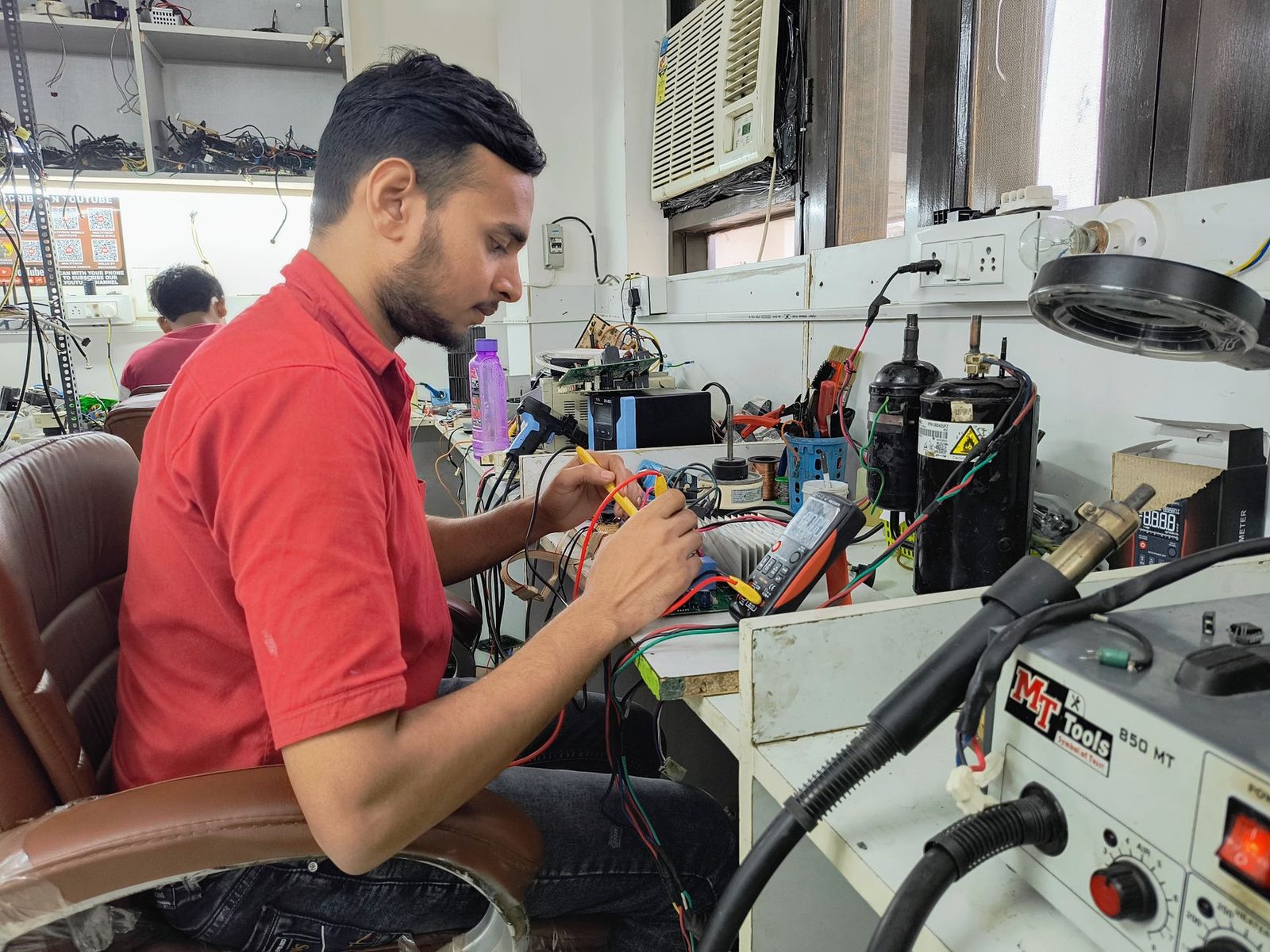
Where does all this water come from?
In cooling mode, the indoor unit cools the room air by passing it over a heat exchanger held below the dew point. The moisture in the air condenses on the fins, exactly as it does on a glass of iced water taken out of the fridge, then trickles down into a drain pan located beneath the exchanger.
The volumes always surprise those measuring them for the first time:
| Situation | Condensate production |
|---|---|
| 2.5 kW wall-mounted split, dry day at 30 °C | 0.5 to 1.5 L/day |
| 2.5 kW wall-mounted split, humid spell (coastal area, storm) | 3 to 6 L/day |
| 7 kW ducted unit during a prolonged heatwave | 10 to 20 L/day |
| Outdoor unit during winter defrost | 1 to 3 L per defrost cycle |
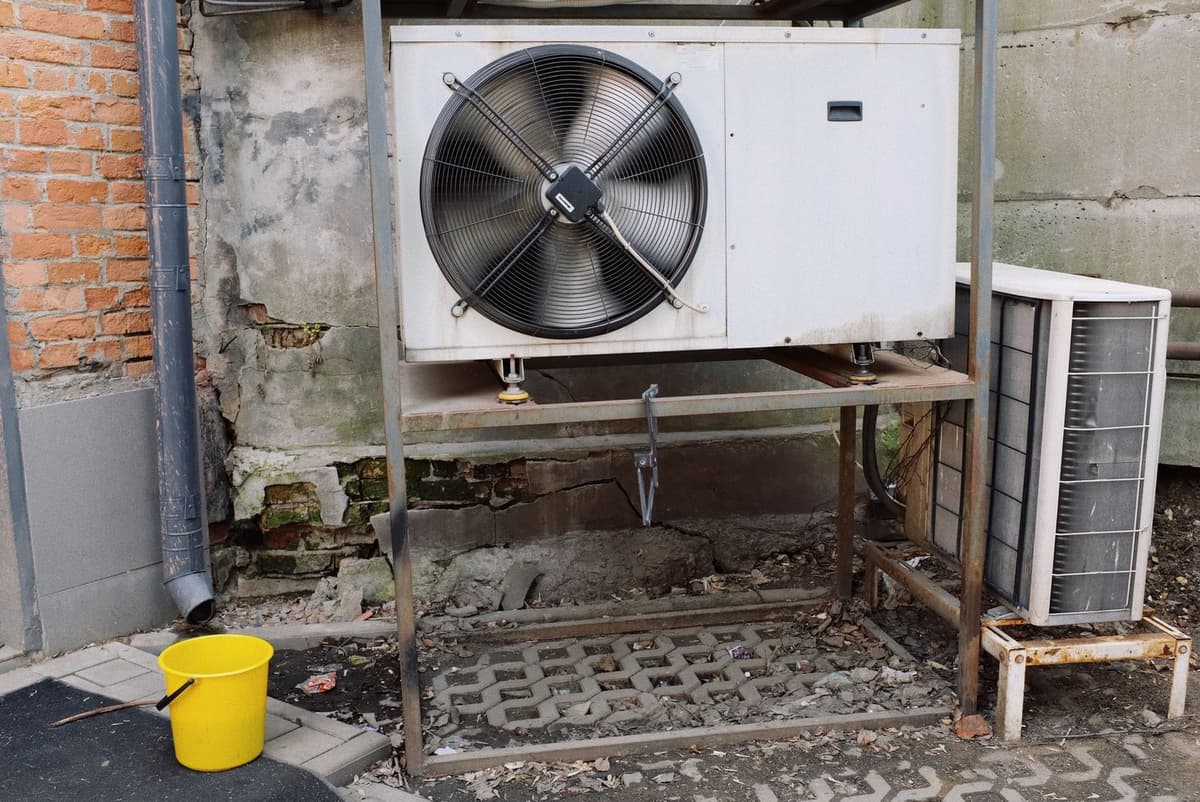
That last line is the one everyone forgets. In heating mode, it is the outdoor unit that ices up and releases several litres of water onto the ground with every defrost cycle. On a terrace sloping towards the façade, on a communal landing or above a building entrance, that water freezes overnight and creates a sheet of black ice. Several municipalities have already had to settle disputes on exactly this point.
The four most common drainage defects
1. The reverse slope
This is the classic one. The condensate pipe works by gravity: it needs a continuous fall of at least 1 cm per metre, ideally 2. When the installer routes the pipe behind a piece of furniture, works around a stud in the partition or lifts it a few centimetres to reach an existing hole, they create a low point. Water stagnates, biofilm develops, and the blockage forms within two seasons.
Typical symptom: the air conditioner does not drip in the first year, it drips in the third — in the middle of a heatwave, when condensate production is at its peak.
2. The missing trap
An indoor unit under negative pressure will draw air in through the drain pipe if that pipe has no trap. The result: constant gurgling, poor drainage, and above all odours backing up when the pipe has been connected to the wastewater system. That direct connection to a basin waste pipe, very common in renovation work, should in fact be ruled out without a water seal: it is an open door for sewer smells in the living room.
3. The condensate pump left to fend for itself
When gravity is not an option — a split in a basement, a ducted unit in a false ceiling, an indoor unit below the discharge point — the installer fits a condensate pump. It is a small electromechanical device with a float, an impeller and a safety contact. It has a limited service life, it clogs up, and it gives no warning when it starts to tire.
On properly executed installations, the pump's alarm contact is wired to the air conditioner's control board: on a high-level signal, the machine shuts down. On many rushed installations, that wire is never connected. The pump fails, the pan overflows, and the air conditioner carries on quietly producing water for three days.
4. The badly drilled wall penetration
The through-hole that carries the refrigerant lines must be drilled sloping towards the outside and sealed with a flexible sealant. Drilled horizontally or sloping inwards, it channels rainwater and condensate from the trunking back into the wall. Nothing shows for two winters, then a stain appears, then the insulation slumps.

The warning signs worth knowing
A drain never blocks up abruptly. It gives warning — provided you know how to listen.
- Recurring gurgling when the indoor unit stops or starts: air in the circuit, a missing trap or a partially obstructed pipe.
- Drips on the wall, under the left or right end of the split: the pan is overflowing on the side opposite the drain, a classic sign of a blockage or a reverse slope.
- A damp-earth or musty smell as soon as the unit starts up: biofilm in the pan and the pipe. This is also a health issue, ANSES having repeatedly pointed out that stagnant condensate pans are a breeding ground for microbial growth in air handling systems.
- A condensate pump running continuously instead of switching on in short cycles of a few seconds: the non-return valve is worn out and the water keeps flowing back.
- A high-level fault code on the remote control, often displayed cryptically (P-something, depending on the brand). It is never a false alarm.
A simple connected water leak detector placed on the floor beneath a ducted unit in a false ceiling or next to a condensate pump in a basement costs a few tens of euros and sends a smartphone alert before the neighbour's ceiling soaks through. In terms of cost versus risk avoided, it is one of the best purchases you can make for an air-conditioned home.
What you can maintain yourself
Maintaining the condensate circuit does not involve handling refrigerant: it therefore requires no certificate of competence and you can perfectly well do part of it yourself. One caveat though: switch off the power at the breaker before any work, and never dismantle the casing of a split unit if you are not comfortable doing so — the clips break easily and the heat exchanger is sharp.
Twice a year, ideally in May and October:
- Check the flow. Slowly pour 0.5 L of lukewarm water into the pan (accessible by lifting the flap and the filter on most wall-mounted splits) and check that the water comes out on the outside in under a minute.
- Clean the filters. A clogged filter lowers the exchanger temperature, increases condensation and throws droplets out of the pan. It is the silliest and most frequent cause of a "dripping air conditioner".
- Treat the pan. An anti-algae tablet for condensate pans dropped into the pan in spring limits biofilm formation for the whole season. They dissolve slowly and cost just a few euros.
- Blow out the pipe. From the outdoor end, a manual air pump for condensate lines will shift an incipient blockage without dismantling anything. Use it by blowing towards the outside from indoors, never the other way round, or you will push the blockage back into the pan.
- Test the condensate pump. Lift the float by hand: the pump should start immediately and stop dead when released.
What remains a job for the professional: chemical cleaning of the exchanger, replacing a pump, reworking a slope, and of course anything touching the refrigerant circuit.
The awkward question: who pays in the event of water damage?
This is where things get concrete, particularly in an apartment block.
In a detached house
Water seeping into a partition wall falls under your home insurance policy, water damage cover. But the question of the cause determines whether you have recourse. If the origin is an installation defect — reverse slope, missing trap, unconnected alarm — the insurer can turn against the installer.
Two legal warranties can be invoked:
- The warranty of perfect completion (article 1792-6 of the French Civil Code), which covers any defect reported within one year of handover.
- The ten-year (décennale) warranty (article 1792), where the defect renders the works unfit for their purpose — an infiltration that permanently damages a partition wall or a floor falls within that scope. The RGE-certified installer must be insured on this basis and owes you their décennale insurance certificate on simple request.
Useful habit: keep the quotation, the invoice, the insurance certificate and photographs of the work before the partitions are closed up. Without those documents, the technical discussion turns into one person's word against another's.
In a co-owned building
The most common scenario: a split unit installed in your flat, a condensate pump that fails, and a stained ceiling at the neighbour's below. The IRSI convention (Indemnisation et Recours des Sinistres Immeuble) applies to claims up to €5,000 excluding VAT and designates the managing insurer according to the unit in which the cause of the damage is located. Above that threshold, you fall back on ordinary law and adversarial expert assessment.
One point many co-owners discover too late: if the installation was carried out without authorisation from the general meeting while affecting common parts (drilling through the façade, fixing the outdoor unit to a load-bearing wall or a façade), your position is very weak. The managing agent can demand removal, and the insurer can invoke an undeclared increase in risk.
The right questions to ask BEFORE installation
The best moment to deal with the condensate issue is at the quotation stage. Here are the five questions that separate a serious installer from a hurried fitter:
1. Will drainage be by gravity or by condensate pump?
2. If by pump: will the high-level safety contact be wired to the air conditioner's board so that the machine shuts down?
3. Where exactly does the condensate discharge? (Discharging onto the façade above the pavement or onto a neighbour's property is prohibited under most highway and co-ownership regulations.)
4. Is the pipe insulated along the sections passing through unheated spaces? (Without insulation, it condenses in turn and soaks the insulation.)
5. Is the wall penetration sloped towards the outside, and which sealant will be used to seal it?
Have the answers stated in writing on the quotation. An installer who refuses to write them down is telling you a great deal.
On ducted systems and false-ceiling installations, also insist on an access hatch: a 40 × 40 cm panel facing the pan and the pump. Without a hatch, the slightest maintenance job means cutting into plasterboard at a cost of €300.
The special case of the outdoor unit in winter
As mentioned above, in heating mode the water production moves outdoors. Three simple precautions, to be taken before autumn:
- A collection tray with a drain under the outdoor unit, connected to a rainwater outlet. It prevents run-off across the terrace and black ice.
- A self-regulating heating cable for the condensate drain in regions where temperatures regularly drop below −5 °C: without it, the pipe freezes, water stays in the outdoor unit's tray and defrosting performance deteriorates.
- Raising the unit on feet or a bracket, at least 15 cm off the ground, so that water does not stagnate under the machine and snow does not block the air outlet.
That last point also affects performance: an outdoor unit sitting in its own run-off constantly re-ices and sends the COP tumbling.
In summary
The condensate drain is the cheapest item in an air conditioning installation — a few tens of euros of materials — and the one that generates the most expensive claims. In a year like 2026, marked by an unprecedented volume of installations and tight lead times, it is precisely the detail that gets skipped.
Three habits are enough to remove most of the risk: have the drainage method written into the quotation, check the flow yourself twice a year, and fit a water detector wherever a leak would go unseen. The rest is insurance and regrets.
Regulatory sources cited: French Civil Code (articles 1792 and 1792-6), the IRSI convention applicable to water damage in apartment buildings, ANSES work on indoor air quality and air handling systems. The condensate volumes given are orders of magnitude observed in service and vary considerably with humidity levels.
Need an air conditioning solution?