Air Conditioning in Apartment Buildings: How to Get Your Outdoor Unit Approved at the Owners' Meeting in 2026

L'équipe Proclimo
5 Sep 2026 - 09 min read
Since the VAT cut to 5.5% on air-to-air heat pumps, quotes for reversible air conditioning have been landing by the thousand in the letterboxes of French apartment buildings. But between the signed order form and commissioning, one obstacle still blocks one installation in three in apartments: the general meeting of the co-ownership. Installing an outdoor unit, drilling through a load-bearing wall, running refrigerant lines along a façade — all of these actions affect the common areas. And under co-ownership law, anything affecting the common areas cannot be decided alone, even on "your own" balcony. Here is how to build a file that gets approved, which majority actually applies, and what to do when a refusal has ceased to be reasoned at all.
Why your balcony isn't really yours
This is misunderstanding number one. A co-owner generally assumes that a balcony, loggia or terrace listed in their lot belongs to them outright. In reality, the Act of 10 July 1965 and the settled case law of the Cour de cassation draw a distinction between two things:
- the exclusive right of use of the balcony, which does indeed belong to you;
- the structure and exterior appearance (slab, railing, soffit, façade), which remain common areas in virtually every co-ownership by-law.
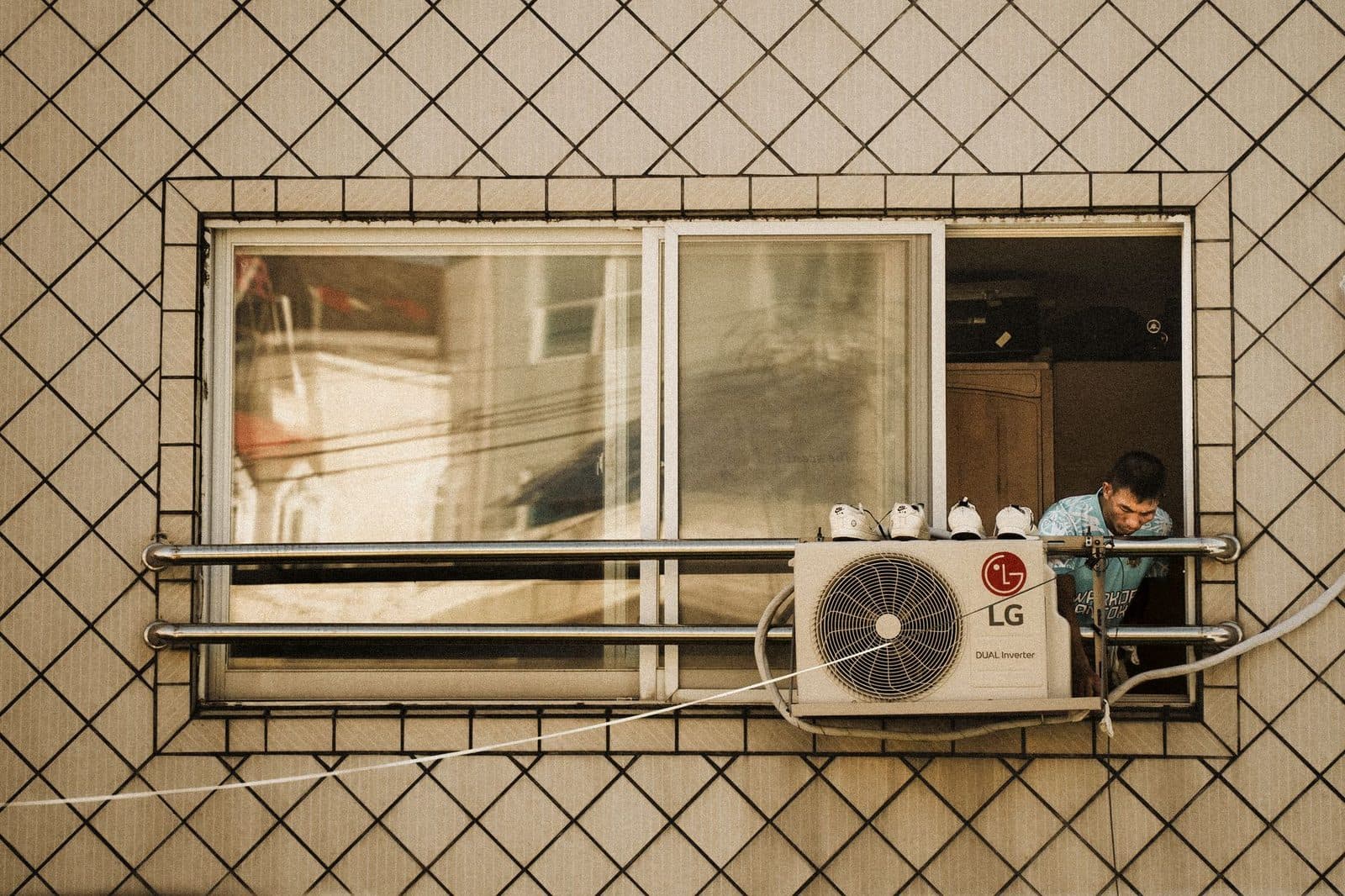
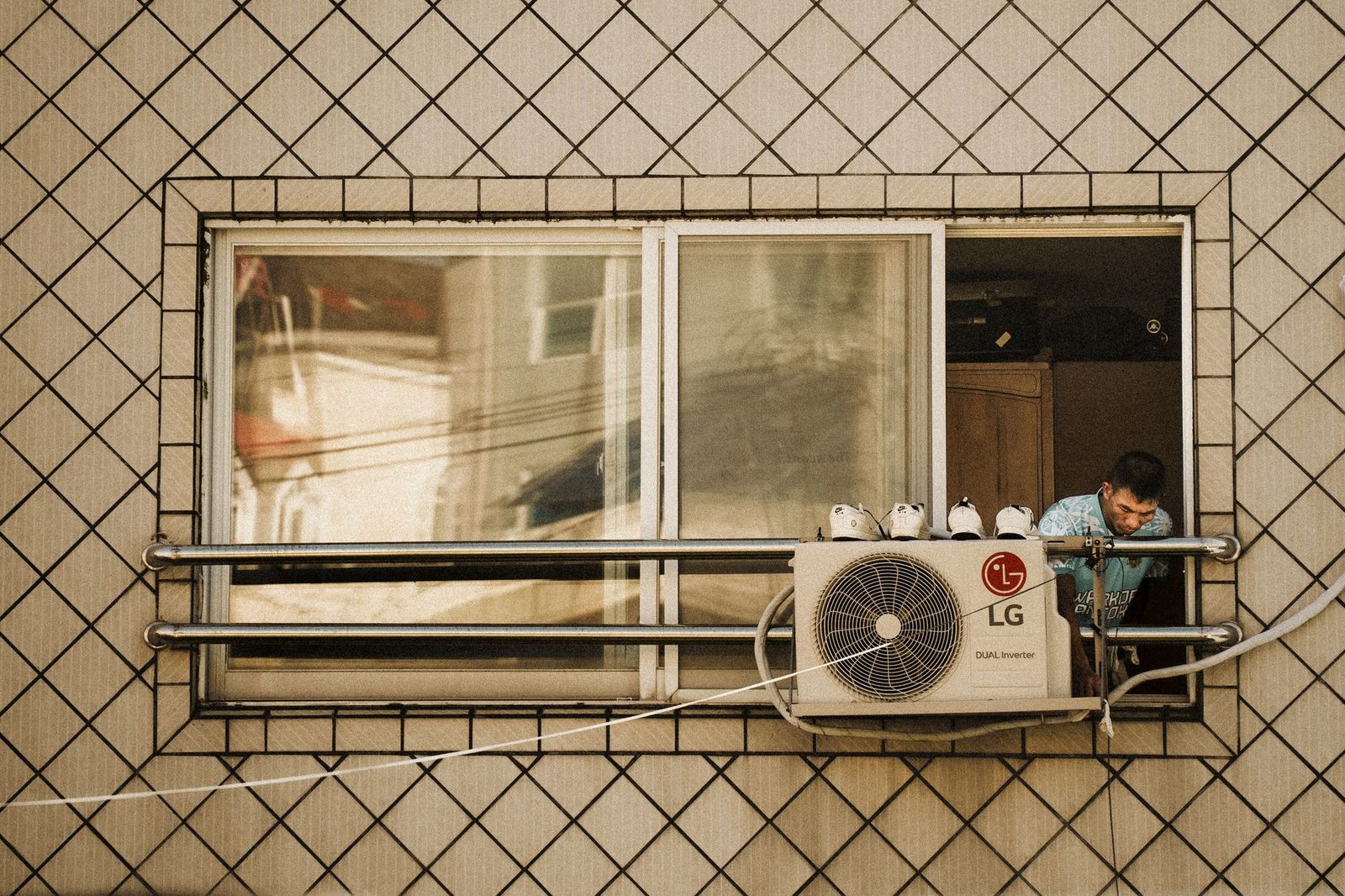
The practical consequence: you can put a table and plants there, but you cannot attach equipment that alters the exterior appearance of the building or that rests on a common element. An outdoor unit weighing 40 to 60 kg bolted to a railing, placed on the slab with drilling for condensate drainage, or fixed to the façade, falls squarely within the scope of Article 25 b) of the 1965 Act: "works affecting the common areas or the exterior appearance of the building."
Bear in mind: even a unit set on the ground on anti-vibration pads, with no drilling of the railing at all, still requires authorisation as soon as it is visible from outside and requires the façade wall to be drilled for the refrigerant lines to pass through. And that drilling is unavoidable.
The case of horizontal co-ownership houses
Housing estates and horizontal co-ownerships follow the same logic: if the by-laws include architectural specifications (which is often the case), siting an outdoor unit visible from the road or from neighbouring lots requires the meeting's approval. In protected areas, the opinion of the Architecte des Bâtiments de France is required on top of that — more on this below.
Which majority applies in 2026?
This is the point most managing agents handle poorly, and it is worth mastering before the meeting.
| Situation | Applicable majority | Legal basis |
|---|---|---|
| Individual installation of an air-to-air heat pump (private use) | Article 25 b) — majority of the votes of all co-owners | Act of 10/07/1965 |
| Article 25 vote obtaining at least 1/3 of the votes of all co-owners | Immediate second vote by simple majority of those present and represented | Article 25-1 (bridging clause) |
| Collective installation on the common areas (shared heat pump, network) | Article 25, or even Article 24 for energy-saving works | ELAN Act / Climate Act |
| Amendment of the co-ownership by-laws | Article 26 (double majority) | Act of 10/07/1965 |
The bridging clause in Article 25-1 is your best ally and it is far too often overlooked: if your resolution gathers at least one third of the votes of all co-owners (not just those present), the chair of the meeting must immediately proceed to a second vote by simple majority. Many resolutions declared "rejected" at a general meeting should have been adopted on that second round. Always check the minutes on this point.
Have the item put on the agenda properly
A request made orally during the meeting has no legal value: a resolution not included on the agenda is void. The procedure:
- Send the managing agent a request for inclusion by registered letter with acknowledgement of receipt or via the co-ownership's online portal, respecting the deadline set in the management contract (allow two months before the meeting to be safe).
- Draft the exact wording of the resolution yourself — don't let the managing agent write it for you. A vague resolution ("authorise Mr X to install air conditioning") is open to challenge; a precise one (brand, model, dimensions, location, colour, noise level, contractor, date) protects everyone.
- Attach the supporting documents (see below): the managing agent is required to append them to the notice of meeting.
The file that swings a vote
A general meeting almost never rejects air conditioning "on principle." It rejects uncertainty: noise, appearance, water leaks onto the neighbour below, the precedent it sets. Your file must address these four fears, in that order.
1. The acoustic evidence
This is the centrepiece. Provide the manufacturer's technical data sheet stating the sound pressure level in dB(A) at 1 metre and, if available, the sound power level. Recent outdoor units in premium ranges drop below 45 dB(A) at nominal operation and offer a night mode at 38–40 dB(A).
Remind the meeting of the actual rule: what is penalised is not absolute noise but emergence (Articles R. 1336-6 to R. 1336-9 of the French Public Health Code), capped at 5 dB(A) by day and 3 dB(A) at night. A written undertaking to have a joint acoustic measurement carried out at your own expense after installation, should a complaint arise, defuses most objections. A digital sound level meter, even an entry-level one, already lets you document the situation before and after installation — useful for grounding the debate in facts rather than simply enduring it.
2. Visual integration
Present a photomontage or at the very least an annotated photo of the façade showing the exact position, dimensions and colour. Offer a concealment solution from the outset: a louvred air conditioner cover (treated timber or lacquered aluminium) costs a few hundred euros and turns an aesthetic sticking point into a selling argument. Careful, though: the cover must be ventilated and respect the clearances specified by the manufacturer, otherwise performance will suffer and the warranty may be voided.
3. Condensate management
This is the most frequent — and most legitimate — technical objection: an outdoor unit produces water in heating mode (defrost cycles), up to several litres a day in a damp winter. Letting it simply drip and run onto the balcony of the neighbour below is a guaranteed dispute. Commit, in the wording of the resolution, to connecting the condensate tray to an existing drain, and have it written into the quote. A condensate drainage kit with a trap and suitable conduit costs a few tens of euros; it is also the detail that reassures the meeting.
4. Liability and insurance
Attach:
- the installer's professional liability and ten-year (décennale) insurance certificate;
- their certificate of competence for handling refrigerant fluids (mandatory for commissioning, Articles R. 543-99 et seq. of the French Environment Code);
- their RGE QualiPAC qualification if you are applying for subsidies;
- a written undertaking to restore the common areas at your own expense if the unit is removed, and to bear responsibility for any damage linked to the installation.
The permits required in addition to the meeting's approval
Approval from the general meeting does not exempt you from any planning formality. In 2026, three checks remain essential.
The prior works declaration
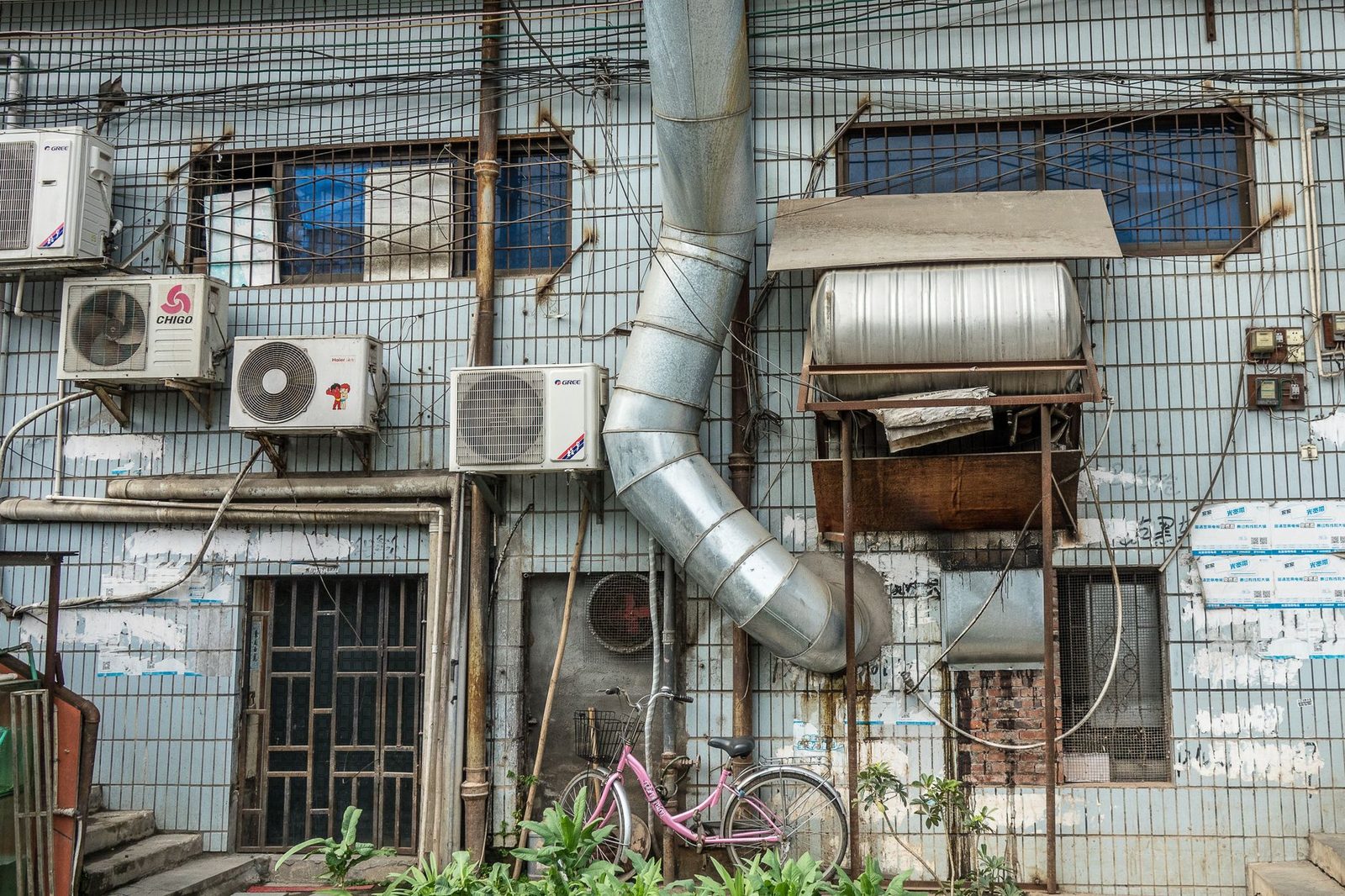
Any alteration to the exterior appearance of an existing building requires a prior declaration (déclaration préalable) filed with the town hall (Article R. 421-17 of the French Planning Code). An outdoor unit visible from public space falls within this requirement in the vast majority of municipalities. The processing time is one month, extended to two months in protected areas. Some municipalities have published very detailed guidance sheets (Paris, Lyon and Bordeaux in particular) setting out acceptable positions: at the back of the balcony, set back from the face of the façade, never projecting over the street.
The opinion of the Architecte des Bâtiments de France
If your building lies within 500 metres of a listed historic monument, in a remarkable heritage site or in a classified site, the ABF is consulted and their opinion is binding on the town hall. In practice, an outdoor unit visible from the street is almost always refused there. The alternatives to explore in that case: siting it in an inner courtyard, on a roof terrace out of sight, or switching to a solution with no visible outdoor unit (a monobloc air conditioner without an outdoor unit, with discreet grilles integrated into the façade).
The co-ownership by-laws themselves
Read them line by line. Some by-laws expressly prohibit "any visible appliance on the façade" or impose a specific colour. A blanket, absolute prohibition may be held unfair if it permanently deprives co-owners of equipment that has become necessary, but until a judge has set it aside, it stands. The Climate and Resilience Act and recent developments do, moreover, allow the by-laws to be amended under Article 26 to bring them into line with energy renovation objectives.
Abusive refusal: your two-month window to appeal
A negative vote is not the end of the story. The law strictly frames the abusive refusal of authorisation for works.
What amounts to abuse
Case law finds abuse where the refusal:
- rests on no ground relating to the collective interest (appearance, safety, structural integrity, intended use of the building);
- reflects discrimination — other co-owners having obtained the same authorisation for identical installations;
- causes the applicant a disproportionate loss compared with the inconvenience invoked.
The most favourable scenario for the applicant: the building already has five or six authorised outdoor units, and yours is refused without any reasons given. Always photograph the existing installations and track down the corresponding meeting minutes (you are entitled to them).
The procedure
You have two months from notification of the minutes to challenge the decision before the judicial court (tribunal judiciaire) of the place where the building is located (Article 42 of the 1965 Act). After that deadline, the decision becomes final — that is the classic trap. The procedure requires mandatory representation by a lawyer above €10,000.
The judge may:
- annul the resolution refusing the works;
- authorise the works themselves, if the refusal is found to be abusive;
- award damages for the loss suffered (delay, heatwaves endured, extra cost).
Before going that far, try conciliation: the conciliateur de justice is free of charge, referral to them is a preliminary step judges often appreciate, and a simple preparatory meeting with the co-ownership council resolves many cases. An up-to-date practical guide to co-ownership lets you cite the right provisions during the meeting and spares you many pointless skirmishes with a poorly informed managing agent.
The alternatives when the meeting says no
A definitive refusal doesn't condemn you to a desk fan. Several solutions remain available without touching the common areas:
- The monobloc air conditioner with no outdoor unit: evaporator and condenser in a single wall-mounted casing, with two 160 mm core-drilled holes in the façade hidden by discreet grilles. Authorisation is still needed for the drilling, but the aesthetic objection largely falls away.
- The portable air conditioner on castors: no authorisation, no alteration to the façade, but mediocre performance, a hose to run out of the window and a high indoor noise level. A stopgap for heatwaves, not a permanent comfort system.
- Solar shading: an external blind or a reflective solar window film lowers the temperature of a south- or west-facing room by several degrees, at an incomparably lower cost. Fitting a retractable awning also requires the meeting's approval; film applied to the inside of the glazing does not.
- Assisted night ventilation: a reversible window extractor fan or simply a high-end circulation fan makes use of the cooler night air, provided the home's thermal inertia allows it.
The co-owner's checklist, in order
- Re-read the co-ownership by-laws (clauses on exterior appearance, balconies, visible appliances).
- Consult the town hall's planning department: protected area? local guidance sheet? prior declaration required?
- Get quotes from two or three RGE-certified installers, insisting on an acoustic data sheet, a siting plan and condensate management.
- Sound out the co-ownership council beforehand, informally: a council won over is worth twenty votes.
- Request inclusion on the agenda by registered letter, with resolution wording you have drafted yourself plus the supporting documents.
- Present the file at the meeting in three minutes flat: noise, appearance, water, liability.
- Check the minutes: was the Article 25-1 bridging clause applied?
- File the prior declaration once authorisation has been obtained, before any work starts.
- Keep the meeting minutes and the certificate of non-opposition in your property file: they will be required when you sell.
The key takeaway
Authorisation from the general meeting is not just one more administrative formality: it is the document that secures your installation for ten or fifteen years, and that protects you if the managing agent changes, if you sell the property, or if a neighbour dispute arises. A well-prepared file — acoustic data sheet, photomontage, condensate drainage connected, installer's certificates — obtains approval in the vast majority of cases. A bare quote presented at the meeting, almost never.
And if the refusal comes anyway, with no serious grounds, remember the two months: once that deadline has passed, the decision is set in stone, however abusive it may be.
Sources: Act no. 65-557 of 10 July 1965 establishing the status of co-ownership of built properties (Articles 24, 25, 25-1, 26, 42); French Planning Code, Article R. 421-17; French Public Health Code, Articles R. 1336-6 to R. 1336-9; French Environment Code, Articles R. 543-99 et seq.; Service-Public.fr, information sheets "Copropriété : travaux" and "Déclaration préalable de travaux"; ANIL (Agence nationale pour l'information sur le logement).
Need an air conditioning solution?