Air conditioning noise and neighbours: what the law says in 2026 and how to settle the dispute

L'équipe Proclimo
20 Sep 2026 - 08 min read
"Ever since they put in their air con, I can't open my bedroom window any more." The registered letter often lands in September, when summer is winding down and nerves are frayed after three months of night-time humming. At the other end sits an owner who is genuinely taken aback: the installer had assured them the unit was "silent" — 48 dB(A) on the spec sheet, barely more than a fridge.
Both are right, and that is precisely the problem. The noise of an outdoor unit is not judged in absolute terms but relative to the ambient quiet — a regulatory concept called emergence, which almost nobody has heard of until they are caught up in it. With installations booming since VAT dropped to 5.5%, disputes are multiplying: conciliators, managing agents and courts are seeing a flood of "outdoor unit" files. Here is how the law settles the matter, and above all how to avoid getting there.
The text that counts: emergence, not decibels
Contrary to a stubborn belief, France has no "maximum decibel threshold" applicable to a private individual's air conditioner. The Code de la santé publique (French Public Health Code, articles R. 1336-4 to R. 1336-13, derived from amended decree no. 2006-1099) reasons differently: it compares the sound level with the appliance running to the sound level without it — what is known as the residual noise.
The difference between the two is the emergence. And it must not exceed:
| Period | Maximum permitted emergence |
|---|---|
| Daytime (7 a.m. – 10 p.m.) | 5 dB(A) |
| Night-time (10 p.m. – 7 a.m.) | 3 dB(A) |
To these figures is added a correction term based on the cumulative duration of the noise: the longer the appliance runs, the lower the tolerance. The correction ranges from +6 dB(A) (for operation lasting less than a minute) down to 0 dB(A) beyond 8 hours of cumulative operation. An air conditioner running all night is therefore granted no leeway whatsoever: 3 dB(A) of emergence, full stop.
3 dB(A) is very little. It is barely a doubling of acoustic energy — a difference the ear can only just perceive, but that a sound level meter picks up without hesitation. On a quiet suburban street at night (residual noise around 25 dB(A)), an outdoor unit measuring 29 dB(A) at the neighbour's window is already in breach.
Measurement is carried out at the property boundary or inside the affected dwelling, with windows open and then closed — not at the foot of the appliance. This is a crucial point: the manufacturer's spec sheet, measured at 1 metre in a free field under the ISO 3744 standard, says absolutely nothing about what the neighbour experiences.
What if the unit is installed by a professional for a business?
If the air conditioning serves a shop, a practice, a restaurant or business premises, the situation shifts to the regime governing noise from activities (article R. 1336-10), which is stricter still, with spectral emergence limits per octave band. A bakery whose refrigeration unit disturbs the building falls under this regime, not the standard neighbourhood noise one.
Why outdoor units get noisier over time
An appliance that complies at installation can stop doing so. Refrigeration engineers point to three recurring causes.
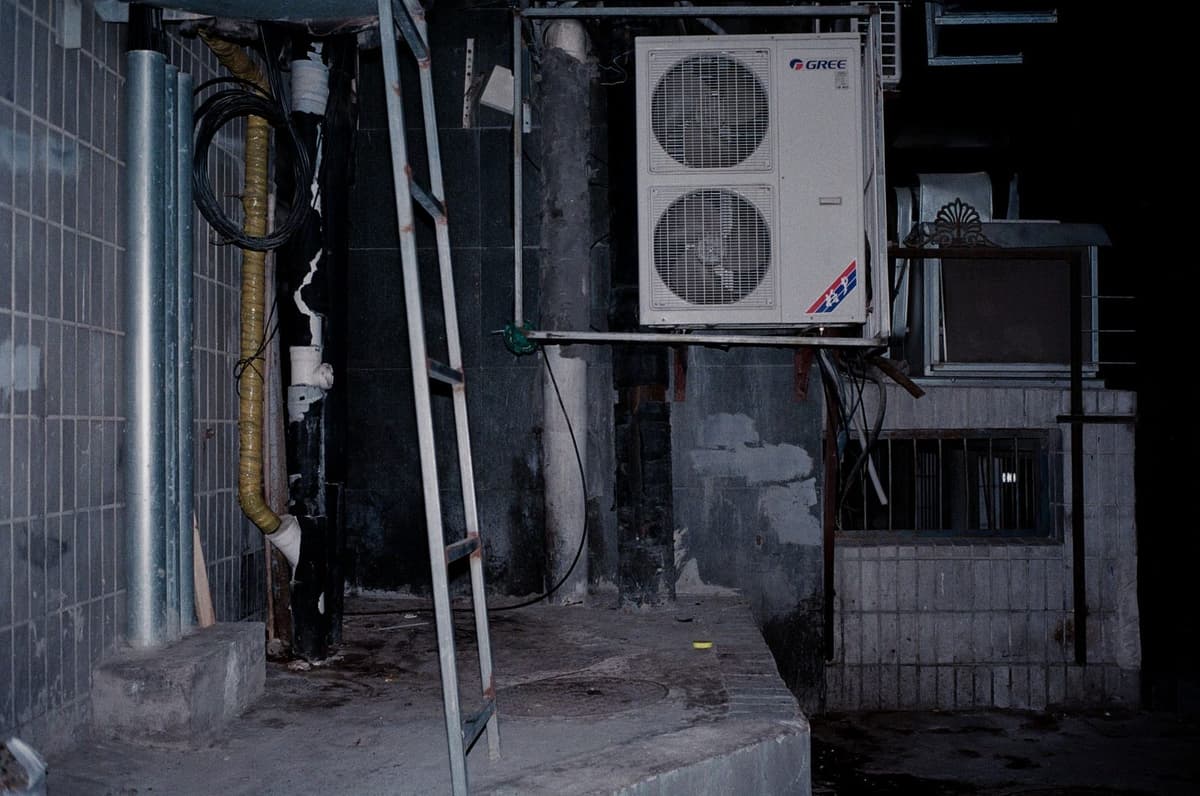
Vibration transmitted to the structure. The compressor generates low-frequency vibrations which, transmitted through a wall bracket screwed into a hollow partition, turn the wall into a sounding board. The neighbour does not hear an "air con noise" but a dull droning, particularly trying at night and very hard to pinpoint. Anti-vibration rubber mounts placed under the feet of the frame cost a few dozen euros and resolve a good proportion of cases.
A fouled heat exchanger. A condenser clogged with poplar fluff, dust or seeds forces the fan to work harder. The noise reduction from a simple annual clean using a condenser fin comb and a suitable product is routinely 2 to 4 dB(A): sometimes exactly what separates compliance from breach.
Mechanical wear. Fan bearings, compressor anti-vibration mounts, a casing panel that starts to rattle as it works loose: after six to eight years, an appliance begins to "sing" differently. This is one of the rare cases where the neighbour is objectively right to say "it didn't always make that noise".
Install it properly and you will never have the problem
Everything is decided on installation day, and it costs infinitely less than relocating a unit after the fact (budget €600 to €1,500 to move an outdoor unit and rerun the refrigerant lines).
The siting rules that prevent 90% of disputes
- Keep away from sensitive openings. A bedroom — yours or the neighbour's — is the critical room. Every doubling of distance loses roughly 6 dB(A) in a free field.
- Avoid internal corners. Placing a unit in a corner formed by two walls, or beneath a balcony, creates a reflection effect that can add 3 to 6 dB(A). It is the most common mistake in semi-detached houses.
- Never blow towards the façade opposite. The fan's airflow is directional: aiming the outlet at a wall two metres away is effectively building a reflector.
- Prefer ground mounting on concrete pads over a wall bracket wherever possible: structure-borne transmission through the masonry then disappears.
- Check the capacity. An oversized unit runs in short on/off cycles, far more audible than a correctly sized one that modulates continuously thanks to inverter technology.
"Night" mode is not a gimmick
Almost every recent model offers a quiet mode ("Quiet", "Night", "Silent") that caps fan speed and limits compressor frequency. The loss of cooling capacity is real — in the region of 10 to 20% — but the noise reduction reaches 3 to 5 dB(A). In a night-time dispute it is often the quickest fix, and it is free. You just have to know how to turn it on: many users have never found it in their remote control's menu.
Acoustic screens: effective, provided you don't smother the unit
An acoustic enclosure for an outdoor unit or a louvred absorbent screen can deliver 5 to 10 dB(A). But beware the classic trap: boxing in an outdoor unit without respecting the manufacturer's clearance distances (generally 30 cm at the rear, 50 cm at the sides, 1 to 2 m in front of the air outlet) causes hot air recirculation, wrecks efficiency in summer, drives up consumption and triggers safety shutdowns. The cure becomes worse than the disease. A screen left open at the top and at the front, lined with absorbent material on the source side, is almost always preferable to full enclosure.
To get objective figures before and after any work, an entry-level digital sound level meter (€30 to €80) obviously carries no legal weight, but it does let you compare two situations and avoid spending €900 on pointless work.
You are the disturbed neighbour: the steps to follow
Step 1 — Talking, genuinely
It sounds naïve, but the majority of cases are settled through a conversation: many owners have no idea at all that their appliance can be heard next door, because they cannot hear it themselves from inside. Making concrete suggestions (night mode after 10 p.m., anti-vibration mounts, cleaning) works better than demanding removal.
Step 2 — The registered letter
If that has no effect, a registered letter with acknowledgement of receipt establishes the date, describes the nuisance precisely (times, rooms affected, nature of the noise) and cites articles R. 1336-4 et seq. of the Public Health Code. This is the document that opens the door to every subsequent remedy.
Step 3 — Official measurement
Two routes exist side by side:
- The town hall or municipal police. Many local authorities have sworn officers who can carry out a measurement. The mayor holds police powers over noise and can serve formal notice on the party causing the disturbance. A breach of the Public Health Code is a class 3 offence (fine of up to €450).
- An independent acoustics consultant. A standardised measurement (NF S 31-010) by a consultancy generally costs €500 to €900 and produces a report that can be relied upon — far more robust before a judge.
Step 4 — Mandatory conciliation
Since the reform of civil procedure, an attempt at amicable resolution is compulsory before bringing neighbour disputes before the tribunal judiciaire. The conciliator of justice is free of charge and can be contacted online or at the town hall. In practice, an acoustic report in hand changes the tone of the session dramatically.
Step 5 — Abnormal neighbourhood nuisance
Since law no. 2024-346 of 15 April 2024, abnormal neighbourhood nuisance has been written into the Civil Code (article 1253): liability arises as of right, with no fault to prove, as soon as the disturbance exceeds the normal inconveniences of neighbourhood life. Noise can therefore be held abnormal even if the regulatory emergence limits are met, depending on the context (quiet rural area, continuous operation, tonal character of the noise). The judge may order noise-reduction work, relocation of the unit, or even its removal subject to a daily penalty, and award damages.
The special case of apartment blocks
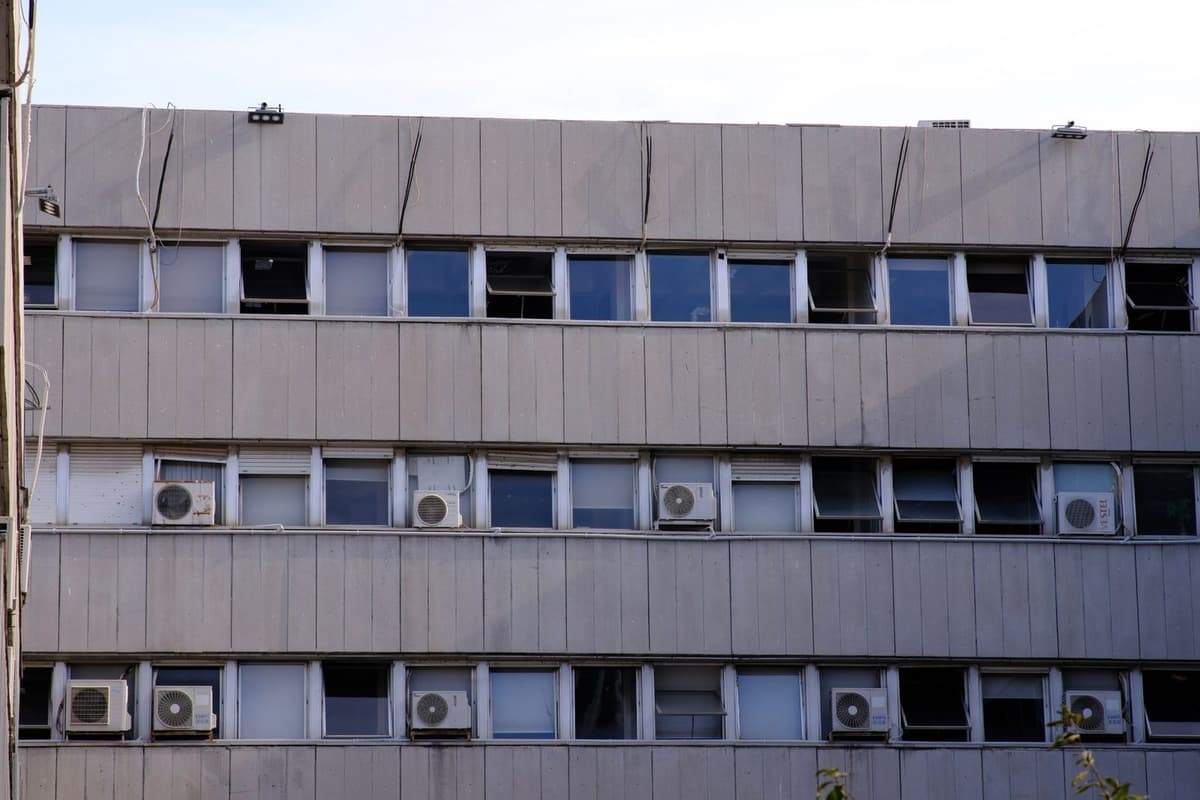
In a block of flats, an extra layer applies. Installing an outdoor unit on the façade, on a visible balcony or on the roof affects the common parts and the external appearance: it requires authorisation from the general meeting (article 25 of the law of 10 July 1965), often subject to technical conditions.
An affected co-owner therefore has two levers that can be combined:
- the neighbourhood noise regime described above;
- breach of the co-ownership regulations, if the installation was carried out without authorisation or in disregard of a quiet-enjoyment clause. The managing agent can then take action, including demanding reinstatement.
Conversely, the duly authorised co-owner is not in the clear: authorisation from the general meeting never amounts to a licence to cause nuisance. Recent regulations increasingly include a clause imposing a maximum noise level at the neighbouring balcony boundary and requiring an anti-vibration device.
What to demand from your installer before signing
A serious quotation does not merely state the equipment reference. Ask in writing for:
- the sound power level Lw of the outdoor unit (in dB(A)), not just the sound pressure at 1 m, which always looks more flattering;
- the level in night mode;
- the chosen location, with the distance to the neighbour's or neighbours' openings;
- the anti-vibration arrangement planned (mounts, rubber bushings, isolated slab);
- a reference to compliance with the order on neighbourhood noise.
Manufacturers publish these figures: across the 2026 ranges, the best single-split outdoor units come down to around 55 to 58 dB(A) of sound power in night mode, against 62 to 66 dB(A) for entry-level models. The price gap is real, but it remains lower than the cost of a dispute. And since the incentives — 5.5% VAT, energy-saving certificates (CEE) — apply to the total amount, choosing a quieter model costs less than it appears.
For anyone wanting to dig into the subject before committing to work, a practical guide to building acoustics sets out the useful orders of magnitude (adding sound levels, attenuation with distance, principles of absorption) and prevents many costly decisions taken on gut feeling.
Key takeaways
- The rule is not a number of decibels but an emergence: 5 dB(A) by day, 3 dB(A) at night, measured at the neighbour's home, not at the foot of the appliance.
- An appliance that is "silent" on paper may well be in breach depending on where it is sited.
- Everything is decided at installation: distance, orientation, vibration isolation, sizing.
- Night mode, anti-vibration mounts and an annual clean settle a large share of disputes for under €200.
- Since 2024, abnormal neighbourhood nuisance has been codified in article 1253 of the Civil Code: liability arises without fault.
- In a co-ownership, authorisation from the general meeting offers no protection against an action for noise nuisance.
Sources: Code de la santé publique, articles R. 1336-4 to R. 1336-13; order of 5 December 2006 on procedures for measuring neighbourhood noise; Code civil, article 1253 (law no. 2024-346 of 15 April 2024); law no. 65-557 of 10 July 1965 on co-ownership; Centre d'information et de documentation sur le bruit (CIDB); standard NF S 31-010 on the characterisation and measurement of environmental noise.
Need an air conditioning solution?