Outdoor unit noise: what the law says and how to settle a neighbour dispute

L'équipe Proclimo
30 Sep 2026 - 08 min read
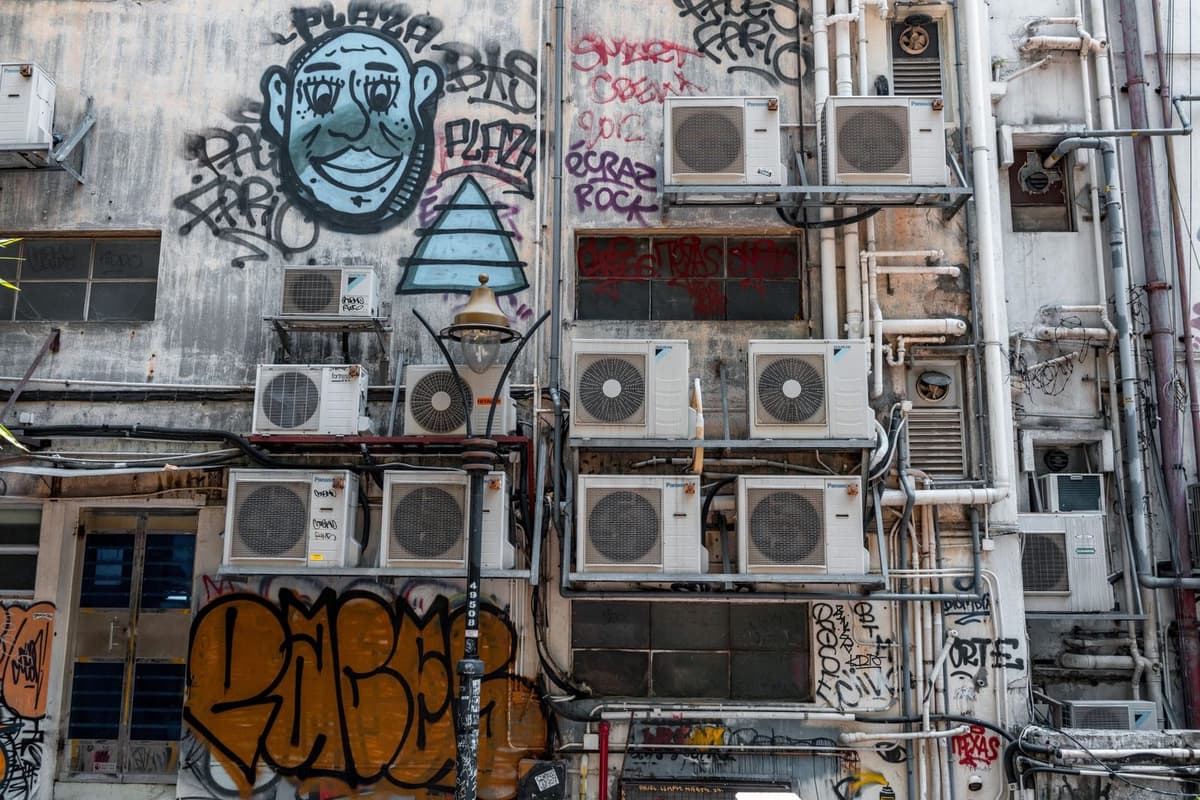
The quote mentioned 3.5 kW, SEER and R-32. Nowhere did it mention decibels. Then summer arrives, the unit runs flat out from 10 p.m. to 6 a.m., and the ground-floor neighbour, whose bedroom sits four metres from the fan, stops sleeping. She isn't going to complain about the CO₂ you've saved: she's going to invoke the public health code. And in most cases, she has solid grounds. Noise from the outdoor unit has become, alongside the boom in air conditioning and air-to-air heat pump installations, the leading source of neighbour disputes involving this equipment. Here is the actual legal framework, how measurements are taken, and what genuinely works from a technical standpoint.
Where the noise actually comes from
An outdoor unit generates three families of noise, and they need to be told apart because each calls for a different remedy.
Airflow noise: the fan pushes air through the finned coil. This is a broadband rush of air whose level climbs very quickly with rotation speed. It dominates under normal operation, and it is also the easiest to attenuate.
Mechanical compressor noise: a lower-pitched, more "penetrating" component, usually perceived as a hum or a drone. The rotary and scroll compressors in modern inverter models are far quieter than they were fifteen years ago, but they remain the main cause of night-time complaints, because low frequencies pass through walls and windows far more readily than high ones.
Structure-borne vibration: the unit transmits its vibration to its mounting — wall bracket, slab, feet — and then into the building structure. The neighbour doesn't hear the unit "through the air" but through their own wall or floor. This is the most insidious case: the noise is faint outdoors, yet perfectly audible in a closed room upstairs.
On top of that come the one-off events, often the hardest to live with: the clunk of the four-way valve on start-up, and above all the defrost cycles in heating mode, where the fan stops and then restarts abruptly, sometimes several times a night in January.
Spec sheets generally quote a sound pressure level "at 1 m" in quiet mode and at minimum fan speed. The reality of a unit running at full output at 2 a.m. during a heatwave, or defrosting at −2 °C, is routinely 8 to 12 dB(A) above that marketing figure.
The legal rule: emergence, not absolute level
This is the point almost nobody grasps, including some installers. French regulations do not set a ceiling along the lines of "your air conditioner must not exceed 45 dB(A)". They work in terms of noise emergence: the difference between the ambient noise with the appliance running and the residual noise without it.
Articles R.1336-4 to R.1336-10 of the code de la santé publique (French public health code, originating in Decree no. 2006-1099 and consolidated since) govern neighbourhood noise arising, in particular, from an activity or a piece of equipment. The thresholds applicable to noise "other than behavioural noise" are:
| Period | Permissible overall emergence |
|---|---|
| Daytime — 7 a.m. to 10 p.m. | 5 dB(A) |
| Night-time — 10 p.m. to 7 a.m. | 3 dB(A) |
To these are added correction terms linked to the cumulative duration for which the noise occurs: the briefer the noise over the course of the day, the greater the tolerance (up to +9 dB for an occurrence of less than one minute). Suffice to say that an air conditioner running for several hours at a stretch enjoys no leniency whatsoever: you stay at 5 dB(A) by day and 3 dB(A) at night.
Two crucial clarifications:
- The measurement is taken at the complainant's home, indoors with windows open then closed, or at the property boundary depending on the layout. Not next to the unit.
- In a quiet setting — a suburban housing estate at night, where residual noise drops to 28-30 dB(A) — reaching the 3 dB(A) emergence threshold is terrifyingly easy. A unit producing 34 dB(A) at the neighbour's is already in breach. That is why installations that are "not noisy at all" end up being ruled against.
Since the reform of articles R.1336-5 et seq., a marked tonal component (an emergent spectral peak, typical of a compressor) can also justify lowering the permissible threshold. The Centre d'information sur le bruit (CidB) publishes reliable explanatory factsheets on this point, and ADEME regularly notes that noise nuisance is the number one reported source of dissatisfaction after an air-to-air heat pump installation.
The civil side: abnormal neighbourhood nuisance
Quite apart from the regulatory threshold, civil case law penalises abnormal neighbourhood nuisance (trouble anormal de voisinage), now codified in article 1253 of the Civil Code by the Act of 15 April 2024. The judge does not need a breach of the public health code: they assess whether the nuisance is abnormal in light of the surroundings. In other words, even an emergence of 2.5 dB(A) accompanied by a constant whistle beneath a bedroom window can result in a ruling against the owner, with an order to relocate the unit plus damages.
Before installation: the decisions that avoid 90% of disputes
Most conflicts are settled at the design stage, not afterwards. A handful of choices are worth more than all the acoustic enclosures in the world.
Choose the location based on bedrooms, not on the refrigerant pipe run. Installers often optimise pipework length. That is technically legitimate, but it is not the only criterion. A unit placed in a re-entrant corner between two walls benefits from a reflection effect that can add 4 to 6 dB(A) — the equivalent of doubling the perceived sound power. Conversely, siting it on an open façade, facing away from the neighbours' openings, changes everything.
Respect clearances and the direction of the air discharge. The airflow must never be aimed at a window, a terrace or a reflective fence less than three metres away. Many condominium regulations and local planning rules (PLU) now impose a minimum setback from the property line: check before ordering.
Mechanically decouple the unit from the structure. This is where false economies hurt most. A wall bracket screwed straight into a hollow wall turns the partition into a diaphragm. Anti-vibration pads in rubber-cork placed between the chassis and the mounting, or anti-vibration mounts for air conditioners sized for the unit's actual weight, cost a few tens of euros and eliminate most structure-borne noise. For a ground-level installation, an isolated concrete slab and spring mounts are preferable to breeze blocks laid straight on the soil.
Slightly oversize rather than the opposite. Counter-intuitive but decisive: a unit sized right on the nose spends a heatwave night at 100% capacity, and therefore at its maximum noise level. A unit with 15% headroom, using inverter technology, runs at low speed and stays noticeably quieter. That is the argument to use against a bare-minimum quote.
Enable night mode from commissioning. Almost every manufacturer (Daikin "Silent", Mitsubishi "Night Setback", Atlantic, Toshiba) offers a function that throttles the compressor and fan during a set time window. It costs a few performance points and gains 3 to 5 dB(A). It often stays switched off simply because nobody configured the remote control.

Bothered by your neighbour's air conditioner: what to do
1. Document before you talk
An acoustic dispute is won with facts. Keep a dated log: start times, duration, type of noise (continuous rush of air, droning, defrost clunks), room affected. A simple pocket digital sound level meter, costing a few tens of euros, carries no legal weight but does let you objectively gauge the gap between background noise and noise in operation — and to know whether you are at 2 or 12 dB of emergence before committing to anything. Smartphone apps, by contrast, are too imprecise at low frequencies to be of any use.
2. The amicable letter
In most cases the neighbour is entirely unaware of the problem: they sleep on the other side of the property. A factual, non-accusatory letter setting out the times and suggesting concrete options (night mode, anti-vibration pads, discharge direction) often unblocks the situation. Send it by registered post to establish the date, but keep the tone of a request, not an ultimatum.
3. Acoustic measurement by a third party
If dialogue fails, official measurement becomes the decisive step. Two routes:
- The town hall or the ARS (regional health agency): the mayor holds policing powers over neighbourhood noise. Some municipalities have a public health department able to carry out an inspection, or even to commission a measurement specialist. An official report can lead to a fine (up to €450 for an individual) and a formal notice to carry out works.
- An independent acoustic consultant: budget €600 to €1,200 for a report compliant with standard NF S 31-010 on the characterisation of environmental noise. This document is the cornerstone of any subsequent litigation, and it is often enough on its own to persuade the other party to settle.
4. Conciliation, then the courts
Since the reform of civil procedure, an attempted conciliation before a conciliator of justice (free of charge, via the tribunal judiciaire or a France Services centre) is a mandatory first step for most neighbour disputes under €5,000. It succeeds more often than people expect, because the prospect of a court-appointed expert assessment costing several thousand euros calms both camps. Failing that, the tribunal judiciaire can order the unit to be relocated, enclosed, and damages paid for loss of amenity.
In a condominium: an extra layer
Installing an outdoor unit on a façade, a balcony or a roof affects common property and in principle requires authorisation from the general meeting. A unit installed without a vote is challengeable in its own right, irrespective of noise: the managing agent can be served with formal notice to act, and the judge can order restoration of the original state. Conversely, a general meeting resolution can perfectly well set the rules for future installations (permitted locations, maximum sound level at 2 m, mandatory anti-vibration pads). That is the most effective solution for buildings where requests for air conditioning are multiplying.
The technical fixes that genuinely work
There is a thriving market in "anti-noise" accessories for outdoor units, whose effectiveness ranges from considerable to nil. Here is what the physics says.
| Solution | Realistic gain | Risk |
|---|---|---|
| Anti-vibration pads or mounts | 0 dB airborne, but eliminates structure-borne noise (often the most troublesome) | None if correctly sized |
| Night mode / time-based throttling | 3 to 5 dB(A) | Slight loss of output |
| Solid acoustic screen, offset from the air discharge | 5 to 10 dB(A) | Air starvation if too close |
| Closed "decorative" enclosure with tight louvres | 1 to 3 dB(A) | High: air recirculation, loss of efficiency, compressor failure |
| Replacing the unit with a recent inverter model | 5 to 12 dB(A) | Cost |
The absolute watchpoint: an outdoor unit must be able to breathe. Any acoustic gain obtained by boxing it in is paid for in excess consumption, short cycling and sometimes compressor failure. An effective acoustic screen is a partial one, placed perpendicular to the line of sight between the unit and the complainant's window, without obstructing intake or discharge, and respecting the manufacturer's clearances (typically 30 cm at the rear, 1 m in front of the fan). A wooden air conditioner cover with spaced slats, mounted on a structure independent of the unit, fulfils that aesthetic and acoustic role properly; the same cover screwed to the chassis becomes a vibration amplifier.
Two frequently overlooked extras: a rubber anti-vibration mat under the feet of a unit sitting on a slab, and checking that the casing panels are properly tightened. A resonating metal panel produces a very recognisable noise — and is fixed with a screwdriver.
Finally, if the noise is perceived inside your own home rather than outdoors, the question becomes one of insulating the window concerned: a window sealing strip properly fitted to a tired frame gains several decibels in the mid frequencies for a negligible outlay. This in no way relieves the neighbour of their obligations, but it will improve your nights while the process runs.
Key takeaways
- The regulations work in terms of emergence: 5 dB(A) by day, 3 dB(A) at night, measured at the affected party's home. In a quiet setting, a "silent" unit can still be in breach.
- Article 1253 of the Civil Code on abnormal neighbourhood nuisance offers a parallel route, with no need to exceed a threshold.
- Mechanical decoupling (pads, mounts) and choice of location solve most problems for a few tens of euros, provided you think about them before installation.
- Never enclose an outdoor unit in a sealed box: you are trading 2 dB for a failed compressor.
- The winning sequence in a dispute: written log → amicable letter → standardised NF S 31-010 measurement → conciliator → court. Every step skipped weakens the next.
Noise is not a comfort detail, it is a design parameter. An installer who refuses to discuss it at quotation stage is exposing you to a very real legal risk. Ask the question before you sign: where is the unit going, what level at 3 m from the property line, what anti-vibration arrangement, and will night mode be configured at commissioning?
Need an air conditioning solution?