AC: Managing 10 to 50 Rented Homes

L'équipe Proclimo
30 Oct 2026 - 08 min read
"We manage 34 units in the Paris region for three family-owned property companies: 12 in Montrouge, 9 in Vincennes, the rest scattered between Massy, Rueil and Saint-Maur. Twenty-two flats have reversible air conditioning, installed between 2009 and 2024 by six different contractors. I have no drawings, no list of models, and I only find out what the units are when a tenant calls. This summer I got eleven calls in three weeks and paid for three call-outs that turned out to be clogged filters."
That is the kind of call we get from lettings managers, property-company directors and private landlords who have crossed a tipping point without noticing. Once you have around ten units, air conditioning stops being a piece of equipment and becomes a technical estate. And a technical estate cannot be managed by waiting for the tenant to call: it is managed through an inventory, a calendar and a contract.
This article is not another reminder of how responsibilities are split between tenant and landlord — that one already exists on this blog. It is an operating manual for managers: how to take back control of a mixed fleet of reversible air conditioners, what it really costs in 2026, and how to phase replacements over several financial years instead of scrambling in July.

The real problem with a portfolio: diversity, not numbers
A landlord with twenty homes fitted with twenty identical units from the same installer has almost no issue at all: one contract, one parts list, one technician who knows the hardware.
What we actually find in a portfolio built up through successive acquisitions:
- wall-mounted splits of 2.5 to 3.5 kW installed across five different periods;
- three to six brands, often including one or two that have vanished from the French market;
- a mix of R410A (units from before 2018–2020) and R32;
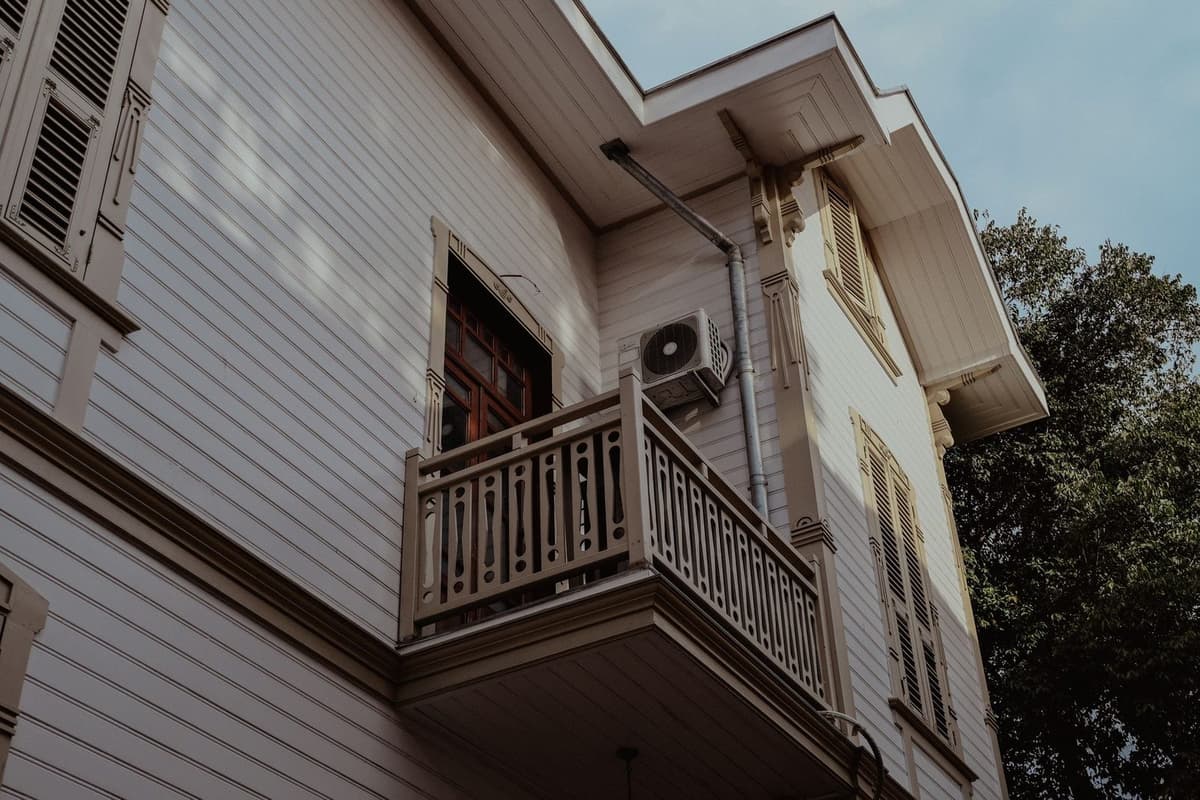
- outdoor units on balconies, in courtyards, on technical terraces, sometimes in landing ducts — with building-association approvals nowhere to be found;
- no documentation whatsoever: no manual, no installation invoice, no commissioning certificate.
Every line on that list turns into euros the day something breaks. Not because the repair itself costs more, but because the diagnosis becomes an investigation. A refrigeration engineer who arrives with no model reference, no idea where the pipework runs and no service history will bill an average of 30 to 45 minutes before even opening a cover.
The three hidden costs of having no inventory
| Hidden cost | Cause | 2026 ballpark figure |
|---|---|---|
| Avoidable call-outs | Filters, remote control, circuit breaker, wrong mode selected | €90 to €150 excl. VAT per visit |
| Diagnostic surcharge | Unknown unit, no history, unidentified part | +€50 to €120 excl. VAT per job |
| Rental void or goodwill gesture | Uncomfortable home during a heatwave, rent negotiation | from €0 to several hundred euros |
Across the 22-unit portfolio described above, these three items added up to more than €2,000 in a single summer. An annual maintenance contract covering the same portfolio costs less.
Step 1: do the inventory once and for all
This is the one step you cannot half-delegate. It is done as a single campaign, ideally between October and March, outside the peak call period.
For each home, we record:
- Exact brand and model reference of the indoor unit AND the outdoor unit (from the rating plate, not the remote control);
- Refrigerant type and charge in kg, as shown on the plate — this is the piece of information that determines the unit's entire future;
- Year of manufacture (often readable in the serial number);
- Nominal cooling and heating output;
- Configuration: single-split, dual-split, number of rooms served;
- Location of the outdoor unit and how it is mounted;
- Condensate drainage method: gravity or condensate pump;
- Condition of the filters and heat exchanger on opening;
- Photos: rating plates, outdoor unit, visible pipework routing.
A pocket laser measure and a simple digital thermometer and hygrometer are enough to complete the survey with room dimensions and a supply-air reading — data that will prove useful the day resizing becomes necessary. Our technicians also note the temperature difference between return and supply air: below 8 °C in cooling mode, the unit is already struggling.
The result fits in a single spreadsheet, one row per home. That document is your asset: it will follow you from one contractor to the next, and it is worth several thousand euros in savings over ten years.
Field tip: schedule the inventory campaign to coincide with check-in/check-out inspections or annual compliance visits. That way you only pay for one mobilisation.
Step 2: a framework contract, not line-by-line billing
A landlord who calls a different repair firm for every incident pays three times over: the one-off rate, the time spent getting familiar with the equipment, and the lack of priority during peak season.
What a multi-site contract changes
In the Paris region, an annual maintenance contract for a residential split costs around €130 to €190 excl. VAT per unit in 2026, with volume discounts above 10 units. We see reductions of 10 to 25 % on a portfolio clustered geographically, far less when the properties are spread across four départements — travel time is the real cost driver.
The contract must spell out the following, and this is where quotes differ:
- the precise scope of the visit: cleaning of filters and the indoor heat exchanger, check of condensate drainage, pressure and temperature readings, cleaning of the outdoor condenser, electrical checks, test in both cooling and heating mode;
- leak-tightness testing where it applies: this is mandatory for equipment containing at least 5 tonnes of CO₂ equivalent of refrigerant (Articles R. 543-75 et seq. of the French Environment Code, implementing the European F-Gas Regulation). A domestic split with 1 kg of R32 does not reach the threshold; a multi-split or a small ducted system may, particularly with R410A. Have this checked unit by unit rather than assumed across the board;
- the contractual response time in the event of a breakdown, and the hours covered;
- the rates for parts and labour outside the contract, with a ceiling above which your written approval is required;
- reporting: who sends you the service report, in what format, and within what timeframe.
The awkward question: who pays for what
Nothing beats clear wording in the tenancy agreement. In practice, we advise the landlords among our clients to keep the maintenance contract at their own expense and to require annual access, rather than recharging it to the tenant through service charges. The reasons are economic, not legal: you retain control over quality, over traceability and therefore over the asset's service life. The respective obligations are set out in detail in our article on air conditioning in a rented home and in the one covering servicing in an apartment building: who decides and who pays.
Step 3: cut down pointless tenant calls
Of the eleven calls received by the manager quoted in the introduction, seven were not breakdowns at all. That matches our usual statistic: half to two thirds of summer call-outs on a rental portfolio can be resolved without a refrigeration engineer.
Three simple tools bring that volume down dramatically.
1. A one-page sheet per home, handed over at move-in and posted inside the services cupboard: the unit's reference, where the dedicated circuit breaker is, how to clean the filters, what to check before calling (mode, set temperature, remote-control batteries, condensate tray and drain hose), and the single number to ring.
2. A maintenance kit left on site. A set of compatible spare filters, a can of air conditioning disinfectant cleaner and a small handheld vacuum are enough to cover the two annual filter cleans a tenant can safely carry out themselves. The exact procedure is detailed in our guide to cleaning your air conditioner yourself.
3. Universal replacement remote controls, kept at the manager's office. A lost or water-damaged remote still triggers full-price call-outs every single summer.
On portfolios where these three measures are in place, we see summer calls drop by 40 to 60 % from the very first season.
Step 4: plan replacements instead of reacting to them
This is the heart of the matter for a portfolio owner, and it is what separates asset management from crisis management.
The R410A wall
Units installed before 2018–2020 overwhelmingly run on R410A. This refrigerant is not banned from use, but the 2024 European F-Gas Regulation (EU Regulation 2024/573) continues to cut the quotas of HFCs placed on the market. The consequence is already visible in 2026: the price of recycled and reclaimed R410A is climbing, and availability varies from week to week. Recharging a 2012 unit after a leak can now cost a significant fraction of the price of a new machine. We go into these trade-offs in detail in our article on a major breakdown on an air conditioner over 10 years old.
Across a portfolio, this translates into one simple management rule:
| Unit age and refrigerant | Recommended policy |
|---|---|
| Under 8 years, R32 | Annual servicing, repair without hesitation |
| 8 to 12 years, R32 | Repair if the part is available and costs < 40 % of new |
| R410A, no known leak | Enhanced servicing, add to the 2–3 year replacement plan |
| R410A + second leak or compressor failure | Replace immediately, no recharge |
| Brand no longer on the French market | Replace at the first electronic fault |
Spreading the spend over three to five financial years
Replacing a single-split system in a Paris-region flat costs between €1,800 and €3,200 incl. VAT in 2026, installation included, depending on capacity, pipe run length and how hard the outdoor unit is to reach. Installation and renovation work in homes more than two years old qualifies for a reduced VAT rate on air-to-air heat pumps following the decrees issued in summer 2026 — something to have confirmed on the quote, since the applicable rate depends on the exact nature of the work.
With a dated inventory in hand, you can build a schedule: five units a year across a portfolio of twenty, starting with the R410A machines in the most exposed homes (top floor, south-west facing, large glazed areas). That lets you negotiate as a batch, choose your own works window — February and November are the best months for both pricing and lead times — and standardise on a single brand.
Standardisation is the most underrated gain of all. A single-brand portfolio means a shared parts stock, one trained technician, interchangeable remote controls and a single after-sales channel. The selection criteria are covered in our article on choosing the brand and the installer.
Step 5: traceability, your insurance in a dispute
Three situations make a service logbook indispensable, and all three turn up sooner or later on a portfolio.
- Water damage from condensate: with no proof of servicing, the landlord's position with the insurer and the neighbours is weak.
- A challenge to service charges or a tenancy dispute over summer comfort.
- Selling the property: a complete technical file supports the value and provides reassurance on the energy performance certificate, a subject covered in our article on the impact of air conditioning on property value.
In practical terms, we advise keeping the following for each home: installation quote and invoice, the certificate of competence of the company that handled the refrigerant, a job sheet for every visit, and where applicable the general-meeting approval for the outdoor unit. A ring binder with clear pockets per property, or a simple portable document scanner, will do the job — what matters is that the file survives a change of managing agent.
On the regulatory side, remember that handling refrigerants is restricted to companies holding a certificate of competence (French Environment Code, Articles R. 543-75 et seq.), and that the holder of the equipment — that is, the owner, so you — is responsible for compliance with those obligations. Not the tenant.
What we actually do on a Paris-region portfolio
Our standard protocol for a manager or a multi-property landlord:
- Scoping visit to two or three representative homes, to calibrate the time and price of the campaign;
- Grouped inventory campaign, delivering the portfolio spreadsheet and the photos;
- Framework contract proposal with a visit schedule organised by geographical area, to limit travel;
- Costed replacement plan over three to five years, ranked by criticality;
- Single breakdown hotline and a guaranteed response time for properties under contract.
If you manage a Paris-region portfolio and only discover your equipment when the calls come in, winter is the right season to take back control: schedules are open, prices are calmer, and you go into June with a list instead of a surprise. You can tell us about your portfolio via the booking form or go through our air conditioning servicing page to locate your properties by département.
Need an air conditioning solution?