Heatwave 2026: 30,000 air conditioners for hospitals — and your commercial buildings?

The Proclimo Team
20 Jul 2026 - 09 min read
The June 2026 heatwave was of exceptional severity, exceeding that of August 2003 in intensity. Red alert across 72 departments (77% of the French population), 43.8 °C in Saintes on 24 June, and for the first time in France, a 24-hour national average above 30 °C. Faced with a health emergency — 6,351 hospitalisations between 18 and 29 June, two-thirds of them involving people aged 75 and over — the government announced a massive adaptation plan: 30,000 air conditioners delivered to hospitals by end of July 2026 and €600 million for the energy retrofit of the hospital estate.
But beyond hospitals, it is the entire French commercial building stock that is concerned. Offices, shops, hotels, care homes (EHPAD), schools: 90% of the buildings that will exist in 2050 are already built, and a majority are not prepared for repeated heatwaves. Here is our breakdown of the 2026 heatwave plan, and what it changes concretely for your professional premises.
The "30,000 air conditioners" plan for hospitals: where do things stand?
The announcement and timeline
On 26 June 2026, Prime Minister Sébastien Lecornu approved, on the proposal of Health Minister Stéphanie Rist, an order for 30,000 air conditioners for hospitals across France. An emergency envelope of €100 million was released to fund the most critical needs.
As of 15 July 2026, government spokesperson Maud Bregeon confirmed on BFMTV the progress of deliveries:
| Date | Air conditioners delivered |
|---|---|
| 10 July 2026 | 6,000 |
| Mid-July 2026 | 16,500 |
| End of July 2026 | 30,000 (target) |
70% of the units are delivered to departments on red alert. The plan is accompanied by a hospital investment plan of €6 billion over 2026-2035, of which the energy retrofit envelope is doubled to €600 million, and by a €100 million fund for quality in EHPAD care homes.
Why are hospitals so vulnerable?
The French hospital estate is 60% outdated and was designed "for the climate of the 1980s", according to the Fédération hospitalière de France (FHF). A large majority of facilities are not air-conditioned outside of operating theatres, intensive care units and radiology rooms. Emergency departments, paediatrics and SAMU are particularly exposed.
During the June 2026 heatwave, peaks were historic:
- 2,089 emergency visits on 26 June for the iCanicule indicator (hyperthermia, dehydration, hyponatraemia) — a record since 2004,
- +13% in visits for children under 2 and +47% for those over 75 in Île-de-France,
- White plan triggered at regional level in Île-de-France,
- Healthcare staff dipping into their own pockets to buy mobile air conditioners from supermarkets, according to a BFMTV report on 25 June.
The IGAS estimates the cost of a full retrofit of the hospital estate at between €27 and €67 billion by 2050. The FHF is calling for €7 to €9 billion per year and a €5 billion green fund over 5 years.
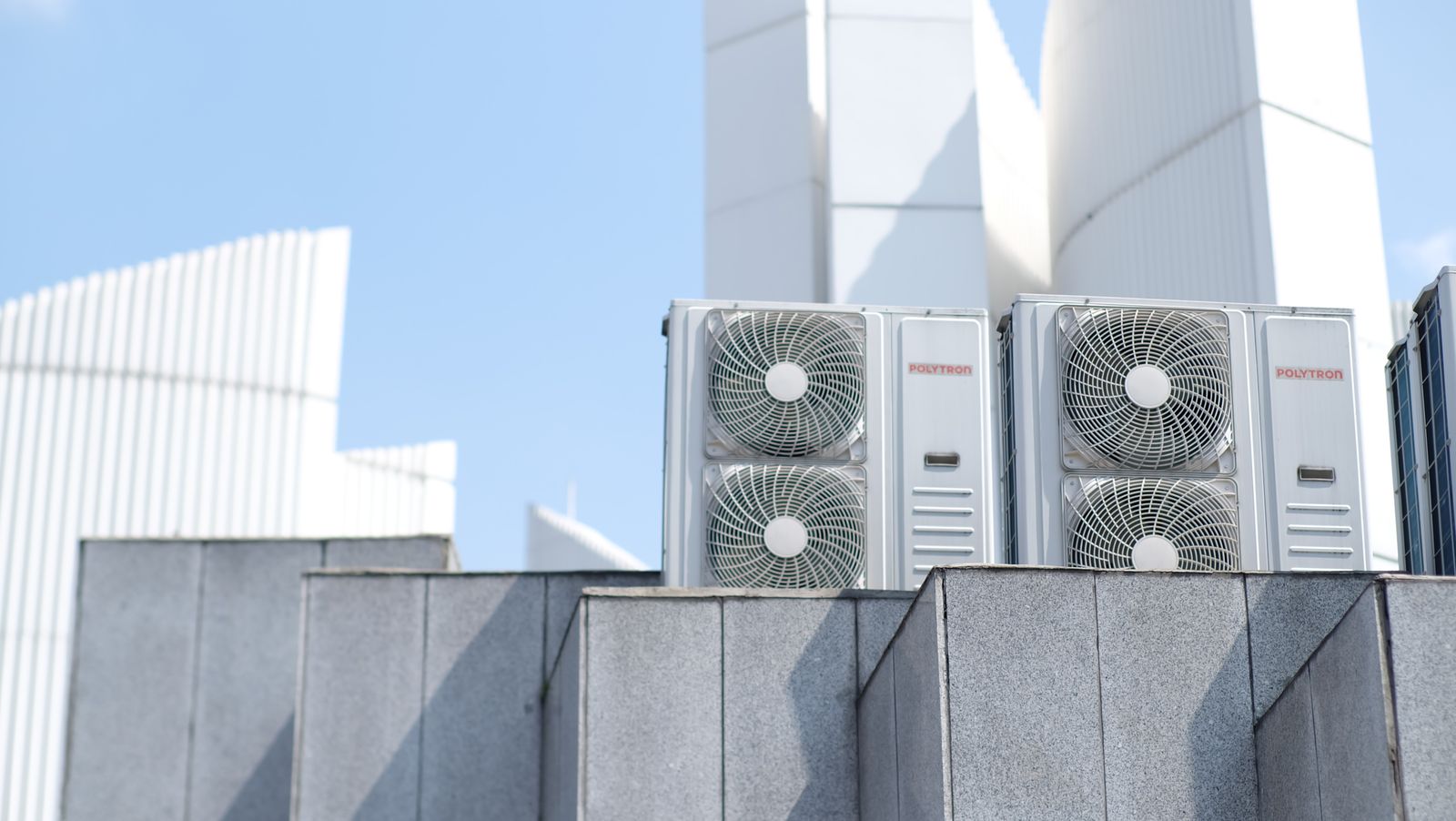
And your commercial buildings? The mirror of the hospital plan
The hospital plan is a revelation: if the health system, supposed to be strategic, is this overwhelmed, what about your offices, shops, hotels or co-managed residential buildings? The figures are unequivocal:
- 53% of employees consider their company poorly prepared for heatwaves (April 2026 survey),
- Productivity drops by 20% when indoor temperature exceeds 35 °C,
- Health risk thresholds set by the INRS: 30 °C for sedentary activity, 28 °C for physical work,
- 90% of the buildings that will exist in 2050 are already built.
The regulatory framework that changes everything
Three texts now structure the obligation to adapt commercial buildings:
-
Decree n° 2025-482 of 27 May 2025 (known as the "heat decree"): heat is registered as an enforceable occupational risk. From Météo-France yellow alert onwards, employers must adapt work organisation, ventilate or air-condition enclosed spaces, provide 3 litres of water per day per employee on construction sites, and integrate heat risk into the DUERP (Single Risk Assessment Document). See our full article on the 2025 heat decree and employer obligations.
-
The 2026 tertiary decree: it strengthens HVAC obligations (heating, ventilation, air conditioning) for buildings over 1,000 m², with enforceable energy performance thresholds. Our article 2026 Tertiary Decree and Building Air Conditioning details the deadlines.
-
RE2020 extended to the tertiary sector since 1 May 2026: buildings for hotel, commercial and restaurant use are now subject to the summer comfort indicator in degree-hours (DH):
- Below 350 DH: comfortable building,
- Above 1,250 DH: non-compliant building,
- In between: "fictitious air conditioning" penalty that degrades the energy balance.
warning
Warning: RE2020 no longer merely measures winter consumption. Summer comfort has become an enforceable criterion. A new or renovated commercial building that exceeds 1,250 DH without installing air conditioning is non-compliant — reversible air conditioning becomes an obligation, not a comfort.
The Adapt Bâti Confort programme
Launched in August 2025 and endowed with €9 million (funded by Energy Savings Certificates), this programme supports 50 pilot renovation operations of existing buildings, led by ADEME, Cerema and CSTB. It trains 3,000 building professionals and 300 specifiers in summer comfort renovation solutions.
The France Stratégie proposals (July 2026)
The report of the Haut-Commissariat à la Stratégie et au Plan, published on 10 July 2026, proposes:
- Mandatory negotiations by professional sectors by spring 2027 to organise work during high heat (business continuity, wage arrangements in case of cessation, schedule adaptation, capacity of workplaces to become "cool refuges"),
- A Public Services Conference to adapt organisation (creation of a national "heatwave hours" regime: e.g. 7am-12pm then 5pm-10pm during red alert).
Solutions to adapt your commercial building
The hierarchy of solutions is clear: passive first, then soft, and active as a last resort. Here is the Proclimo checklist:
1. Passive solutions (no energy consumption)
- External solar protection: adjustable sun louvers, facade canopies, awnings. This is the most cost-effective measure: -5 to -8 °C perceived for a moderate investment.
- Thermal mass: dense materials (concrete, stone, rammed earth) and bio-based insulation (wood fibre) with a 10-12 hour time lag that shifts the heat peak towards the night.
- Orientation and sizing of openings: large south-facing windows with protection, limited glazing to the west and east (most exposed to late afternoon sun).
- Cool roof: reflective paint returning up to 95% of solar radiation, reducing surface temperature by 20 to 40 °C.
2. Soft solutions
- Night-time ventilation (free cooling): can maintain indoor temperatures 5 to 8 °C lower than outside, by opening windows at night and closing them during the day.
- Ceiling air circulators: improve the feeling of coolness by 3 to 4 °C perceived.
- Roof greening: 20 to 40 °C reduction in roof surface temperature.
- Indirect adiabatic cooling: evaporates water to cool the air without increasing indoor humidity.
3. Active solutions: reversible air conditioning
When passive and soft solutions are no longer enough — which is the case for most existing buildings in dense urban areas — reversible air conditioning (air-to-air heat pump) becomes the answer. Three good reasons to choose it:
-
5.5% VAT since 18 July 2026: the order of 13 July 2026 (Official Journal of 17 July) finally formalised the VAT reduction on reversible air-to-air heat pumps, previously taxed at 20%. On a €5,000 ex-VAT installation, that is approximately €600 in savings. See our article on the 5.5% VAT on reversible air conditioning.
-
Stacking with subsidies: the 5.5% VAT can be combined with the CEE Coup de Pouce grant (up to €1,500 for ADEME-approved heat pumps), the eco-PTZ, and MaPrimeRénov' within a supported pathway. Our article on approved heat pumps and the Coup de Pouce grant details the conditions.
-
Heat and cool with a single unit: the reversible air-to-air heat pump produces heat in winter and coolness in summer, with a coefficient of performance (SCOP) of 3 to 5 — 1 kWh of electricity delivers 3 to 5 kWh of heating or cooling. See our guide on the reversible air-to-air heat pump.
To choose an eligible unit, check the minimum A++ energy class in heating (SCOP) AND in cooling (SEER) for mono-split ≤ 12 kW, A+ minimum for multi-split. Our article on the new energy label for reversible air conditioners explains how to read the A to G classes.
Employer obligations: what is enforceable right now
The 2025 heat decree creates enforceable obligations from Météo-France yellow alert onwards. Here is the summary for managers of commercial premises:
- Adapt work organisation: shift to cooler hours, suspend strenuous tasks, allow remote work.
- Modify premises layout: ventilate or air-condition enclosed spaces where possible, provide cooled rooms.
- Fresh drinking water: at least 3 litres per day per person on sites without running water.
- Personal protective equipment: caps, cooling gels, breathable clothing.
- Information and training of employees on the warning signs of heatstroke.
- Integration into the DUERP: heat risk must be included in the Single Risk Assessment Document (DUERP), updated annually.
- Heat referent: The Conversation study of 64 company agreements shows that the heat referent plays a central role — weather monitoring, activation of measures, identification of vulnerable employees.
For the construction sector, a June 2024 decree integrated high heat into the bad weather regime: companies can suspend sites from orange alert onwards and have their employees compensated under the bad-weather stoppage scheme.
How much does it cost to adapt a commercial building?
| Solution | Indicative cost (ex-VAT/m²) | Thermal benefit | Payback period |
|---|---|---|---|
| External solar protection | €80-150 | -5 to -8 °C | 3-5 years |
| Wood fibre insulation (12 h time lag) | €60-120 | -3 to -5 °C | 5-8 years |
| Cool roof (reflective paint) | €15-30 | -20 to -40 °C surface | 2-3 years |
| Ceiling air circulators | €30-60 | -3 to -4 °C perceived | 1-2 years |
| Reversible air conditioning (air-to-air HP) | €150-300 | -8 to -12 °C | 4-7 years* |
| Roof greening | €50-100 | -5 to -10 °C roof | 5-10 years |
* With 5.5% VAT and CEE grants, the payback period of reversible air conditioning drops significantly.
info
Stacking subsidies for the tertiary sector: the 5.5% VAT (since 18 July 2026), the CEE Coup de Pouce grant for ADEME-approved heat pumps, the eco-PTZ, and for commercial co-ownerships the Adapt Bâti Confort programme (€9M of CEE). The hotel, commercial and restaurant sectors have been subject to RE2020 since 1 May 2026 — investment is no longer optional.
The 2026 calendar to remember
| Date | Deadline |
|---|---|
| 16-29 June 2026 | Exceptional heatwave: 72 departments on red alert, 6,351 hospitalisations |
| 26 June 2026 | Lecornu approves the order for 30,000 air conditioners for hospitals |
| 10 July 2026 | France Stratégie report "Improving life in the face of heatwaves" |
| 13 July 2026 | Order for 5.5% VAT on reversible air-to-air heat pumps |
| 17 July 2026 | Publication in the Official Journal — entry into force on 18 July 2026 |
| End of July 2026 | Target: 30,000 air conditioners delivered to hospitals |
| 1 September 2026 | Entry into force of the MaPrimeRénov' reform (single-measure grants excluded) |
| Spring 2027 | Mandatory negotiations by professional sectors on working during heatwaves |
Frequently asked questions
Why is the government delivering mobile air conditioners to hospitals? Because the majority of the hospital estate is not air-conditioned and the June 2026 heatwave caused 6,351 hospitalisations in 12 days. Mobile air conditioners are an emergency response; the €600M energy retrofit is the structural response.
Is an employer obliged to air-condition their offices? Not explicitly, but decree n° 2025-482 of 27 May 2025 requires "ventilating or air-conditioning enclosed spaces where possible" from yellow alert onwards. During orange and red alerts, the absence of air conditioning in a building that is difficult to ventilate becomes a failure of the DUERP, sanctioned by the labour inspectorate.
Does the 5.5% VAT apply to commercial premises? Yes, provided the reversible air-to-air heat pump is installed in a residential dwelling completed more than 2 years ago (main or secondary residence). For offices and shops, VAT remains at 20% unless the premises include a residential part (for example a hotel with bedrooms).
How can the adaptation of a commercial building be financed? Several levers: CEE Coup de Pouce grant for approved heat pumps, eco-PTZ, Adapt Bâti Confort programme (€9M of CEE for pilot operations), and for commercial co-ownerships, a simple majority vote for the installation of air conditioning since the 2026 finance law. A Proclimo advisory audit helps map out the subsidies available for your project.
What is the difference between summer comfort and air conditioning? Summer comfort refers to a building's ability to maintain an acceptable temperature without air conditioning (passive and soft solutions). Air conditioning is an active solution, necessary when summer comfort is no longer sufficient — which is the case for most existing commercial buildings in dense urban areas.
Does Proclimo work in commercial buildings? Yes. Proclimo supports companies, co-ownerships and property managers in Île-de-France across the entire chain: summer comfort audit, reversible air conditioning installation, tertiary maintenance, business maintenance, co-ownership maintenance and emergency breakdown service.
Act with Proclimo before the next heatwave
Heatwaves are following one another and intensifying. The June 2026 heatwave showed that even hospitals — the heart of the health system — were not prepared. For your commercial premises, waiting is no longer an option: regulation (heat decree, RE2020, tertiary decree) and health (productivity, employee health, employer liability) are converging towards an obligation to adapt.
Proclimo is an RGE QualiPAC + QualiClim installer in Île-de-France, and supports individuals, businesses and co-ownerships in all their reversible air conditioning and heatwave adaptation projects:
- Audit and advisory: summer comfort audit, subsidy eligibility check, technical pre-scoping, financing plan.
- Reversible air conditioning installation: quote within 48 h, installation by RGE-certified refrigeration engineers, ten-year guarantee, complete subsidy application (5.5% VAT, CEE, eco-PTZ).
- Tertiary maintenance: annual RGE-compatible contract, refrigerant leak-tightness check, OPERAT and DPE monitoring.
- Emergency breakdown service 7 days a week: intervention within 24 to 96 h in Île-de-France, with an RGE refrigeration engineer every time.
Contact Proclimo for a free summer comfort audit — or book your intervention online so you don't suffer the next heatwave. Our team operates across Île-de-France, in compliance with the 2025 heat decree and the 2026 tertiary regulation.
Sources: Le Parisien — Heatwave: 16,500 of the 30,000 air conditioners delivered by the end of the week · BFMTV — Lecornu approves the order of 30,000 air conditioners · Capital.fr — €600M for the energy retrofit of hospitals · Santé publique France — Heatwave bulletin of 3 July 2026 · France Stratégie — "Improving life in the face of heatwaves", 10 July 2026 · Les Échos — Public hospitals demand more resources · The Conversation — Heatwaves and occupational health · Aire+ — Summer comfort of commercial buildings.
Need an air conditioning solution?