Air Conditioning, Heat Pumps and Home Insurance: Who Pays When Your System Causes Damage?

L'équipe Proclimo
6 Sep 2026 - 08 min read
Nobody thinks about their home insurance policy on the day the installer packs up his ladder and drives away. You think about comfort, about the SCOP rating, about the size of the bill. Then one September morning a brown ring appears on the ceiling of the flat below, an outdoor unit slips two centimetres down on its rusting brackets, or a circuit breaker trips in the middle of the night. And the question suddenly becomes very concrete: who pays? With a French installed base now exceeding ten million units and a 5.5% VAT rate that accelerated installations in 2026, insurers are watching a new family of claims emerge — those of thermal comfort. Here is how the cover really works, where the exclusions hide, and what to do in the five days following any damage.
Is your air conditioning even insured?
The first surprise for many homeowners: a standard multi-risk home insurance policy does not cover "air conditioning" by name. It covers the building, the contents and fixtures and fittings, and your equipment lands in one of those three boxes — with very different consequences.
- A built-in multi-split air-to-air heat pump, with refrigerant lines running inside the partition walls and an outdoor unit fixed to the structure, is generally treated as a fixed element of the building. It therefore falls under "building" cover.
- A portable monobloc air conditioner, or a split unit simply set in place, remains movable property, compensated under contents cover, with a frequently low ceiling and depreciation applied without mercy.
- A heat-recovery ventilation system installed in the loft follows the same logic as the heat pump: a fixed, inseparable part of the building.
The practical consequence is clear: if your installation cost €6,000 to €12,000, it must be reflected in the rebuild value you declare to your insurer. Many policies taken out before 2020 describe a home that had no heat pump, no solar panels and no EV charging point. In the event of a total fire loss, under-insurance triggers the proportional rule of capital sums set out in Article L. 121-5 of the French Insurance Code: the payout is reduced in proportion to what was not declared. A simple endorsement, free with most insurers, avoids this trap.
Back-to-school habit: dig out your policy schedule and check that "fixed heating and air conditioning equipment" is listed among the insured property. An installation invoice scanned into your customer portal is worth more than a long argument a year later.
Water damage: the number one air conditioning claim
Why an air conditioner leaks
An indoor unit in cooling mode produces condensation — up to one or two litres an hour in humid conditions. That water is drained through a condensate tray and a pipe that must fall in a continuous slope, or be lifted by a pump. The causes of overflow are always the same:
| Cause | Frequency | Likely responsibility |
|---|---|---|
| Clogged condensate tray (dust, biofilm) | Very common | Occupant: poor maintenance |
| Blocked or crushed drain pipe | Common | Shared, depending on the age of the installation |
| Failed condensate pump | Common | Normal wear → maintenance contract |
| Reverse fall on the condensate line | Less common | Installer: defective workmanship |
| Refrigerant line rupture | Rare | Installer or equipment |
The distinction matters enormously. Poor maintenance is a classic exclusion in home insurance policies, and loss adjusters are quick to invoke it. If the adjuster opens the unit and finds a heat exchanger caked with five years of dust, water damage cover may be reduced or even refused outright.
What water damage cover does — and does not — include
The cover compensates the consequences of the leak: ceiling, paintwork, flooring, furniture, temporary rehousing if needed. It does not compensate the faulty appliance itself, unless you have an "electrical damage" or "machinery breakdown" option. In other words, your neighbour gets repainted; your air conditioner stays your problem.
Since the IRSI convention (Indemnisation et Recours des Sinistres Immeuble) came into force, replacing the earlier CIDRE convention, water damage and fire claims below €5,000 excluding VAT in apartment buildings are handled by a single "managing" insurer, designated according to where the damage occurred. That is good news: no more waiting for three companies to agree before an adjuster is sent out. But it changes nothing about the underlying law: above €5,000, recourse actions resume their normal course.
The steps that limit the damage
A connected water leak detector placed under the indoor unit or near the condensate pump costs a few tens of euros and alerts your smartphone before the ceiling below starts staining. Some insurers even grant a premium discount on proof of such a device. In the same spirit, an annual cleaning of the tray with a soft brush and an air conditioner cleaning kit — collector bag, disinfectant spray for the heat exchanger — leaves a useful maintenance trail should an adjuster call, especially if you keep dated photographs.
Falling units, spray and noise: when public liability comes into play
Custody of the object
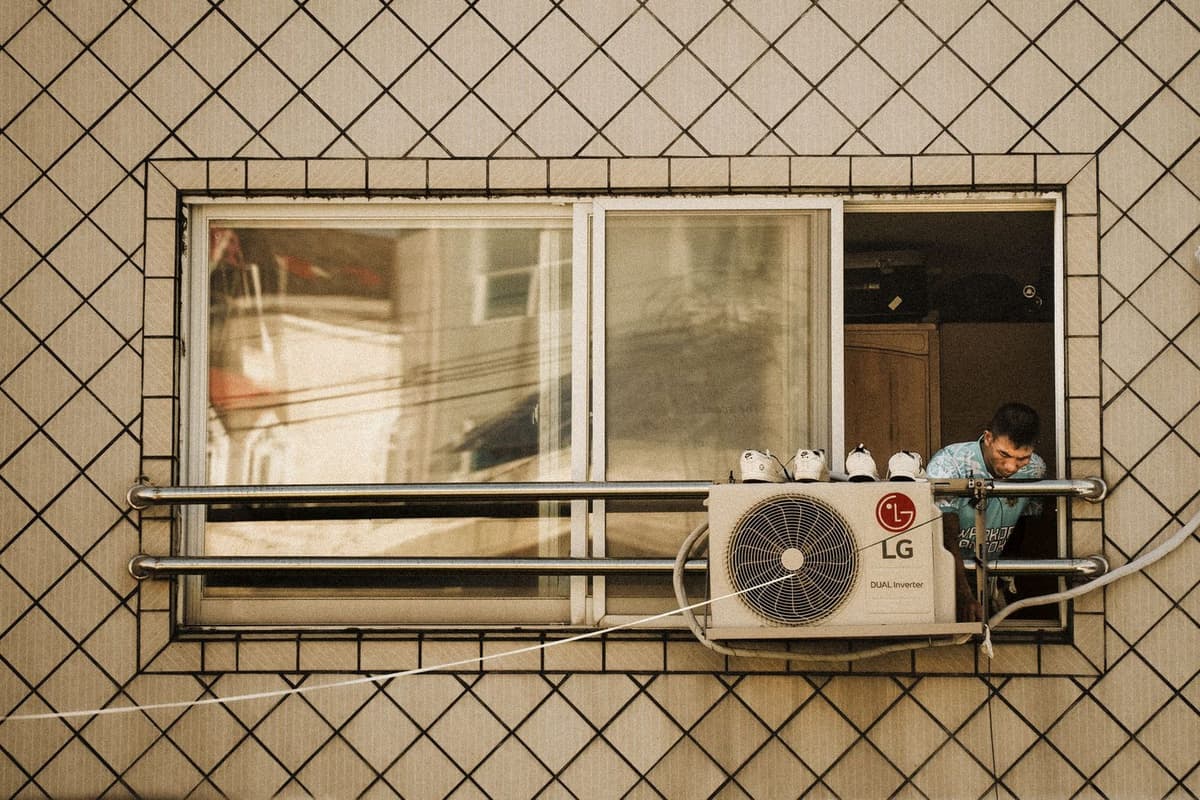
An outdoor unit weighs between 30 and 70 kg. Fixed to a façade, a balcony or a flat roof, it becomes, in legal terms, an object in your custody. Article 1242 of the French Civil Code (formerly Article 1384) establishes strict liability: if the unit falls and injures someone or destroys a vehicle, you are liable without any need to prove fault. It is your public liability cover, included in every home insurance policy, that will step in — and may then pursue a recourse action against the installer.
Loss adjusters know the warning signs well:
- corroded galvanised brackets in coastal areas or polluted urban air;
- unsuitable fixings in a cavity wall or hollow brick;
- missing anti-vibration mounts, which accelerates fatigue in the fixings;
- snow or ice overload on a bracket in a mountain area.
An annual visual inspection of the fixings, carried out with a simple magnetic spirit level placed on the chassis, will reveal an incipient tilt before it becomes dangerous. If the unit is no longer level, the load is no longer evenly spread and ageing accelerates.
Run-off, frost and condensate on your neighbour's property
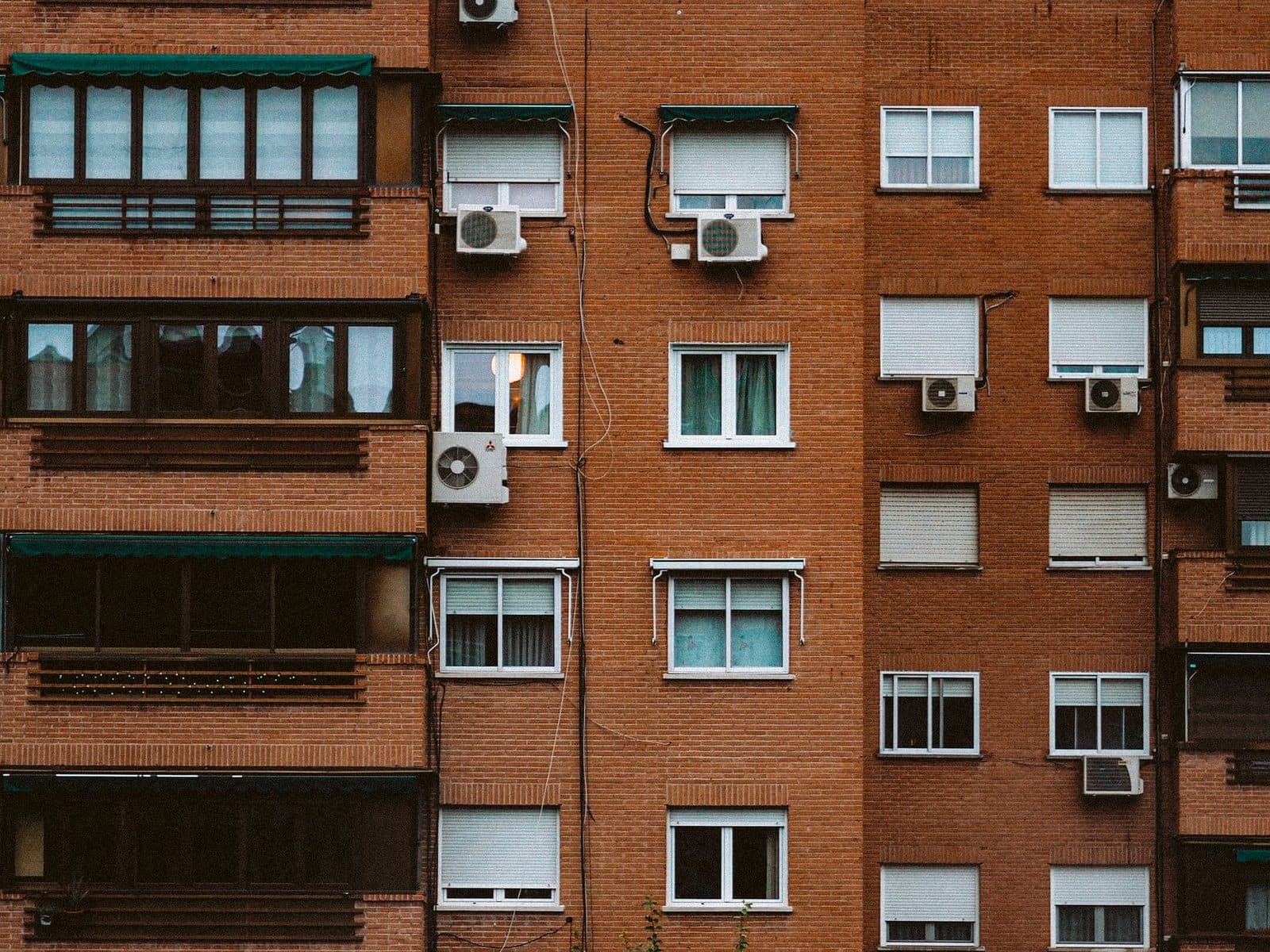
The most frequent dispute is not the falling unit but water discharge. An outdoor unit in heating mode defrosts regularly and releases water; in cooling mode, a poorly connected indoor unit may drain straight into thin air. Water running onto the balcony below, staining a façade or freezing on a staircase constitutes an abnormal neighbourhood nuisance, regardless of any fault. Courts regularly order the installation of a collection tray and a drain connected to the rainwater system, at the expense of whoever created the problem.
Noise: an exclusion that is often overlooked
Be careful: rulings against noise nuisance from an outdoor unit generally fall under neighbourhood nuisance rather than accidental damage. Yet many liability policies exclude damage that is "foreseeable" or "resulting from a choice of siting". In practice, your insurer will rarely fund the relocation of your unit ordered by a judge. Prevention is better: measure the noise emergence with a digital sound level meter before your neighbour does, and fix the problem with an acoustic hood or new anti-vibration mounts.
New installations: ten-year, two-year and completion warranties
When damage occurs within ten years of installation, the installer's insurance often takes precedence over yours. Three regimes overlap, and confusing them is expensive.
| Warranty | Duration | What it covers |
|---|---|---|
| Perfect completion (Art. 1792-6 Civil Code) | 1 year | All defects reported at handover |
| Proper functioning / two-year (Art. 1792-3) | 2 years | Separable equipment: wall-mounted split, thermostat, remote control |
| Ten-year (Art. 1792) | 10 years | Defects rendering the works unfit for their purpose or compromising structural soundness |
Case law from the Cour de cassation accepts that a faulty heat pump may fall under the ten-year warranty when it is the home's main heating system and can no longer heat it properly: the works become unfit for their purpose. Conversely, a simple comfort split unit in a bedroom, supplementing central heating, will generally remain within the scope of the two-year warranty.
Hence three documents to demand before signing a quotation:
- the ten-year insurance certificate, currently valid, explicitly mentioning the activity "climate engineering" or "heat pump and air conditioning installation";
- the RGE QualiPAC qualification or equivalent, required for subsidies and reassuring for the insurer;
- the company's refrigerant handling certificate, mandatory for working with R-32 under the F-Gas regulation.
A ten-year insurance certificate can be verified by calling the named insurer directly: forged documents circulate, and cover valid for "plumbing" will not extend to a heat pump installation.
The handover report, even handwritten, is the key document. It is what starts the warranty clocks running. Without it, dates become debatable and the installer's insurer will take full advantage.
Theft, hail, frost, power surges: the cover people forget
Theft of the outdoor unit
Copper and compressors are valuable. Theft of outdoor units, long confined to building sites, now affects isolated houses and business premises. The bad news: theft cover in many home insurance policies applies only to property located inside the home or in an enclosed, covered outbuilding. A unit standing in an open garden may therefore only be covered under an extension for "theft by break-in of outdoor property", rarely taken out by default. An anti-theft cage for outdoor units, bolted into the slab, is an effective deterrent and works in your favour when you file a claim.
Hail and weather events
Severe hailstorms deform condenser fins and cut efficiency by 10 to 30%. This damage falls under storm, hail and snow cover, present in virtually every home insurance policy — but only if the appliance is recognised as part of the building (see above) and if the damage is recorded within days of the event. Photograph it, date it, keep the weather report.
Power surges and electrical damage
Lightning, an outage followed by a spike, a violent storm: inverter circuit boards are sensitive and cost €300 to €900 each. "Electrical damage" cover is almost always optional and often capped at €1,500 or €3,000. In parallel, a consumer unit surge protector (type 2) has been mandatory in areas with a high lightning strike density under the NF C 15-100 standard, and is strongly recommended everywhere else to protect a heat pump.
What to do in the five days after damage occurs
The French Insurance Code sets a reporting deadline of 5 working days (2 days for theft, 10 days after a natural disaster order). Beyond that deadline, the insurer may invoke forfeiture of cover if it can prove prejudice. Here is the method that works:
- Stop the cause: switch off the equipment at the breaker, close a valve if necessary. Do not carry out permanent repairs before the adjuster's visit.
- Photograph broadly: overall view, close-up of the damage, the appliance's rating plate, the serial number.
- File the claim online or by registered letter, describing the facts without legal qualification (do not write "poor maintenance" or "defective workmanship" — that is the adjuster's job).
- Assemble the file: purchase and installation invoices, handover report, the installer's ten-year insurance certificate, annual maintenance reports, service contract.
- Notify the building manager if common areas are affected, and complete a joint water damage report with the neighbour concerned.
- Do not throw away the faulty part: cracked tray, burnt-out pump, broken bracket. It is the physical evidence of the loss.
If the adjuster's conclusion is a refusal you consider unjustified, you can request a counter-assessment (often covered up to a ceiling by the "policyholder's expert fees" cover), then refer the matter free of charge to La Médiation de l'Assurance, which can be contacted online once the company has issued its final response.
The maintenance contract: your best insurance policy
Since Decree no. 2020-912, a maintenance contract has been mandatory for air conditioning and heat pump systems rated between 4 and 70 kW, with a professional visit at least every two years. Beyond the legal obligation, these dated reports build a formidably effective body of evidence against an adjuster looking for a negligence exclusion.
A well-kept file includes:
- the service report for each visit, signed and dated;
- leak-tightness inspection records if the refrigerant charge exceeds regulatory thresholds;
- invoices for filters and consumables;
- your own record of routine care (monthly filter cleaning, dusting the condenser).
It is also the document a buyer will ask for when you sell the property, and the one the new owner's insurer will examine. Well-maintained equipment sells better, breaks down less often, and above all: it offers no foothold for a refused claim. In a field where disputes turn on a dated photograph and two lines in a service report, it is the best investment of the season.
Need an air conditioning solution?