Air Conditioning a Laundromat, Dry Cleaner or Gym

L'équipe Proclimo
11 Nov 2026 - 08 min read
Updated on
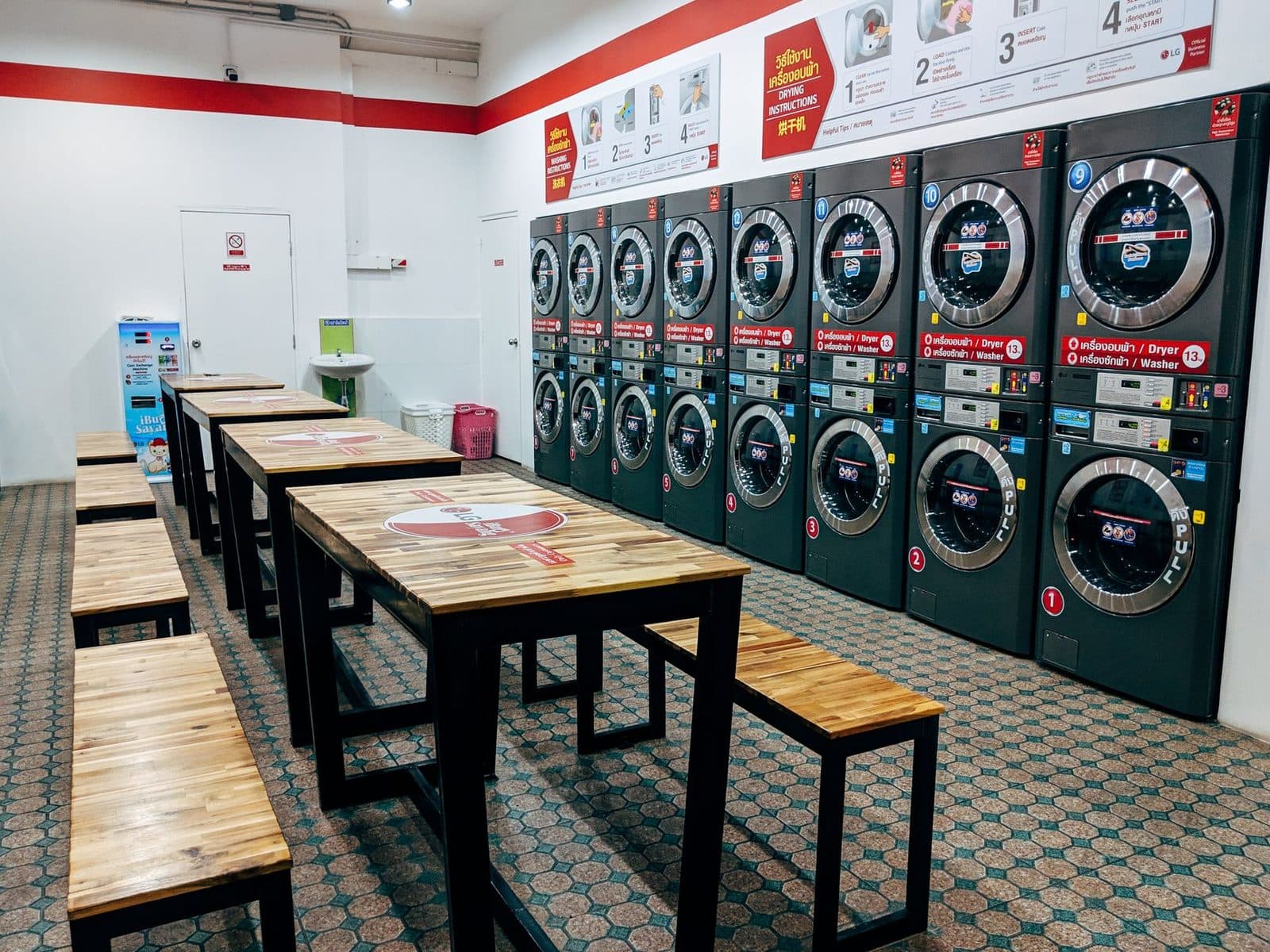
"We run a 45 m² self-service laundromat in Montreuil, twelve washing machines and six tumble dryers, open from 7 a.m. to 10 p.m. with no staff on site. In July, a customer measured 36 °C inside at 6 p.m. We had two 3.5 kW wall-mounted split units installed in 2023: they run non-stop, the temperature barely drops, and the windows are streaming with water. The installer tells us the space is 'too heavily loaded'. Now we're being offered 7 kW."
A 7 kW unit will fix nothing. A laundromat, a dry cleaner or a gym are not shops to be air conditioned: they are spaces where heat arrives hand in hand with water. And an air conditioning system sized in kilowatts of "cooling" without distinguishing what goes into cooling the air from what goes into condensing vapour will be 30 to 50 % wrong about the machine to install. That is precisely why these three trades are the ones where you most often find recent equipment running with no result at all.
This article does not revisit topics already covered here — commercial leases and homeowners' association approval, outdoor unit noise, the cost of a repair call-out, mandatory servicing, odours and disinfection. It describes the working method specific to high-latent-load premises in the Paris region: self-service laundromats, dry cleaners with a pressing table and a dry-cleaning machine, standalone gyms, cross-training studios, boxing gyms, hot yoga studios, physiotherapy practices with an exercise area. Three different trades, one and the same design flaw.
Sensible heat and latent heat: the confusion that ruins quotes
An air conditioning quote states an overall cooling capacity, 5 kW for example. That capacity splits into two parts:
- sensible heat, the part that brings down the temperature shown on the thermometer;
- latent heat, the part that condenses water vapour on the cold coil, and therefore lowers humidity.
In a standard office, a wall-mounted split unit devotes roughly 75 to 80 % of its capacity to sensible heat. That makes sense: moisture gains are limited to the occupants' breathing. In a laundromat, the ratio is almost reversed. Six tumble dryers in operation evaporate several litres of water per hour, and a dry cleaner with a vacuum pressing table and a steam iron produces it continuously throughout the working day.
The practical upshot: a machine sold as 5 kW of "cooling" delivers, in a space at 70 % relative humidity, only 2.5 to 3 kW of useful air cooling. The rest goes into drying the air. The customer sees a brand-new machine that cannot bring the temperature down, and concludes it lacks capacity. The problem lies elsewhere: the latent load was never calculated.
To get hard facts before any quote, a simple digital thermometer and hygrometer placed 1.50 m above the floor, away from the supply grilles, is enough to record temperature/humidity pairs in the morning, in the middle of the day and at the end of trading. Three days of readings completely change the conversation with the installer — and avoid paying for oversizing, whose real cost we detailed in our room-by-room kW calculation method.
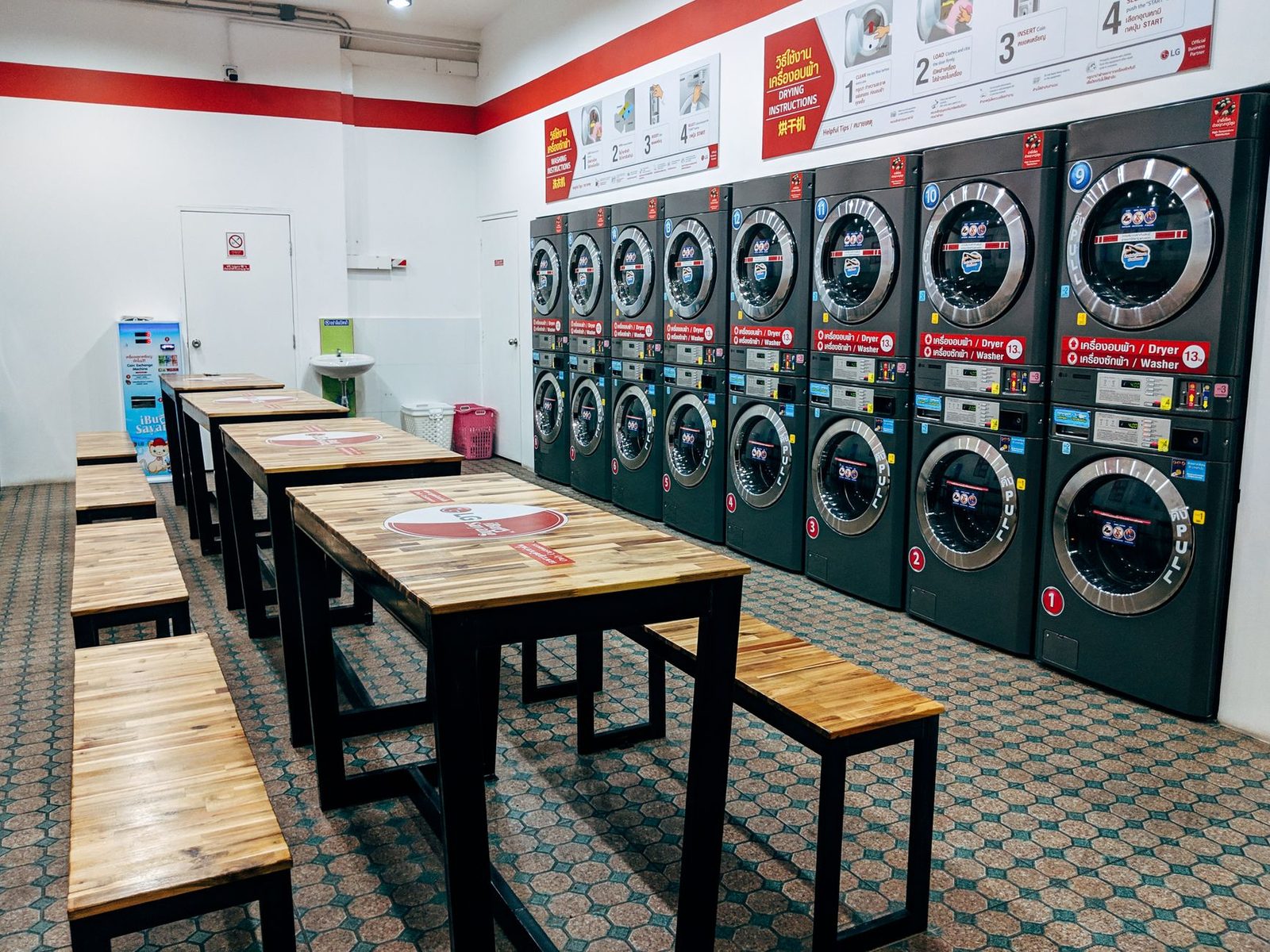
Self-service laundromat: the tumble dryer dictates everything
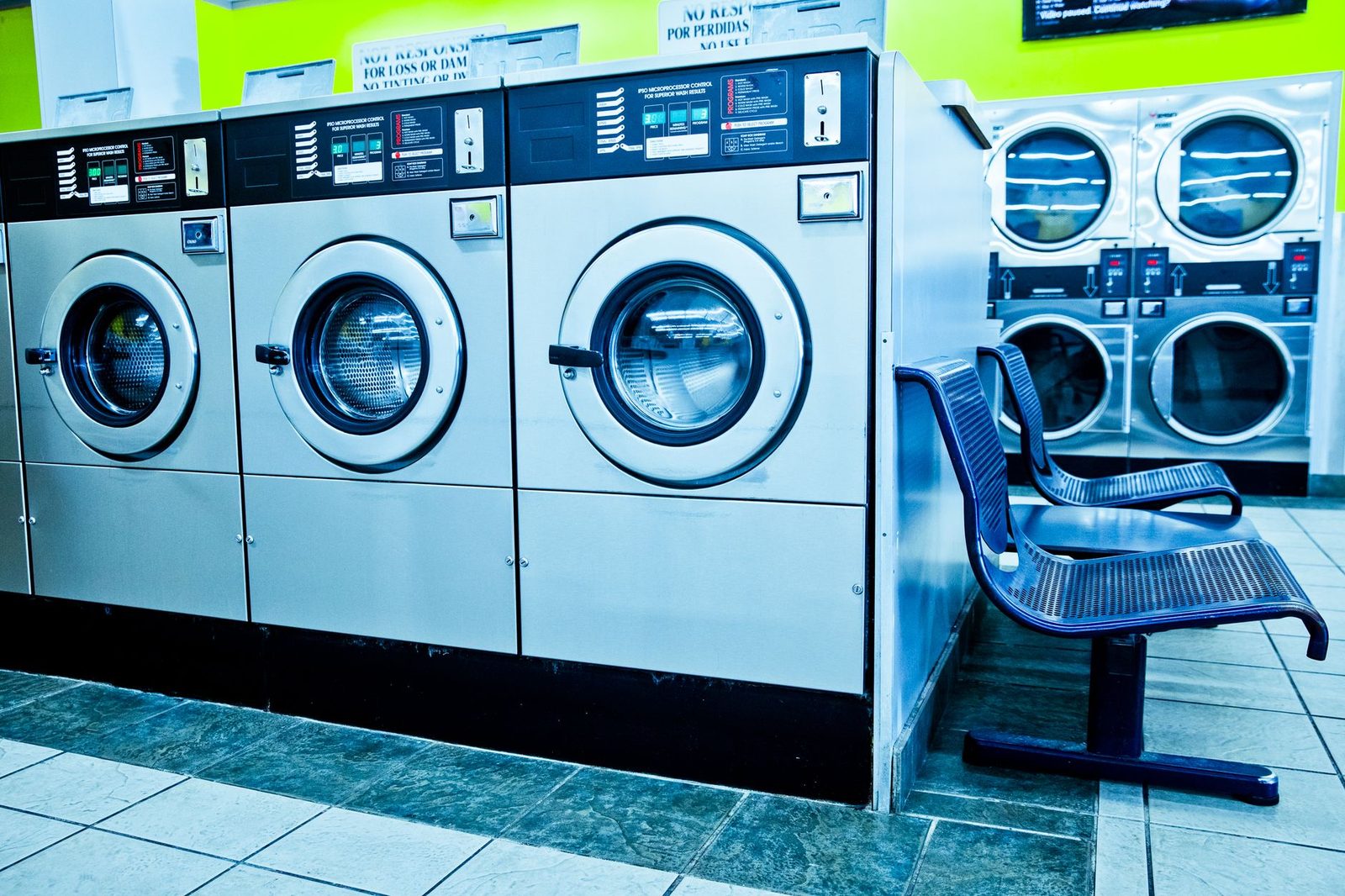
In a Paris-region laundromat of 40 to 70 m², the heat gains break down as follows, in order of importance:
| Source | Order of magnitude | Nature |
|---|---|---|
| Tumble dryer (heat + vapour) | 1.5 to 3 kW per unit in operation | Mixed, heavily latent |
| Washing machine (hot water, motors) | 0.3 to 0.8 kW per unit | Sensible |
| Shopfront glazing | 0.4 to 0.8 kW per m² of west-facing glass | Sensible |
| Lighting and displays | 0.5 to 1.5 kW in total | Sensible |
| Passing customers | 80 to 100 W per person | Mixed |
Two mistakes come up systematically in the jobs we take over.
The first: badly connected tumble dryers. A vented dryer must discharge its humid air outdoors, through a short, airtight duct. In practice, you find ducts crushed behind the machines, joints that have come apart, sometimes an outlet discharging into a suspended ceiling. Every litre of water released into the space is a litre the air conditioning will have to condense and then drain away. As long as the discharge ducts are not put right, no machine will meet the target. This is the first item to check, before even discussing cooling capacity.
The second: no dedicated mechanical extraction. A laundromat needs permanent air renewal, independent of the air conditioning. An extraction system of one hundred to a few hundred m³/h, in an acoustic casing, with compensating air inlets, removes part of the latent load without making the heat pump pay for it. The cost of the extraction system is far below that of the extra cooling kilowatts it saves.
As for equipment selection, an unstaffed laundromat is a poor fit for a conventional wall-mounted split. The units are exposed to air laden with textile lint: the filters clog up within a few weeks. Two options stand the test of time:
- four-way ceiling cassettes, positioned out of the direct airflow from the machines, with filters accessible from a work platform;
- a ducted system with a single filtered return, fitted with a replaceable G4 ventilation duct filter that requires no dismantling — the cleanest solution, provided you have the available ceiling height.
In both cases, plan for a cleaning frequency well above the norm, as we explain in our article on air conditioning filter maintenance.
Dry cleaner: constant steam and the counter area
A dry cleaner poses a different problem: the load is not intermittent, it is continuous over eight to ten hours, and it is concentrated in the back room while comfort is measured at the counter.
The vacuum pressing table, the steam iron, the spotting booth and the cleaning machine together create an environment that most operators end up accepting as inevitable: 30 to 33 °C at the back, with humidity that condenses on the windows and makes labels buckle.
The working method that does deliver comes down to three decisions.
Capture at the source rather than treat the whole room. An extraction hood above the pressing station, ducted directly outside, removes 50 to 70 % of the steam before it spreads. By far the best-spent euro in the whole project.
Separate the back room from the counter thermally. A full-height partition, even a lightweight one, with a self-closing door, turns premises that are impossible to air condition into two volumes that can be treated separately. The counter then gets a small 2 to 3.5 kW unit that holds its setpoint; the back room gets a robust unit set to a more realistic target — 26 to 27 °C rather than 24 °C.
Protect the indoor units. Aerosols from spotting products and solvents attack aluminium heat exchangers and clog up the fans. On dry-cleaning installations, we recommend a visit every six months, including coil cleaning, and in-house use of a foaming cleaner for air conditioning heat exchangers of professional grade between visits is only useful on accessible parts — anything involving the refrigerant circuit remains the preserve of a technician holding the relevant certificate of competence.
Standalone gym: the occupant load blows the calculations apart
Neighbourhood gyms — cross-training studios, boxing gyms, physiotherapy floors, dance studios of 80 to 200 m² — follow a third logic altogether. Here, the dominant load is the occupant.
A seated adult gives off around 100 W. The same adult exercising intensely gives off 400 to 600 W, with a very high latent share from sweating and pulmonary ventilation. A group class of fifteen people therefore represents 6 to 9 kW of human load — on its own, more than most existing installations can deliver — and that load appears within eight minutes, then disappears when the class changes over.
Three practical consequences:
Ventilation is not optional, it is the heart of the system. The departmental public health regulations and the French Labour Code (articles R. 4222-1 et seq.) require fresh-air flow rates that rise with the level of physical activity. For a sports activity room, the usual basis is tens of m³/h per occupant. A heat recovery ventilation unit or, at the very least, extraction controlled by occupancy, ideally driven by a CO₂ sensor, makes a difference that air conditioning alone never will.
Control must anticipate, not follow. A fixed setpoint is always behind the curve on a group class. The right approach is to pre-cool the space 20 to 30 minutes before the time slot, then let the machine absorb the rise. On recent installations this can be programmed; on older ones, a time schedule on the centralised controller is often enough.
Supply air must never blow onto the participants. A sweating body in a 14 °C airstream means complaints guaranteed, and a genuine risk of muscle chilling. Favour cassettes with adjustable vanes positioned away from the mat areas, or a ducted system with linear diffusers around the perimeter.
One final point that is often overlooked: residual humidity after closing. A room at 75 % relative humidity left closed up all night develops mould in the corners and in the changing rooms. The useful habit is to run the system for 30 to 45 minutes in dehumidification mode after the last class, or to install a dehumidifier for commercial premises in the changing rooms, which are almost never air conditioned. We set out the dividing line between the two appliances in our comparison of dehumidifier versus air conditioning.
What to insist on in the quote
For these three families of premises, a serious quote is recognisable by four line items.
- A heat load calculation separating sensible and latent, with the assumptions written down: number of appliances in simultaneous operation, number of occupants, starting humidity level, design outdoor temperature used (32 °C for the Paris region in standard calculations, often raised to 34 or 35 °C since the recent summers).
- The ventilation strategy, priced separately: extraction, compensating air inlets, possibly heat recovery ventilation. A quote that only mentions split units for a humid space is incomplete by design.
- Suitable refrigerant and equipment: R-32 on current ranges, indoor units with treated coils where the air is laden with solvents or chlorine, accessible condensate trays.
- A maintenance contract at an increased frequency, two to four visits a year depending on the trade, with cleaning of coils and trays. This is non-negotiable in these premises: the operating records an inspector or an insurer will ask for in the event of an incident depend on it.
Budget ranges observed in the Paris region
| Configuration | Equipment + installation | Annual servicing |
|---|---|---|
| Laundromat 40-60 m², 2 cassettes + extraction | €7,000 to €12,000 excl. VAT | €450 to €900 excl. VAT |
| Dry cleaner 50 m², partitioning + 2 units + hood | €8,000 to €14,000 excl. VAT | €500 to €1,000 excl. VAT |
| Gym 150 m², ducted system + heat recovery ventilation | €20,000 to €40,000 excl. VAT | €1,200 to €2,500 excl. VAT |
These ranges assume an accessible outdoor unit location and a sufficient electrical supply. In ground-floor premises within a residential building, the siting of the outdoor unit often remains the sticking point: the applicable rules are covered in our guide to outdoor unit siting.
Since 2026, reversible air-to-air heat pumps have qualified for a reduced VAT rate under certain conditions for dwellings; for commercial premises, VAT remains recoverable under ordinary rules. ADEME (the French Agency for Ecological Transition) and the service-public.fr portal publish the reference texts applicable to energy improvement works.
The mistake to stop making
In all three trades, the initial request is almost always the same: "we need something more powerful". In all three cases, the right answer starts with removing water from the space before making a refrigeration unit condense it — in other words, with ventilation and capture at the source. The kilowatts come afterwards, and you often need fewer of them than announced.
An operator who turns up with three days of temperature/humidity readings, the number of appliances in simultaneous operation and the real occupancy time slots gets the sizing right first time. That is exactly what we do during a technical site visit.
If you run a laundromat, a dry cleaner or a gym in the Paris region and your current installation cannot hold its setpoints, book a technical site visit: the latent load survey is carried out on site, in an hour, and determines the entire project.
Need an air conditioning solution?