Heading off on holiday with peace of mind: the 2026 check-list for your air conditioning, MVHR and home before you zip the suitcase

The Proclimo Team
17 Jul 2026 - 08 min read
On 4 July 2026, the summer holidays started for 12 million French people. By the end of the month, most households in the Paris region and the major cities will be leaving their home for 2 to 4 weeks — right in the middle of the heatwave that has already pushed France into orange alert and which, according to Météo France, will bring new peaks of 36–40 °C in August. While the suitcases may be ready, the state of the home during your absence is a much less settled question: air conditioning, MVHR (mechanical ventilation), water heater, devices left on standby, the risk of a breakdown… a poorly prepared departure can turn the return from holiday into a hefty bill, a damage report, or — worst case — an AC breakdown right when you need it most. Here is the Proclimo check-list for leaving with peace of mind, saving energy in your absence, and coming back to a cool home.
First things first: a final service before you leave safely
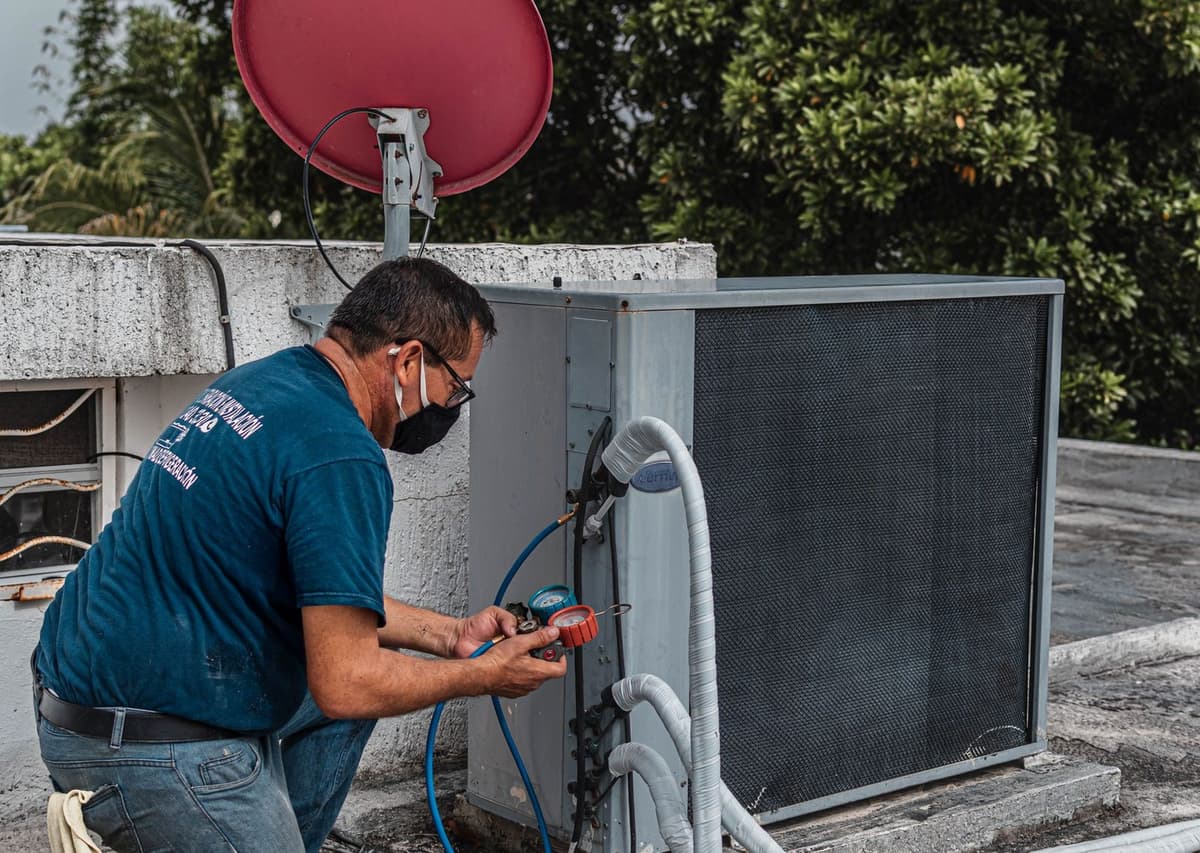
The first reflex before a long departure: have your air-conditioning installation checked by a certified refrigeration technician. The high season is in full swing, lead times are getting longer, and the shortage of qualified technicians is still a fact of life in 2026. A complete air-conditioning service — filter cleaning, refrigerant circuit check, leak-tightness test, outdoor unit cleaning and pressure test — is the most worthwhile investment before several weeks of inactivity.
info
Decree n° 2020-912 and the 7 May 2017 order require an annual leak-tightness check for any unit containing more than 5 tonnes of CO₂ equivalent of refrigerant (≥ 2.5 kg of R32 or ≥ 1.4 kg of R410A). For a household, the recommended frequency is one service per year, ideally before the high season. See our article on the mandatory AC service in 2026.
This service is also the right time to ask your technician for a performance diagnostic. A unit with a SEER ≥ 6.0 consumes 15 to 20 % less than a previous-generation unit. If your AC is more than 10 years old, this may be the right moment to plan a replacement with a reversible air-to-air heat pump once you return — you will consume less in summer and in winter, with the reduced 5.5 % VAT and the CEE "Coup de pouce" premium if you are eligible.
Air conditioning: should you switch it off, leave it on, or set it to "absence" mode?
This is the most common question before a departure. Three options, three very different uses:
Option 1 — Switch the AC off completely
Ideal for absences shorter than 5 days, or if you have no animals, no sensitive plants and no equipment sensitive to heat. Cut the power at the electrical panel to avoid standby consumption (1 to 5 W depending on the model, i.e. €1 to €4 per month) and close shutters and curtains in sun-facing rooms. On your return, the home will be warm but will cool down quickly with good night-time ventilation.
Option 2 — Activate "absence" mode (the right trade-off)
This is the solution recommended by manufacturers and by ADEME for absences of 5 to 30 days. Most remote controls and mobile apps (Daikin, Mitsubishi, Atlantic, Toshiba) include an "absence", "holiday" or "reverse anti-frost" mode that keeps the home between 28 and 30 °C — cool enough to protect animals, plants, musical instruments, medicines and sensitive electronic devices, without over-consuming.
In practice, the gap between an absence mode set to 30 °C and a comfort mode set to 22 °C represents 50 to 70 % less electricity over the duration of the stay. Over a one-month absence in July–August, that is a saving of €40 to €80 on the bill, and 2 to 3 kg of CO₂ avoided per day depending on the French electricity mix (see our analysis of AC's impact on the power grid).
Option 3 — Leave it running at 26 °C continuously
To be avoided. In a heatwave, the AC runs at full power non-stop, your bill soars, and the grid suffers (RTE has shown that one degree less on the thermostat costs 5 to 8 % more consumption). This mode is only relevant for a few hours of absence during a heat peak, never for several weeks.
tip
Activate absence mode before you leave, not from the car park: the initial start-up consumes more than the steady-state regulation. Programme it within the 2026 summer off-peak hours if your contract allows, to spread consumption across the 9 am–6 pm window and ease the grid at the evening peak.
MVHR and ventilation: never switch it off, but check it
The MVHR is one of the most mishandled pieces of equipment during the holidays. Many households switch the ventilation off to "save money". That is a false economy: without MVHR, humidity builds up, mould develops within days, and indoor air quality deteriorates (VOCs, dust mites, radon). On your return, you will breathe air that is less healthy than before you left.
The right practice:
- Never switch the MVHR off, even in summer. A single-flow hygro-adjustable MVHR consumes less than €30 per year of electricity — the savings from switching it off are negligible compared with the cost of an anti-mould treatment.
- Clean the extraction vents (kitchen, bathroom, WC) before you leave: a simple wipe with a damp sponge on the grille and filters is enough.
- Leave the vents open: closing them does not reduce consumption and puts the motor under stress.
- For the MVHR in a heatwave, the right reflex is to switch to low speed at night (to evacuate the accumulated heat) and to turn off the automatic speed during the day when it is hotter outside than inside.
Water heater and hot water: the "absence" reflex
The water heater accounts for 15 to 25 % of the electricity consumption of a French household. While you are away, two reflexes:
- Activate the "absence" or "anti-frost" mode of your water heater (button or dial often marked with a "holiday" symbol). It keeps the water frost-free without heating it continuously. Estimated saving: €30 to €50 over 3 summer weeks.
- Cut the water at the main stopcock if you are away for more than 10 days. In the event of a leak on a flexible hose, a tap or a toilet, you avoid a claim worth several thousand euros — and a hefty water bill. It is also a fire safety reflex (reduced risk of short-circuit in an empty home).
Energy savings: everything to unplug
The average French household leaves 20 to 50 devices on standby permanently, accounting for 5 to 15 % of the electricity bill (i.e. €80 to €200 per year). Before you leave, take a tour:
- Internet box: keeping it on for connected cameras and home automation is legitimate, but disable Wi-Fi if you have no use for it.
- TVs, screens, consoles: unplug them. Standby uses 1 to 8 W per device, and the risk of power surge during a summer storm is real.
- Washing machine, dishwasher, oven, microwave: switched off at the panel or unplugged.
- Switched power strips: turn them off in one move. A standard power strip with 6 devices on standby consumes the equivalent of an LED bulb on 24/7.
- Electric roller shutters: leave them closed on the most exposed façades. You can programme a 10-minute daily opening at dawn (via a timer or home automation) to air the home without overheating.
info
The new Linky meters let you measure each device's consumption with a connected plug (eco-meter, smart plug). A quick test before you leave gives you the exact list of standby loads and the value of the potential saving. It is a worthwhile investment: €30 to €50 for the plug for €80 to €200 of identified savings in the first year.
Safety and damage: the reflexes that prevent the worst
An empty home in summer is more exposed to burglaries, fires and water damage. The right reflexes:
- Presence simulator: programme 2 or 3 lamps on a timer or via a smart plug, to mimic a presence in the evening.
- Shutters closed on the street side: it is the first sign of absence. Keep one shutter half-open in a living room if you live in a quiet neighbourhood.
- Connected camera or motion detector: a €50 to €150 investment that can prevent a burglary worth several thousand euros. The recent models (Netatmo, Ring, Xiaomi) can be controlled remotely from your smartphone.
- Alarm: if you have one, switch it on systematically before leaving.
- Neighbours and caretaker: tell a trusted neighbour or your caretaker. An overflowing letterbox is just as visible a sign of absence as a closed shutter.
- Home insurance: check that your contract properly covers "holiday" stays and damage occurring in your absence (water damage, fire, burglary, natural disaster). During a heatwave, violent thunderstorms are common: a power surge can blow your AC, your box and your TV.
On your return: the procedure to start the AC back up gently
On your return from holiday, the most brutal transition is often the thermal one: the home is at 32–35 °C, and the temptation is to push the AC down to 18 °C to cool quickly. That is the best way to break down at the worst possible moment.
The right procedure:
- Air the home out massively for 1 to 2 hours by opening windows and doors on the shaded side, ideally in the evening or early morning.
- Close everything, shutters included, and set the AC to 26–27 °C, with a maximum gap of 7 to 8 °C from the outside (see our guide on how to set your AC during a heatwave).
- Check the filters and the outdoor unit: remove leaves, clean the filters, and visually check for any nest or foreign body.
- Programme a 30-minute test cycle to confirm proper operation. In the event of abnormal noise, a leak or no cold air, call air-conditioning repair straight away — the 2026 high season is showing lead times of 48 to 96 h in the Paris region.
The special case of second homes and absences longer than one month
If you leave your main home for more than 4 weeks, or if you manage a second home that remains empty for most of the year, three additional reflexes are needed:
- Drain the water circuits if the house is not heated in winter (risk of freezing). A plumber can do it in less than an hour for €80 to €150.
- Leave the taps in a half-open position: this reduces the pressure in the event of water hammer and limits the risk of a joint failure.
- Call on a "remote maintenance" service: some providers, including Proclimo, offer contracts that include a monthly inspection visit (AC, water heater and MVHR check, shutter check, operating test, filter cleaning) and a photo report. It is the safest solution for second-home owners in the Paris region.
Frequently asked questions
Should I switch the AC off during the holidays? Not necessarily. For a short absence (less than 5 days), switching it off is acceptable. For 5 to 30 days, it is better to activate absence mode at 28–30 °C: you protect the home without over-consuming. Beyond a month, a full switch-off is possible as long as the home stays dry and ventilated.
Does the MVHR consume a lot? A single-flow MVHR consumes between €10 and €30 per year of electricity. Switching it off does not produce a meaningful saving and encourages humidity, mould and a deterioration of air quality. Never switch it off.
What should I do in the event of an AC breakdown on my return from holiday? Switch the power off, check the filters and the absence of any obstacle on the outdoor unit, then call a certified refrigeration technician. During the high season, lead times can reach 96 h: better to anticipate with an annual maintenance contract.
Does home insurance cover an AC breakdown during a heatwave? Generally, yes for damage following a covered event (short circuit, water leak). A breakdown linked to wear or lack of maintenance is often not covered: this is precisely the point of an annual maintenance contract.
How do I protect animals and plants while I am away? Absence mode at 26–28 °C, lamp on a timer, fresh water renewed for the animals, and plants grouped in the shade. For long absences, call on a relative or a pet-sitter — the AC alone is not enough.
Act with Proclimo
Want to leave with peace of mind and come back to a cool home? Proclimo offers an annual maintenance contract that includes the pre-summer visit, complete cleaning, leak-tightness check, MVHR and water heater verification, and a photo report before you leave. For second homes and businesses, our commercial contract adds remote monitoring and interventions within 24 h in the Paris region.
Also discover our air-conditioning installation, maintenance and cleaning and emergency repair services. You can book a service online or contact us for a personalised assessment before the big departure.
Need an air conditioning solution?