Air Conditioning a Studio or One-Bedroom Under 35 m² in Paris: The Constraints Nobody Anticipates

L'équipe Proclimo
23 Oct 2026 - 09 min read
"I have a 28 m² studio on the sixth floor with no lift, right under the roof. In summer it's 33 °C at 11 p.m. I want air conditioning, and every installer I call tells me 2.5 kW minimum. Isn't that too much?"
This question comes up every year, and it is perfectly justified. In a small space, the problem is never finding enough capacity: it's finding little enough. Residential ranges on the market start at 2 to 2.5 kW of cooling, which, in theory, corresponds to a well-insulated room of 25 to 30 m². A Parisian studio under the eaves, poorly insulated and facing due west, will easily use all of that capacity. A studio on the second floor facing the courtyard, with a single north-facing window, needs only half.
On top of that come three constraints that larger homes never face: there is almost never room for the outdoor unit, indoor noise becomes critical when you sleep three metres from the machine, and the top floor of a Parisian building imposes its own installation rules.
This article describes what we actually see in small Île-de-France properties: the configurations that work, the ones we refuse to install, and the real budgets in 2026.
The real problem with small spaces: imposed oversizing
In a 100 m² open-plan space, sizing is up for discussion. In 28 m², there is almost nothing to discuss: manufacturers simply don't go below a certain threshold.
The residential mono-split ranges of the major manufacturers (Daikin, Mitsubishi Electric, Toshiba, Atlantic, Panasonic) typically start at 2.0 or 2.5 kW nominal cooling. A few 1.5 kW references exist, often within specific series, but they have limited distribution and aren't always quickly available in the Paris region.
The practical consequence: a 25 to 30 m² studio facing the courtyard, shaded, with little glazing, ends up fitted with a unit that covers twice its actual need.
That is not harmless. An oversized air conditioner:
- reaches the setpoint very quickly, then shuts down — this is known as short cycling;
- barely dehumidifies at all, because dehumidification requires extended operation at low speed across the heat exchanger;
- creates an unpleasant sensation of dry cold alternating with temperature rebounds;
- prematurely wears out the compressor, which racks up start-ups.
That is exactly the opposite of what you want in a studio, where night-time comfort depends as much on humidity levels as on temperature. We covered this in detail in our method for room-by-room sizing: excess capacity costs you twice, at purchase and in use.
What changes the picture: inverter technology and the modulation range
The good news is that every unit sold on the French market today uses inverter technology: the compressor modulates its speed instead of stopping and restarting.
But not all inverters are equal, and this is where you need to look at a figure that sales brochures rarely highlight: minimum capacity, sometimes listed as "operating range" or "min. capacity" in the technical documentation.
| Unit (nominal cooling) | Typical min. capacity | Suited to |
|---|---|---|
| 2.0 kW, min. range 0.9 kW | modulates well | studio 20-30 m² facing courtyard |
| 2.5 kW, min. range 1.2 kW | acceptable | studio 28-35 m², one-bedroom |
| 2.5 kW, min. range 1.8 kW | modulates poorly | avoid under 30 m² |
| 3.5 kW (whatever the range) | too much | never in a studio |
Always ask for the full technical datasheet, not the sales leaflet, and look at the ratio between nominal and minimum capacity. A 2.5 kW unit able to drop to 1.2 kW will work very well in 30 m². The same 2.5 kW unit stuck at 1.8 kW will spend its life in on/off mode.
Where do you put the outdoor unit when there's no room?
This is constraint number one, by far, in small Parisian properties.
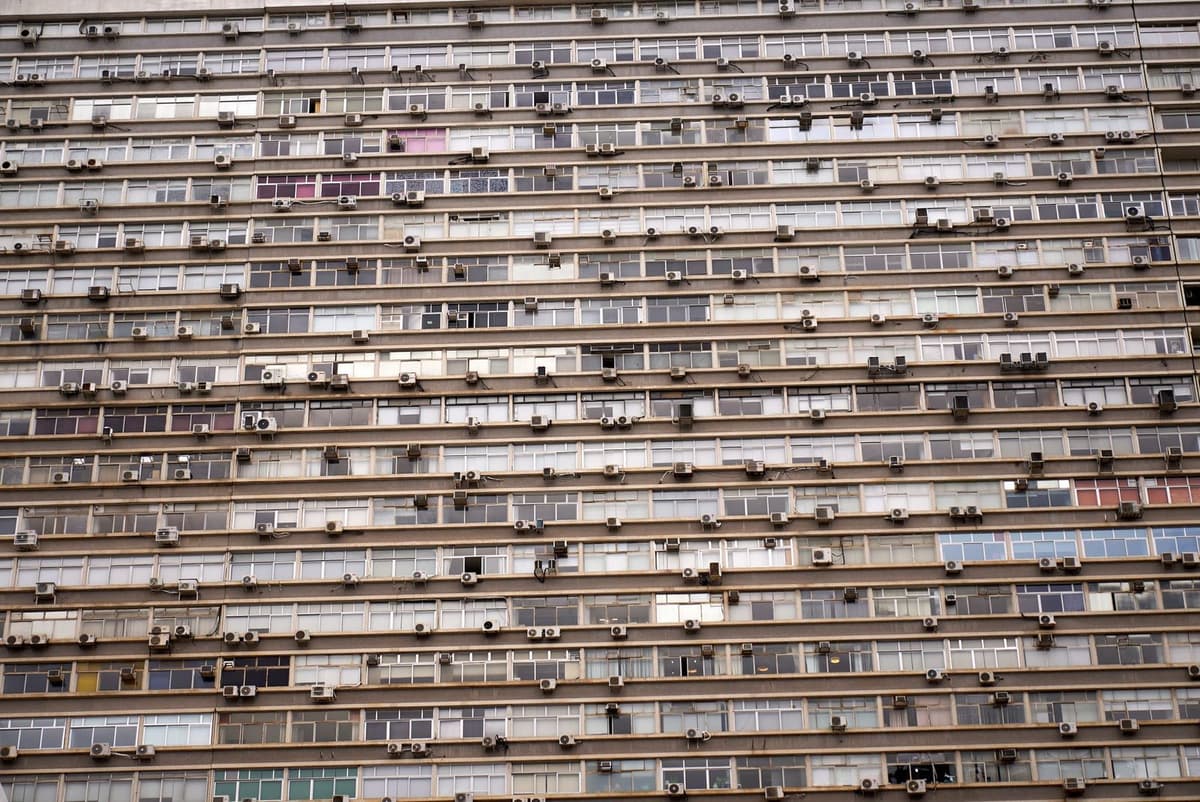
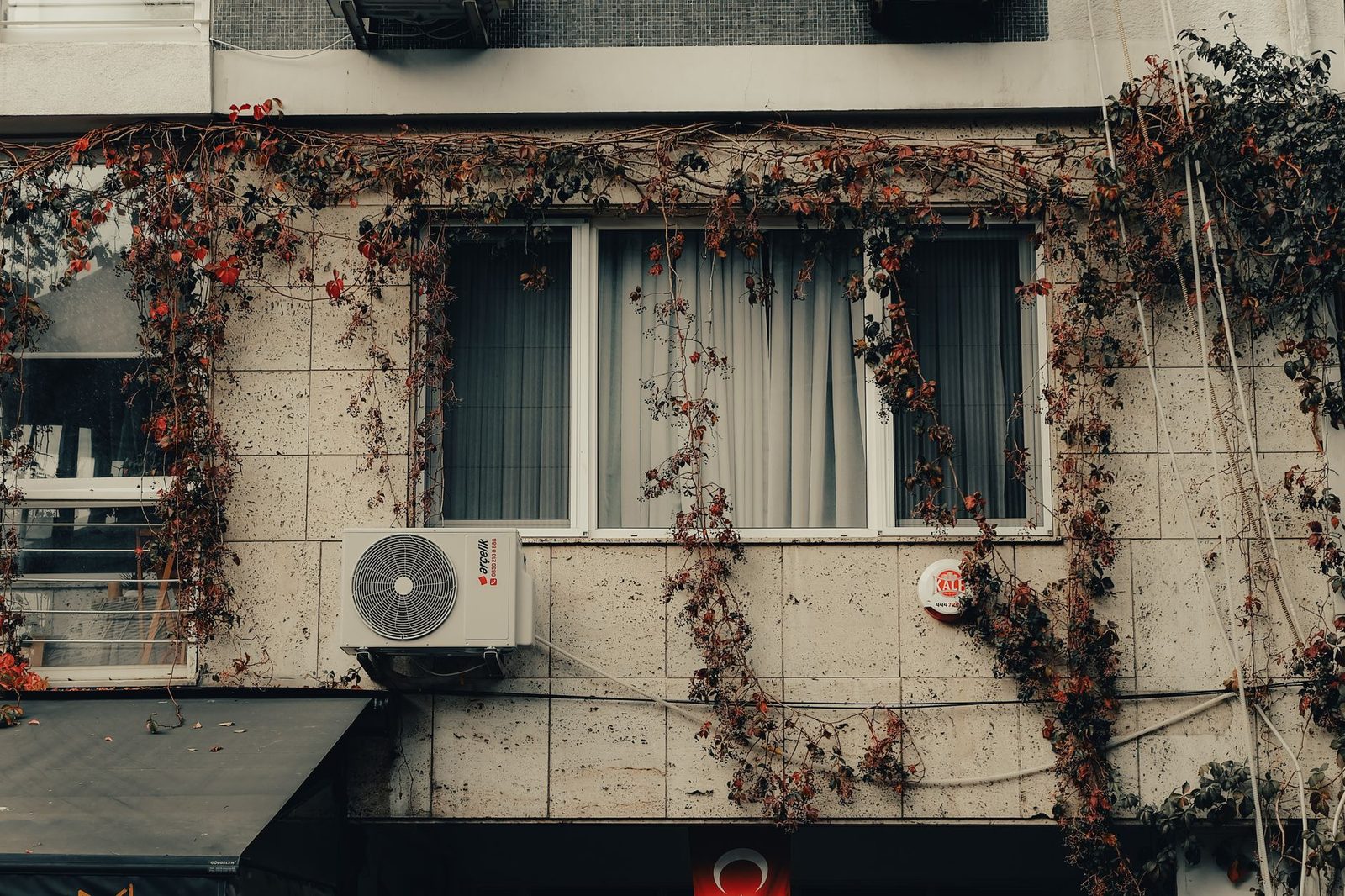
A studio rarely has a balcony. If it does, it's 80 cm deep and already used for something else. That leaves the façade, the courtyard, the roof — and each of these options comes with its own rules.
The balcony or loggia
This is the best solution when it exists. A few cautions, though:
- the unit must have air clearance at the rear and above (generally 10 to 30 cm behind, 50 cm above, depending on the manufacturer);
- placed on the ground on anti-vibration pads, it transmits far fewer vibrations than when wall-mounted;
- a unit blowing towards the upstairs neighbour's window is a dispute waiting to happen.
The courtyard façade
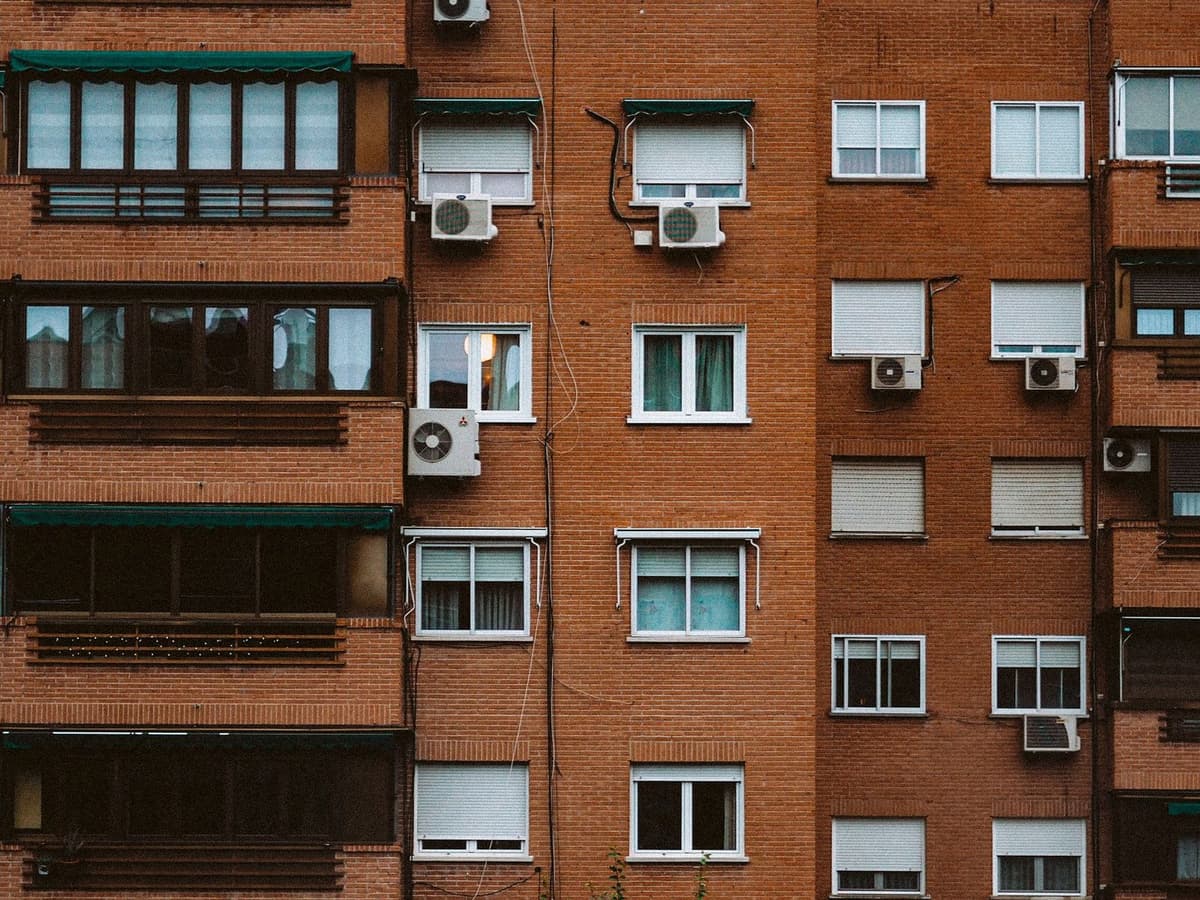
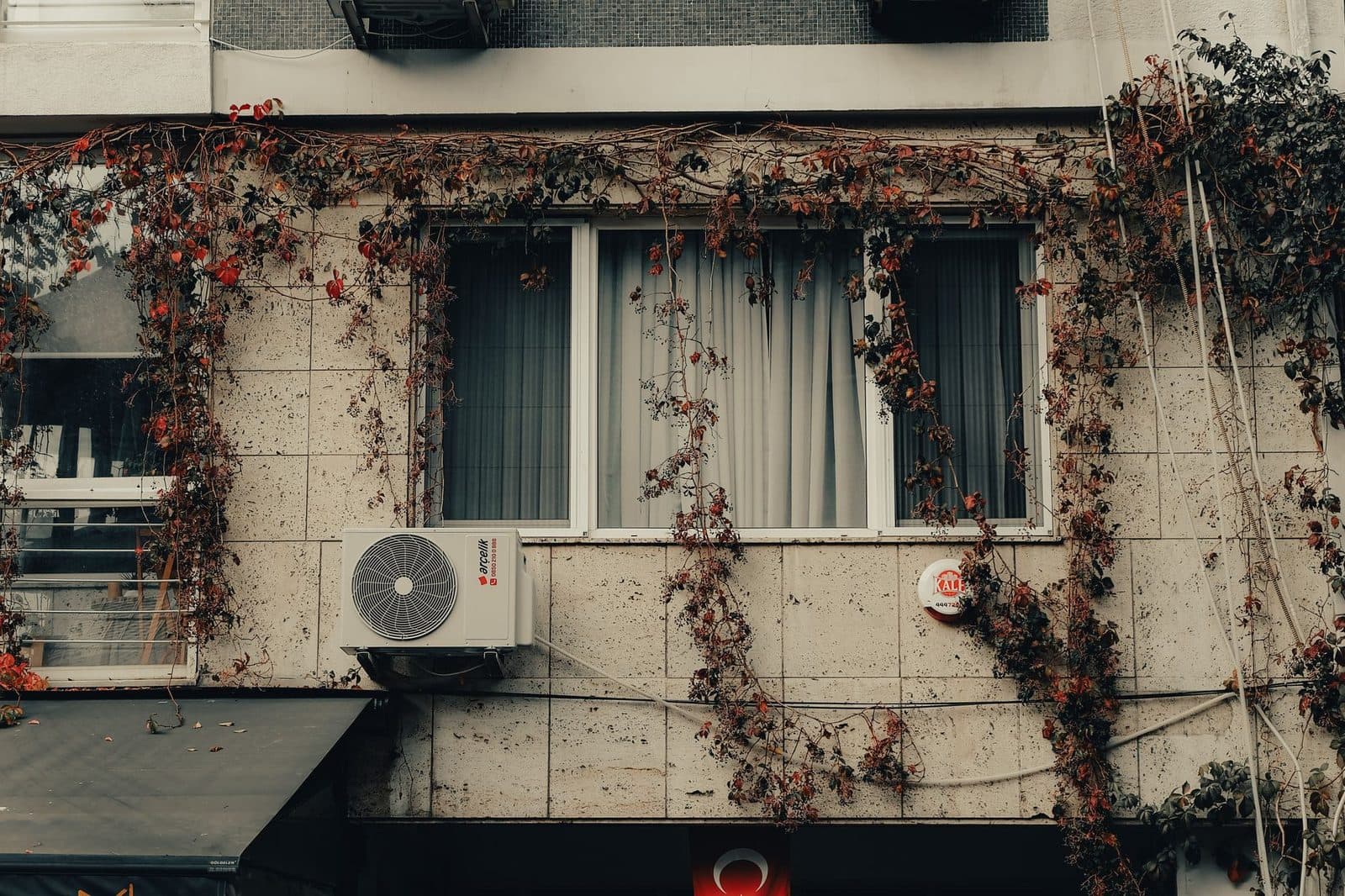
Very common in Paris, and subject to the building's co-ownership rules as well as local planning regulations. Approval from the general meeting is almost always required as soon as you drill through a load-bearing wall or fix equipment to a common area. The topic deserves separate treatment: see our guide on installation in a co-owned building.
In protected areas and near listed monuments, visibility from the public street is the decisive criterion. An enclosed inner courtyard is approved far more easily than a street-facing façade.
The roof or technical terrace
Possible, but the cost soars: the length of the refrigerant line (and therefore of trunking, routing, insulation) increases sharply, and a cherry picker or secured work-at-height operation is often needed. Expect a significant premium compared with a wall-mounted installation.
And when nothing is possible?
That leaves monobloc units with no outdoor unit, fitted against an interior wall with two 160 mm penetrations through the façade. Their efficiency is lower than a split's, they are noisier indoors (the whole machine sits in the room) and they don't suit every configuration — but in a studio with no outdoor option whatsoever, it is often the only credible fixed solution. We compared these solutions in our article on air conditioning without an outdoor unit.
Noise: the constraint that rules out half the units
In a 40 m² living room, an indoor unit at 24 dB(A) is inaudible. In a studio where the bed is three metres from the unit, every decibel counts.
The sound levels quoted by manufacturers correspond to the lowest mode, measured in a laboratory at one metre. Good units now post 19 to 22 dB(A) at minimum fan speed. Entry-level units are often at 26-30 dB(A), which, in a single-room home, is immediately noticeable at night.
Three concrete recommendations for a studio:
- Insist on a sound pressure figure at minimum fan speed of ≤ 22 dB(A) on the indoor unit's technical datasheet, not an average.
- Never place the unit above or facing the bed. Direct airflow on the face during sleep is the number one cause of complaints (dry throat, waking up, aching muscles). Prefer a position above a door, a cupboard, or along the line of the hallway, with louvres angled towards the ceiling.
- Use night mode (sometimes called "sleep" or "night comfort"), which gradually raises the setpoint and throttles the fan.
If the installation unavoidably creates an uncomfortable airflow, an air deflector for indoor units, which clips onto the discharge grille, redirects the air towards the ceiling for a few tens of euros. It isn't elegant, but it works.
Outdoors, noise transmitted to neighbours is governed by the French public health code (articles R.1336-5 onwards): the permissible increase above background noise is 5 dB(A) by day and 3 dB(A) at night at the property line. In a narrow, echoing Parisian courtyard, that threshold is quickly reached. A quality anti-vibration bracket and careful positioning cost far less than litigation. Our article on noise and neighbours sets out the procedure.
The special case of the top floor under the eaves
A large share of small Parisian properties are former servants' rooms, on the sixth or seventh floor, under a zinc roof.
These are the homes where air conditioning delivers the most comfort — and where it is the hardest to size.
Why? Because heat gains through the roof cannot be calculated like a façade. An uninsulated zinc roof under 35 °C outdoor temperature can reach 70 to 80 °C at the surface, and releases that heat for much of the night. The actual cooling need of a 25 m² space under the eaves can exceed that of a 50 m² flat on the second floor.
In such cases, three points are decisive:
- Check the insulation under the roof slope before sizing anything. If the roof is bare, installing insulation under the slope often halves the heat gains and allows a smaller unit, therefore quieter and cheaper. ADEME is very clear about the order of priorities: insulate first, cool afterwards. We covered this connection in our article on the insulation / air conditioning synergy.
- Deal with the glazing. An unprotected roof window is a radiator. An external blackout blind for roof windows (a model fitted on the outside face, not an interior curtain) blocks the heat before it enters, with a far greater effect than an internal blind.
- Plan the routing of the refrigerant lines. Under the eaves there is no service duct, no suspended ceiling and often no free vertical run. The path between the indoor and outdoor units is the real technical issue of the pre-installation survey.
The question of available height
Under a sloping roof, ceiling height varies from 1.10 m at the low point to 2.40 m at the high point. A standard wall-mounted unit is 25 to 30 cm tall and requires clearance at the ceiling. So you need a stretch of straight wall with at least 1.80 m of free height — which isn't always available.
The alternatives: floor-console units (fitted low on the wall, like a radiator), less common but very useful under a sloping roof, and recessed cassettes where a suspended ceiling already exists.
Real budgets in 2026 for a small space
The ranges below reflect what we observe in the Paris region, equipment and installation included, with the 5.5 % VAT rate applied to air-to-air heat pumps in homes completed more than two years ago.
| Configuration | Observed range |
|---|---|
| Mono-split 2.0-2.5 kW, outdoor unit on balcony, short line run (< 4 m) | €1,800 - €2,800 |
| Mono-split with outdoor unit wall-mounted on courtyard façade | €2,200 - €3,400 |
| Mono-split with outdoor unit on the roof, long line run | €3,000 - €4,500 |
| Monobloc with no outdoor unit, two wall penetrations | €2,000 - €3,200 |
| Console unit under a sloping roof | €2,400 - €3,600 |
Three line items move the quote in a small space: the length of the refrigerant line, access arrangements (cherry picker, scaffolding, rope access) and the way the outdoor unit is fixed. A studio on the sixth floor with no lift and a rooftop installation bears no relation, in cost, to the same studio on the first floor with a balcony.
Before signing, read through our list of 12 items to check on a quote: on small jobs, the forgotten items (condensate drainage, dedicated electrical supply, making good) often account for 15 to 20 % of the total.
The electrical work you shouldn't overlook
An older studio frequently has a limited consumer unit, sometimes with no room for an additional circuit. A 2.5 kW mono-split requires a dedicated supply with its own circuit breaker. If the board is full, you need to budget for an extra row or a sub-board.
This is a check to carry out during the technical survey, not on installation day. A simple socket and RCD tester is already enough to spot installations without earthing, common in former servants' rooms — and a refrigerant line cannot be installed on a system with no earth connection.
The configurations we refuse to install
From experience, three set-ups cause more problems than they solve:
- The outdoor unit resting on a window ledge with no structural fixing. The weight (30 to 45 kg) and the vibrations on old stone, sometimes already cracked, pose a real risk of the unit falling. No serious installer will accept it.
- A split in a hallway meant to cool a closed bedroom. An air-to-air heat pump heats and cools where it blows. In a one-bedroom flat, a single split in the living room leaves the bedroom 3 to 5 °C warmer in summer with the door shut. It's the same mechanism as in winter, described in our article on heating a flat with a reversible air conditioner.
- Installation with no possible gravity drainage and no condensate pump. In a small space, the only available drain is often the trap in the shower room or kitchen corner, and the required slope simply doesn't exist. In that case a condensate pump isn't an option, it's a technical requirement.
What improves comfort without oversizing
Before increasing capacity, we always work on the heat gains. In a small space, four levers deliver measurable results:
- External solar shading. A blind, a shutter or a solar film for glazing cuts the gain before it enters. It is always more effective than an interior curtain.
- Managing air renewal. Open wide between 11 p.m. and 7 a.m., keep everything closed the rest of the time: a classic, but still the most cost-effective measure.
- Air movement. Alongside air conditioning set to 26-27 °C, a ceiling fan or a quiet tower fan lets you raise the setpoint by 1 to 2 °C for the same comfort, at negligible consumption.
- Measurement. An indoor thermo-hygrometer placed away from the indoor unit finally tells you what is really happening: above 60 % relative humidity, the problem is the humidity, not the temperature, and the solution is to run the machine longer at low speed rather than harder.
These measures don't replace a correctly sized installation, but they very often allow you to choose the lower capacity model rather than the one above it — with an immediate gain in noise, running costs and dehumidification.
In summary
In a Parisian studio or small one-bedroom, the decision isn't about kilowatts but about four points:
| Point to settle | What to check |
|---|---|
| Capacity | The unit's minimum capacity, not just the nominal figure |
| Outdoor unit | Available space, co-ownership rules, access for installation |
| Noise | ≤ 22 dB(A) at minimum fan speed, positioned out of line with the bed |
| Top floor | Insulation under the roof slope and glazing protection before sizing |
A well-equipped studio means a modest unit correctly positioned, not a big machine. And it is almost always an on-site technical survey that decides it: in 28 m², the line routing and the space for the outdoor unit determine the project, not the theoretical calculation.
If you're unsure whether it's feasible in your home, a technical survey can settle the question in under an hour: book an appointment or use our contact form to describe your set-up.
Need an air conditioning solution?