Buying a Home With AC: The Real Checklist

L'équipe Proclimo
2 Nov 2026 - 10 min read
"We're signing the preliminary sale agreement in three weeks for a four-room flat in Saint-Mandé. The seller advertises 'reversible air conditioning throughout the apartment, recently installed'. There are three split units, one outdoor unit in the courtyard, and that's all I know. No invoice, no manual, no identifiable brand without climbing a stepladder. The estate agent tells me it's 'a bonus'. I want to know whether it's a bonus or a €7,000 bill two years from now."
We get this call more and more often — and it almost always comes too late, one or two weeks before signing. A reversible air conditioning system that is already in place is neither an added value nor a trap: it is a piece of technical equipment whose real worth depends on five or six pieces of information nobody thinks to ask for before the deed.
This article does not revisit the energy performance certificate (DPE) or building-association approvals, both already covered on this blog. It sets out the protocol for auditing an existing air conditioning system during a property sale in Paris and the Île-de-France region: what a buyer should insist on, what a seller would be wise to prepare, and how to put an honest price on a system taken over with the property.
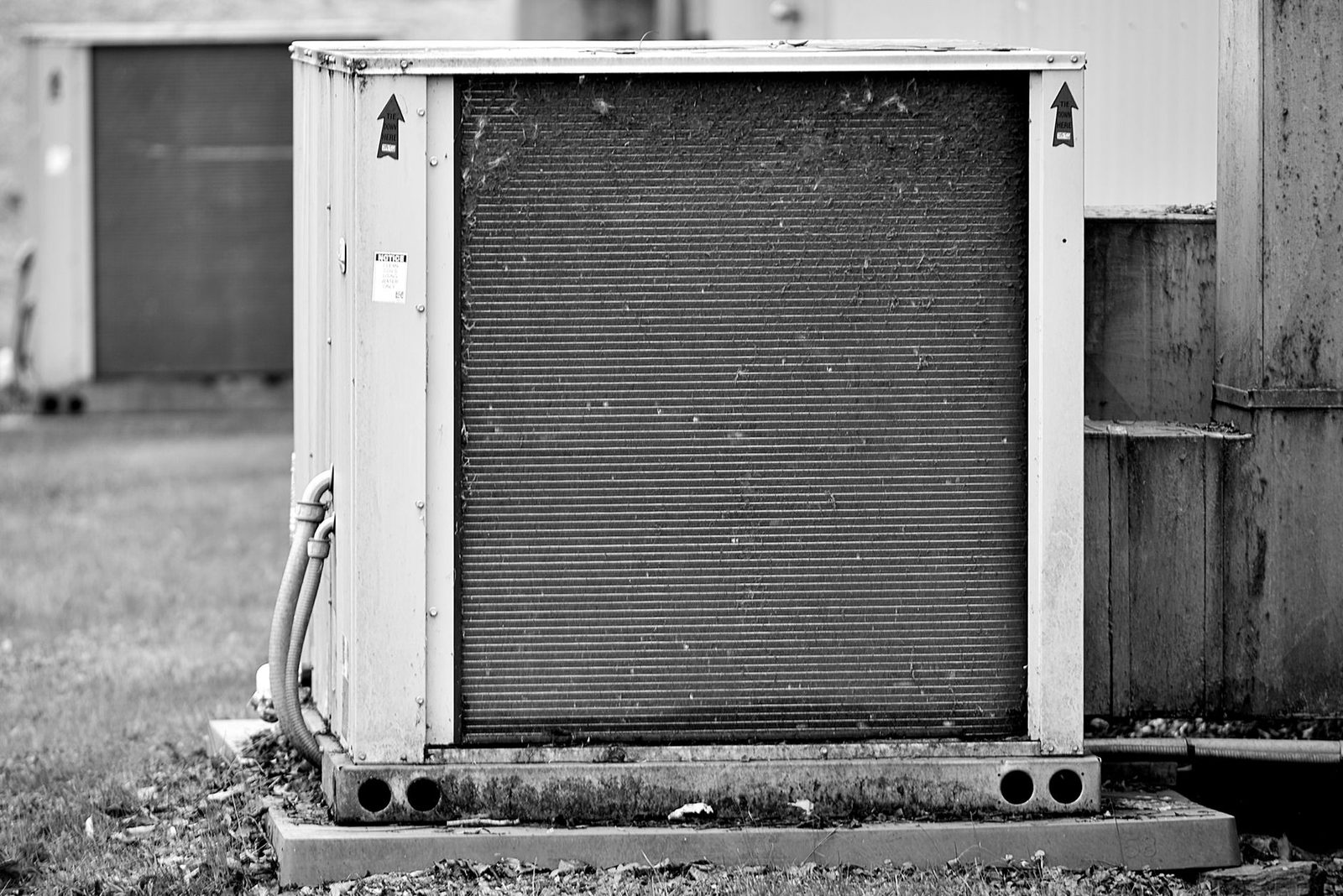
Why air conditioning is the blind spot of property sales
In a sale file in the Paris region, everything is framed: energy performance certificate, asbestos, lead, electrical and gas inspections, Carrez floor area, minutes of the last three general meetings of the building association, the amount of service charges. Air conditioning, however, falls under no mandatory survey at all. There is no equivalent of the electrical inspection for an air-to-air heat pump.
The result: the equipment is dealt with verbally. "It works very well", "we've had it serviced", "it's a Daikin." Three sentences that commit nobody and say nothing about the only parameter that matters: how many years of use are left, and at what cost?
We regularly visit buyers three to six months after they move in, only to discover:
- machines from 2010–2013 running on R410A, technically at the end of their life, where the slightest leak triggers the repair-or-replace decision;
- an outdoor unit mounted on the façade or in the courtyard with no trace whatsoever of approval at a general meeting;
- refrigerant pipework running through a shared duct, sometimes without fire sealing;
- condensate discharged into a rainwater downpipe or, worse, dripping onto the balcony below;
- a "5-year manufacturer's warranty" invoked by the seller, but non-transferable for lack of an invoice in their name and a registered commissioning.
None of these points blocks a sale. All of them can be priced, and all of them can be negotiated — provided they are known before signing.
The 9 points to check before you sign
1. The real age of the units, not the declared age
The rating plate on the outdoor unit carries a serial number and, with most manufacturers, a production date or week. It is the only non-negotiable piece of data. A seller may sincerely believe that "the AC is 5 years old" because they bought the property 5 years ago: the unit itself may well have been installed in 2011.
A realistic order of magnitude for a properly maintained residential wall-mounted split: 12 to 15 years of service life, sometimes 18 for high-end equipment under light use. Beyond 10 years, the buyer should think like someone buying a used car: the equipment works, but its trade-in value is low.
2. The refrigerant: R410A or R32
This is the single most decisive piece of information. It appears in plain text on the outdoor unit's plate ("Refrigerant: R410A, 1.45 kg").
| Refrigerant | Typical installation period | What it means when buying |
|---|---|---|
| R22 | before 2004 | Banned from recharging since 2015. Equipment to be replaced, full stop. |
| R410A | 2004 → 2018/2020 | Still rechargeable, but being progressively phased out under the F-Gas Regulation. Price per kilo rising steadily. |
| R32 | since 2018–2020 | The current residential standard. Parts and refrigerant widely available. |
| R290 (propane) | marginal in splits, growing | Recent technology, very low climate impact. |
An R410A installation is not doomed: it simply has no trade-in value. The right attitude for a buyer is to treat it as free comfort for 3 to 6 years, not as new equipment. We go through the decision in detail in our article on choosing between repairing or replacing an air conditioner over 10 years old.
3. Building-association approvals
This is the point that costs the most — and the easiest to check. In the minutes of the last three general meetings handed over by the notary, look for a resolution mentioning the installation, the fitting of an outdoor unit, or the name of the selling co-owner. If the installation is more than three years old, explicitly ask the seller or the managing agent in writing for the minutes of the general meeting that approved it.
Two scenarios:
- Approval voted and recorded: the equipment is in order, and the buyer inherits a right of private use. Perfect.
- No trace at all: the installation amounts to appropriating common property. Action for removal is time-barred after ten years (Article 42 of the Act of 10 July 1965), but it is the new owner, not the seller, who inherits the potential dispute. In a small building association, this is often settled by a regularisation resolution at the next general meeting — the approach described in our article on decision-making in a small building association with no professional managing agent.
4. The unit's service log
Above a 2 kg charge (roughly 5 kW of cooling capacity, so most multi-split and ducted systems), regulations require a periodic leak-tightness check by an operator holding a certificate of competence, with an intervention sheet issued (Articles R.543-75 et seq. of the French Environment Code). If the seller cannot produce a single sheet for an 8 kW multi-split, it means one simple thing: the unit has never been checked.
For a 2.5 kW single-split, there is no leak-tightness check requirement. Ask for the servicing invoices anyway: an 8-year-old air conditioner that has never been cleaned announces itself by smell long before it shows up on paper, and our article on musty smells and disinfection explains why.
5. Condensate drainage
During the viewing, find out where the water goes. Three sound configurations: gravity drainage into a wastewater downpipe with a trap, a condensate pump with a level safety switch, or a controlled outdoor discharge. One problematic configuration: a flexible hose poking out of the wall and dripping into thin air.
This is the leading cause of damage we see in apartments. Ask whether there has already been a water damage claim — and check the general meeting minutes, claims show up there.
6. The condition of the pipework and mountings
From outside, and from the courtyard if possible:
- is the refrigerant pipework insulated and sheathed, or bare and cracked by UV exposure?
- is the outdoor unit on anti-vibration mounts, or screwed straight into the wall shared with a neighbour's bedroom?
- are there signs of rust, oil seepage, persistent frost?
A simple indoor thermometer and hygrometer left in each room for 20 minutes during the viewing will already tell you whether the splits genuinely cool or heat the whole flat, or only the room they are installed in.
7. Remote controls, manuals and codes
A trivial detail with a real cost. A lost original remote control means €30 to €80; a proprietary Wi-Fi module that has not been reset stays paired to the seller's account; a missing manual means an hour of searching for every error code. Insist, at the handover inventory, on: all the remote controls, the printed manuals, and the disconnection of manufacturer accounts.
If the seller no longer has the manuals, the exact reference of the indoor unit (read off the side label) is usually enough to find them on the manufacturer's website. A small insulated multi-bit screwdriver and a head torch make reading it off far easier when the label sits behind the front panel.
8. Warranty transfer
Manufacturer warranties (often 3 to 5 years on parts, sometimes 5 years on the compressor, even 10 years subject to annual servicing) are generally attached to the installation, not to the person — but their activation almost always depends on commissioning declared by an approved installer and on documented servicing. Without an invoice or a registration certificate, the buyer is left with no recourse.
Two documents to have annexed to the preliminary sale agreement, if possible:
- the installation invoice in the seller's name (it carries the date, the brand, the model and the installer's name);
- the commissioning certificate or the warranty certificate.
The installer's ten-year structural warranty, for its part, follows the works and benefits the subsequent owner for defects affecting structural soundness or rendering the property unfit for its purpose: the subject is covered in detail in our article on the ten-year warranty on an air conditioning system.
9. How well the system matches your own use
The last point, and the most often forgotten. A system can be in perfect condition and unsuited to the buyer. Real examples:
- a 3.5 kW single-split in the living room and nothing in the bedrooms: the family buying the flat wanted to sleep in the cool;
- a ducted system sized for occasional cooling, bought by someone planning to replace their electric convector heaters;
- three splits driven from a single master remote control, with no room-by-room control.
If your plan is to heat with it, start by reading what a reversible air conditioner really delivers in heating mode from November to March. Sizing, meanwhile, has to be checked room by room — our method for calculating the kW is here: sizing your air conditioning.
What it is worth, in euros
Let's be concrete. Here are the ranges we see in the Île-de-France region, special cases aside, for the value to attribute to an inherited installation in a negotiation.
| Condition of the equipment | Realistic trade-in value | Spending to anticipate |
|---|---|---|
| R32 multi-split less than 5 years old, invoices and general meeting minutes provided | close to new (60–80% of the installation price) | annual servicing €120–200 |
| R32 aged 5 to 9 years, partial servicing history | 30–50% | servicing + deep cleaning €250–450 in the first year |
| R410A aged 10 to 14 years, working | ~€0: free comfort, not an asset | replacement to budget for: €2,500–4,500 per split, €6,000–12,000 for a multi-split or ducted system |
| No building-association approval | negative value | regularisation at a general meeting, or even removal: €400 to €1,500 for removal and façade repair |
| R22, or a unit idle for two seasons | negative value | removal with refrigerant recovery by a certified professional: €250–600 |
Two important remarks.
First, the 5.5% VAT rate applicable since July 2026 to air-to-air heat pumps (confirmed by publications from service-public.fr and the professional building press) changes the calculation: replacing ageing equipment now costs appreciably less than in 2025, which further reduces the appeal of keeping an R410A machine on its last legs. The conditions, particularly regarding which refrigerants are covered, remain to be watched.
Second, on the energy performance certificate (DPE) side, an installed reversible air-to-air heat pump is taken into account as a heating system as soon as it is fixed in place: its impact on the rating is far from negligible, especially in a home originally heated by convector heaters. We covered this in detail in our article on the DPE and property value.
For sellers: three hours of preparation, one selling point
If you are selling a property with a system installed, the information asymmetry works in your favour — but only if you document it. A simple file, stapled together and handed over at the first viewing:
- installation invoice and commissioning certificate;
- brand, model, capacity and refrigerant for each unit (photo of the rating plates);
- servicing invoices and, where applicable, leak-tightness check intervention sheets;
- extract from the general meeting minutes approving the installation;
- manuals and remote controls gathered in a plastic document wallet with flap along with the rest of the property's technical paperwork.
A ring binder with dividers for the home's technical documents costs a few euros and makes, in practice, a considerable difference in perception: the buyer moves from "I don't know what I'm buying" to "this has been looked after". In a Paris-region market where buyers negotiate on everything, this is the kind of detail that avoids a €3,000 precautionary discount.
And if your system is more than twelve years old, there are two honest options: state its age clearly and accept that it does not count towards the price, or have a technical survey carried out before putting the property on the market so you know what you are selling. An audit visit is billed in the region of €90 to €180 in Île-de-France — compare that to the discount it prevents.
The right timeline
The technical audit of the air conditioning system is done between the second viewing and the preliminary sale agreement, never after.
In practice:
- First viewing: photograph the rating plates of the indoor and outdoor units, count the splits, locate the condensate drainage.
- Before the offer: ask the agent or the seller in writing for the installation invoice, the servicing invoices and the general meeting minutes granting approval. No answer is an answer.
- Between offer and preliminary agreement: if the equipment matters to your plans (main heating, large volume, business premises), bring in a refrigeration engineer for a technical visit: checking pressures, supply air temperatures, operation in both cooling and heating modes, and the condition of the heat exchangers.
- At the preliminary agreement: have the documents you obtained annexed, and mention the equipment in the schedule of furniture and equipment included in the sale.
- At the key-handover inventory: remote controls, manuals, manufacturer accounts disconnected, filters checked.
One last practical tip: plan a thorough cleaning of the indoor units as soon as you move in, whatever age you have been told. You don't know who lived there, nor what state the fan wheels and drain trays are in. A set of replacement filters in the right reference and a foam cleaner for air conditioner heat exchangers are enough for routine upkeep between professional visits; the rest — dismantling the unit, disinfecting the fan wheel, checking the refrigerant circuit — remains the refrigeration engineer's job.
In summary
An air conditioning system inherited with a home is second-hand equipment with no registration document. Three pieces of information decide everything: its real age, its refrigerant, and the existence of written approval. The other six points on this list refine the figures, but those three make the difference between free comfort and a five-figure bill.
Are you buying or selling a property with a system installed in the Île-de-France region, and want to know what the installation is really worth? We carry out pre-purchase technical audit visits in Paris and the inner suburbs: book an appointment online or use our contact page to describe your situation. Three weeks before the preliminary agreement beats three months after the keys.
Need an air conditioning solution?