Portable monobloc air conditioner in 2026: the false good idea for tenants, and the real alternative to know about

The Proclimo team
25 Jul 2026 - 09 min read
Every summer, the same scene repeats itself: the heatwave arrives, the shelves of big-box stores groan under portable monobloc air conditioners at €299, €399, or €599, and furnished rentals equip themselves in panic mode. On paper, the promise is appealing: no installation, no outdoor unit, no co-ownership agreement — just plug it in, cool down, store it in September. In practice, the portable monobloc stacks up the flaws: it is noisy, power-hungry, fragile, and often costs more over five years than a real wall-mounted fixed split installed by a professional. Here is the full Proclimo briefing to make the right choice in 2026 — whether you are a tenant, an owner, in a co-ownership, or in a furnished rental.
What exactly is a portable monobloc air conditioner?
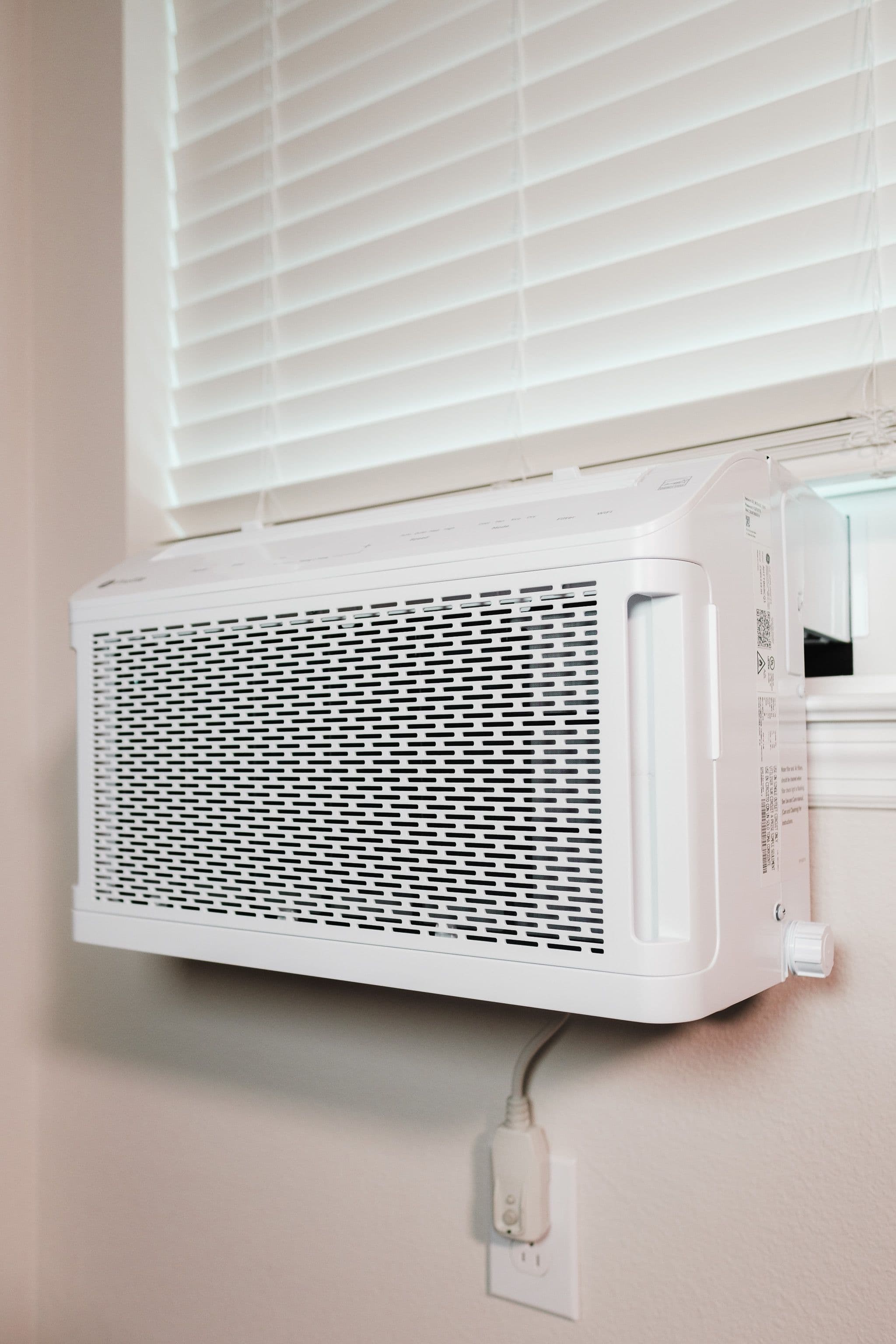
A portable monobloc air conditioner (also called a "mobile AC" or "portable air conditioner") is a single unit, placed on the floor on casters, that draws warm air from the room, cools it via a compression refrigeration circuit, and expels the warm air outside through a flexible hose (duct) passed through a half-open window or a dedicated hatch. The condenser, the compressor, and the evaporator are all housed in the same casing.
Three families exist on the French market in 2026:
| Type | Power | Target | Indicative price |
|---|---|---|---|
| Mini monobloc (5,000 to 7,000 BTU) | 1.2 to 2 kW | Bedroom 10-15 m² | €200-350 |
| Standard monobloc (9,000 to 12,000 BTU) | 2.5 to 3.5 kW | Living room 20-30 m² | €350-600 |
| High-power monobloc (14,000 to 18,000 BTU) | 4 to 5.2 kW | Large room 35-50 m² | €600-1,200 |
The most common brands in big-box stores and online: Equation (Leroy Merlin), Oceanic, Rowenta, Whirlpool, De'Longhi, Electrolux, AEG. Entry-level models under €250 have an average lifespan of 1 to 2 summers before compressor failure.
The 7 flaws that sellers don't show you
1. Omnipresent noise — including at night
The compressor is inside the room. Every summer night, you sleep with a 50 to 65 dB(A) motor one metre away, which is also pulsating (thermostat on/off cycles). By comparison, the indoor unit of a wall-mounted split drops to 19-25 dB(A) in silent mode — the equivalent of a rustle of leaves. For a child's bedroom, an office, or a studio, the difference is a deal-breaker.
2. Electricity consumption up to 3 times higher
A monobloc has an EER (Energy Efficiency Ratio) of 2.0 to 2.7, compared to 3.5 to 4.5 for a modern inverter split. In other words, for 1 kWh of electricity consumed, you get:
- 2.0 to 2.7 kWh of cooling from a basic monobloc,
- 3.5 to 4.5 kWh of cooling from a class A++ inverter split.
Over 4 summer months (June-September) at 8 hours of operation per day, a 12,000 BTU monobloc consumes 350 to 500 kWh, i.e. €80 to €115 of electricity at the 2026 regulated tariff. The same comfort with an inverter split costs you €40-60. Over five summers, that's a €200-275 difference.
3. The exhaust hose: the false freedom
"No installation, you set it up and it works": in theory, yes. In practice, the 1.5 m flexible hose creates two immediate problems:
- It blocks the window by 15-20 cm, which lets hot outdoor air in, degrading performance by 10 to 20%.
- It blows a cloud of hot air at 50-60 °C and an audible mechanical breath toward the street or courtyard. In Paris, Lyon, or Marseille, several co-owner associations have already won in court for neighbourhood disturbance, even with a rental monobloc.
Without an openable window, you have to drill through a wall or a door — which, in a rental, is strictly forbidden without the landlord's written consent.
4. Condensation water: a second device to manage
The compressor of an air conditioner condenses the humidity in the air. On a wall-mounted split, this water drains by gravity (gutter) or via a condensate pump. On a portable monobloc, it accumulates in an internal tank that must be emptied every 1 to 7 days depending on humidity. In the middle of July in Marseille, that's 1-2 litres per day. Forget to empty it → the unit goes into safety mode and stops cooling. Some models have continuous drainage, but this requires a floor drain nearby.
5. A very short lifespan
A properly maintained wall-mounted split lasts 15 to 20 years. A portable monobloc, on the other hand, rarely exceeds 3 to 5 seasons before compressor failure, tank leak, or electronic board defect. At €450 per unit, that represents an annualised cost of €90 to €150 in pure depreciation, to which you add electricity. A split installed at €1,800 incl. VAT comes out to €90-120 per year over 15 years — and it cools 2 to 3 times better.
6. Degraded thermal comfort
Unlike an inverter wall-mounted split, a portable monobloc has no true fine regulation. The temperature oscillates by ±2 to 3 °C around the setpoint (on/off cycles), which causes sensations of cold then warm. The inverter split, on the other hand, modulates its power continuously and holds the setpoint to ±0.5 °C. For people with asthma, sensitive to variations, or simply demanding, the difference is clear.
7. R32 refrigerant: allowed, but must be recycled
Monoblocs sold in France in 2026 mostly use R32 (GWP 675) or, on a few models, R290 propane (GWP 3, but flammable). R32 complies with the F-Gas Regulation 2024/573 applicable in 2026, but at end of life of the unit, the refrigerant must be recovered by an approved operator — not dumped at the standard waste collection centre. This is a constraint that few sellers mention.
The real economic comparison over 5 years
For a 25 m² room in the Paris region, operating 8 h/day from June to September, 2026 regulated tariff (€0.25/kWh):
| Item | 12,000 BTU portable monobloc | 2.5 kW inverter wall-mounted split (class A++) |
|---|---|---|
| Purchase price | €450 | €850 |
| Installation by RGE professional | €0 (self-installed) | €950 (€1,800 incl. VAT all-in) |
| Electricity over 5 summers | €1,000 (≈ €200/year) | €500 (≈ €100/year) |
| Appliance replacement | 1 time in year 3 (€450) | None |
| Checks / maintenance | Filter cleaning (DIY) | €250 over 5 years (1 visit/year) |
| Total cost over 5 years | €1,900 | €2,600 |
| Total cost over 10 years | €3,350 (2 replacements) | €2,850 (1 maintenance/year) |
| Thermal comfort | Mediocre, 2-3 °C oscillations | Excellent, ±0.5 °C |
| Noise | 50-65 dB(A) | 19-25 dB(A) in silent mode |
Beyond 5 years, the fixed split is unbeatable. And with the 5.5% VAT applicable since the decree of 13 July 2026 on reversible class A+ and A++ air-to-air heat pumps, the gap on initial investment is reduced even further. See our detailed article on reduced VAT at 5.5% on reversible air conditioning.
The real alternatives for tenants and co-ownership
Option 1 — The wall-mounted split with a discreet outdoor unit (our preferred choice)
Contrary to a common misconception, installing a split in a rental is possible with the landlord's written consent. The reversible installation agreement provides for:
- Free removal at the end of the tenancy,
- Restoration of the façade (filling in the duct passage, painting),
- No alteration to the building's structure.
In Paris co-ownerships, the outdoor unit on a balcony, courtyard façade, or rooftop terrace goes through a general meeting (absolute majority vote, art. 25 of the law of 10 July 1965), with an acoustic technical file to be provided since the decree of 22 December 2025. Allow 2 to 4 months for review. The result: an air conditioner 2 to 3 times more efficient, 10 times quieter, and which also heats in winter (reversible heat pump). For details, see our guide to installing air conditioning in an apartment and our article on air conditioning noise in co-ownership.
Option 2 — The multi-split: air-condition the whole home with a single outdoor unit
For a 1-bed or 2-bed apartment, the multi-split (2 or 3 indoor units + 1 outdoor unit) air-conditions all rooms with a single unit on the façade. This is the preferred solution for landlord-owners renting out a furnished property. Investment: €3,500-5,500 incl. VAT installed, eligible for the 5.5% VAT and the CEE "Coup de Pouce Chauffage".
Option 3 — Ducted air conditioning (for new builds or major renovations)
Ducted systems hide the indoor unit in the attic or a false ceiling and distribute the cool air through discreet grilles. It is the most aesthetic and most efficient solution, but it requires significant work: duct reservations, false ceiling, etc. Reserved for comprehensive renovations and new builds. See also our article on the reversible air-to-air heat pump.
Option 4 — Passive cooling (without air conditioning)
Blinds, ceiling fans, night ventilation, greening: for those who can tolerate heat up to 28-30 °C, these free or low-cost solutions are often enough. Our complete guide to cooling a home without air conditioning details the right steps.
Option 5 — The monobloc, but in "emergency short-term" mode
If you are on a 1 to 2-week holiday rental in an un-air-conditioned property, the portable monobloc rented from a big-box store (often €30-50 per week) remains relevant. Beyond that, it is a false economy. For breakdowns in the middle of a heatwave while your split is out of order, see our emergency air conditioning repair service in Île-de-France.
The special case of noise in co-ownership
The decree of 22 December 2025 strengthens acoustic obligations for any installation, including portable monoblocs. In practice, a monobloc on the façade with an exhaust hose can be considered an abnormal neighbourhood disturbance if the emergence exceeds 5 dB(A) during the day or 3 dB(A) at night at the measurement point in the neighbour's home (decree of 31 August 2006, art. R. 1334-30 of the Public Health Code). At 50-65 dB(A) 1 m from the unit, the threshold is quickly exceeded in adjoining housing. For Parisian buildings, the co-ownership rules may also prohibit ducts on the street-side façade. Our dedicated article on air conditioning noise and neighbours covers the possible remedies.
The Proclimo decision table
Before buying, ask yourself these 7 questions:
| Question | If yes | If no |
|---|---|---|
| You are staying less than 2 months in the home? | Monobloc rented from a big-box store | Move on to the next question |
| The room to be cooled is more than 30 m²? | Fixed split, oversized | Monobloc possible, but compare |
| You have an openable south-facing window? | Monobloc or split possible | Fixed split only (drilling) |
| You are in a co-ownership with strict rules? | Monobloc (subject to noise) | Acoustic study required |
| You own the home? | Fixed split (long-term return) | See landlord's agreement |
| You also want to heat in winter? | Reversible heat pump (mono or multi-split) | Cooling-only split |
| Your total budget (installation included) is under €600? | Monobloc as a stopgap | Fixed split from €1,800 incl. VAT |
In 80% of the cases we see in Île-de-France, the wall-mounted fixed split is the right answer: better comfort, lower noise, lower total cost from year 5 onwards, and eligibility for 2026 grants (5.5% VAT, CEE, MaPrimeRénov' subject to conditions).
Why Proclimo does not sell monoblocs
We are a multi-certified RGE installer (QualiPAC and Qualifroid) in Île-de-France, and our business is to sell lasting comfort, not stopgaps. A portable monobloc at €450 seems to us to be a bad deal for our customers — which is why we prefer to inform you objectively, even if it means recommending that you buy nothing if your needs are modest (blinds + ceiling fan + night ventilation cover 80% of situations outside extreme heatwaves). If despite everything you choose a monobloc, buy it from a retailer that takes back old units to recycle the R32 refrigerant.
Take action with Proclimo
Proclimo operates in Île-de-France (75, 77, 78, 91, 92, 93, 94, 95) for the installation, maintenance, and repair of all types of air conditioning: mono-split, multi-split, ducted, reversible air-to-air heat pump, and tertiary solar air conditioning. Our integrated offering covers the audit, sizing, installation by a refrigeration engineer certified with a refrigerant capacity attestation, and the annual maintenance contract.
- Free on-site assessment: a technician comes to measure the room, identify constraints (co-ownership, façade, electrical) and give you a comparative quote for a fixed split vs. monobloc.
- Wall-mounted split and multi-split installation: Daikin, Mitsubishi Electric, Atlantic, Fujitsu, Hitachi brands, with 5-year manufacturer warranty and maintenance contract.
- Annual maintenance contract: filter cleaning, leak check, R32 refrigerant inspection, compliant with the maintenance obligation.
- Emergency repair 7 days a week: intervention within 24 to 96 hours in Île-de-France.
Contact Proclimo for a free assessment, or book your audit online. We operate in compliance with the 5.5% VAT on reversible air conditioning, the 2026 RGE reform and best practices for adjustment during heatwaves. For an informed air conditioner purchase, also check out our guide to choosing the right air conditioner in 2026 and our comparison of reversible air-to-air models.
Sources: ADEME — "How to cool down without air conditioning?" (2024 guide) · Légifrance — Decree No. 2025-1342 of 22 December 2025 on neighbourhood disturbance · Légifrance — Decree of 13 July 2026 amending Annex IVA of the CGI (5.5% VAT on reversible heat pumps) · Regulation (EU) 2024/573 of the European Parliament and of the Council of 7 February 2024 on fluorinated greenhouse gases · Public Health Code — art. R. 1334-30 (acoustic emergence) · Law No. 65-557 of 10 July 1965 setting the status of co-ownership — art. 25 (absolute majority) · France Rénov' — Directory of RGE installers · CEREMA — Acoustic guide for air conditioning installations in residential buildings (2025) · ADEME — "Portable air conditioners: an unfavourable energy balance" fact sheet (2023) · UFC-Que Choisir — Portable air conditioner test 2025 · Hello Watt — 2026 portable air conditioner buying guide · 60 Millions de Consommateurs — Monobloc air conditioner comparison 2025.
Need an air conditioning solution?