Air Conditioning a Converted Basement or Garage in Paris

L'équipe Proclimo
4 Nov 2026 - 09 min read
"We turned the garage of our house in Fontenay-sous-Bois into a teenager's bedroom with a shower room. The work was finished in March: plasterboard, floating floor, one transom window. In summer the room hit 29 °C even though it's half below ground; in winter the convector heater runs non-stop and the place smells stale. Two installers came round: the first suggested a 2.5 kW split system within ten minutes, the second turned the job down, saying 'you don't do that in a basement'. Who's right?"
Both are wrong, and that is exactly why we get calls like this one. A partly below-ground space is not just an ordinary room with fewer windows: it is a microclimate, where humidity drives everything and where air conditioning is only the last building block of a wider system. Installed on its own, it often creates more problems than it solves.
This article does not revisit topics already covered on this blog — building management approvals, outdoor unit noise, repair costs, dehumidifier versus air conditioner. It describes the specific working method for garages, cellars, basements and semi-buried levels converted into living spaces in the Paris region: bedroom, rental studio, home gym, home office, workshop, utility-cum-shower room. A fast-growing segment in the suburban housing of the 92, 93 and 94 départements, and in older Parisian buildings with vaulted cellars.
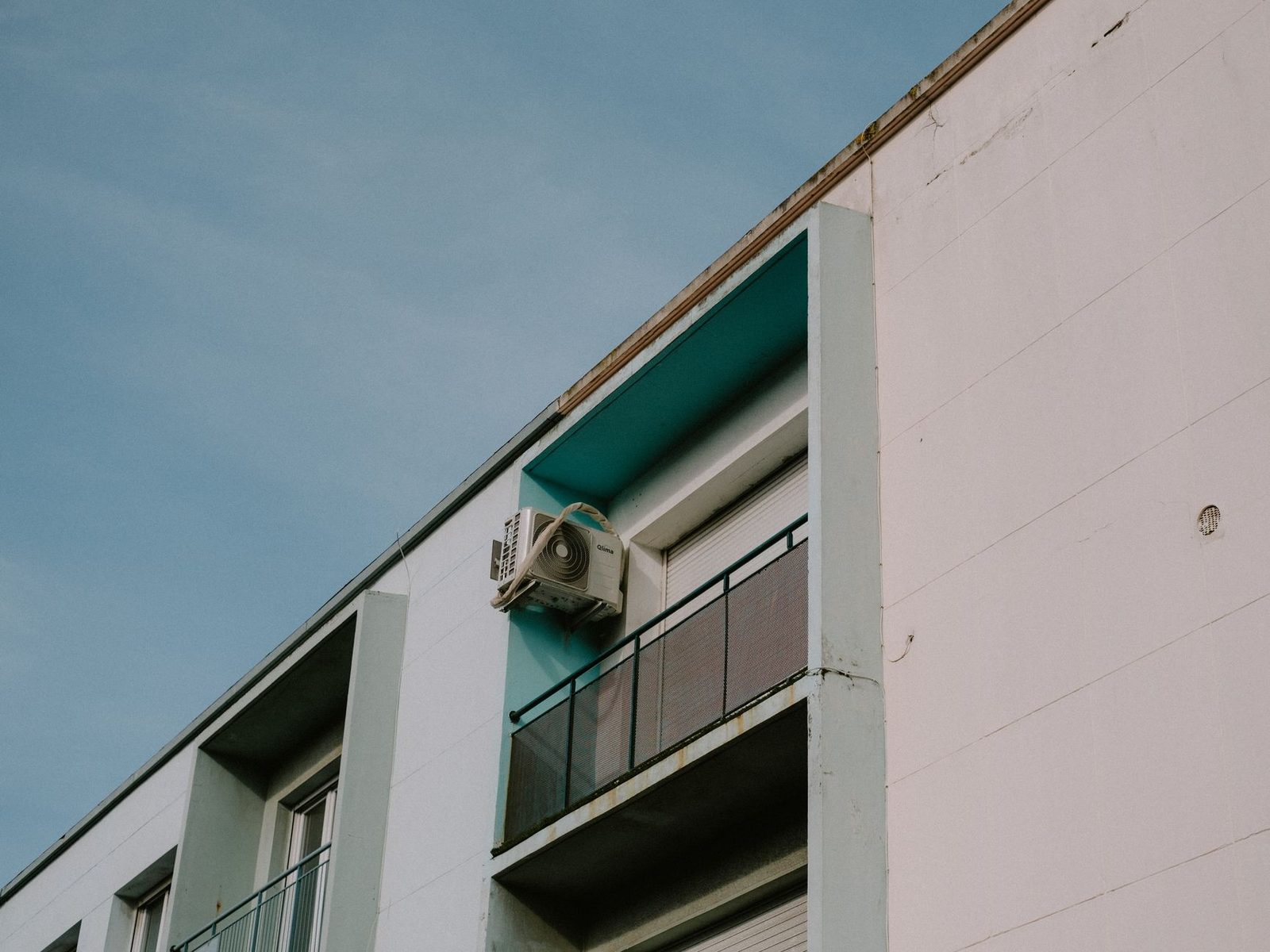
Why a basement behaves in exactly the opposite way to an upper floor
In a typical Paris-region house, heat comes from above: roof, loft, south-facing windows. We set this out in detail in our article on the hot upper floor of a house and treating the loft. A basement works in exactly the opposite way, with four distinctive features:
- ground inertia: buried walls stay between 13 and 17 °C all year round in the Paris region. A basement warms up slowly, but it also cools down very slowly;
- internal heat gains dominate: there is almost no solar gain, so heat comes from occupants, lighting, appliances — and very often from the adjoining plant room (boiler, hot water tank, washing machine, freezer, internet router, server);
- the air is the most humid in the house: cold walls + warm air coming down from upstairs = condensation on cold spots. This is the mechanism described in our feature on damp, condensation and mould;
- air renewal is virtually nil: one transom window, sometimes a vent, rarely a mechanical ventilation system that actually serves the level.
The practical consequence: a converted basement almost never has a cooling capacity problem. It has a humidity and fresh-air problem, and a winter heating requirement that is greater than owners imagine.
A rule we apply on every technical survey: if the measured relative humidity exceeds 70 % under normal conditions, no installation goes ahead until the cause has been dealt with. An air conditioner fitted in those conditions becomes an odour diffuser within six months.
Step zero: measure before sizing
Before any quotation, we ask for two to three weeks of readings. Not to buy time: because the figures almost always contradict what people feel.
What should be measured, and what the owner can do themselves:
| Parameter | Tool | Alert threshold |
|---|---|---|
| Temperature and relative humidity | digital thermometer-hygrometer placed 1.20 m above the floor | RH > 70 % or < 35 % |
| Surface moisture of buried walls | visual inspection + tape test on the skirting | marks, saltpetre, peeling |
| Air renewal | sheet of paper held in front of the vent / transom | no suction at all |
| CO₂ (if used as a bedroom or office) | indoor CO2 sensor | > 1,200 ppm by the end of the night |
A simple €15–25 digital thermometer-hygrometer left in place for a fortnight produces a more useful curve than any estimate. In a healthy Paris-region basement, you would expect 18–22 °C and 50–60 % relative humidity. Above 70 %, there is water ingress, a significant thermal bridge or a ventilation fault — and sometimes all three.
The three causes of damp that air conditioning will not remove
- Lateral water ingress or rising damp. An undrained buried wall absorbs water from the ground. No thermal equipment corrects this: it is structural work (perimeter drainage, tanking, water-repellent render). We decline installation in such cases, and we put it in writing in the survey report.
- Condensation on cold walls. It disappears once you insulate on the inside with a ventilated air gap, or once you heat the space continuously rather than in bursts. This is where an air-to-air heat pump becomes relevant.
- Internal moisture production with no extraction. An unvented tumble dryer, a shower with no extract fan, laundry drying indoors. A remote humidistat paired with mechanical extraction solves 80 % of these cases for a few hundred euros.
What equipment actually works in a below-ground space
The wall-mounted split remains the baseline — but not just any model
In the vast majority of cases, the technical solution is a reversible single-split R-32 unit of 2 to 3.5 kW, with two specific requirements:
- a genuinely low operating range in heating mode: the room must be heatable in January, when the outdoor unit — often sited at ground level in a yard or against a boundary wall — is working at -5 °C. Check the heat output delivered at -7 °C, not the nominal rating;
- a dehumidification mode independent of cooling (often labelled dry), able to run in the shoulder seasons without dragging the room down to 19 °C.
We set out the calculation method in our guide to room-by-room sizing in kW. In a basement, we systematically increase the heating requirement and reduce the cooling requirement: the opposite of what an online configurator does.
The case of the Parisian vaulted cellar
Cellars built of millstone or rubble masonry in Haussmann-era buildings present a different problem: the walls are breathable and thermal inertia is enormous. Fitting a split system there without ventilation turns the cellar into a condensation trap as soon as warm summer air is introduced. In such spaces we almost always work in two stages: first controlled mechanical ventilation, and only then the thermal equipment. The façade and courtyard constraints are the ones described in our article on the Haussmann-era apartment and heritage architect constraints.
What to rule out
- The portable monobloc air conditioner: it exhausts through a hose run out of the transom window, so it continuously draws hot, humid outdoor air into the coolest space in the house. It is the worst possible environment for it, for the reasons set out in our analysis of portable monobloc units and their real alternatives.
- Electric supplementary heating on its own: it dries the air at the surface without dealing with the water vapour, and costs three times as much to run as a heat pump.
- A dehumidifier alone in summer, if there is no extraction at all: it dehumidifies by reheating the air, which can raise the perceived temperature.
The technical point that derails half of all projects: condensate
This is constraint number one in a below-ground space, and the one that rushed quotations overlook.
In summer, an indoor unit in a basement produces 0.5 to 1.5 litres of condensate per hour of operation. On an upper floor, it drains outside by gravity. In a basement there is no low point available: the water has to be lifted.
Three possible arrangements, in decreasing order of reliability:
- Gravity drainage to an existing inspection chamber or sump, where the layout allows. Minimum fall of 1 to 2 cm per metre, trap mandatory.
- A built-in or remote condensate pump, connected to a foul or surface water drain in the shower room, with a trap and a non-return valve. This is the most common solution. It requires maintenance access — an access hatch, not a screwed-on sheet of plasterboard.
- A collection tray + alarm, as a fallback solution only.
In the last two cases, we now systematically fit a connected water leak detector at the foot of the wall below the unit, and sometimes a drip tray beneath the indoor unit. For €30 to €60, this avoids damage to a brand-new floating floor. Liability rules in the event of a claim are explained in detail in our article on air conditioning and home insurance, and the mechanics of the failure itself in the one devoted to condensate drainage.
A condensate pump is a consumable: typical service life 5 to 8 years, longer if it is cleaned at every service. In a basement it runs more often than anywhere else. Insist that the exact part reference appears on the installation invoice.
Ventilation: the requirement owners discover too late
Converting a garage into a bedroom or a rental studio brings the room within the scope of decent housing rules (French decree no. 2002-120 of 30 January 2002): ceiling height, floor area, natural light and adequate ventilation. A space with no opening window and no mechanical extraction fails that criterion, however well air conditioned it is. And the Règlement sanitaire départemental (departmental public health regulations), enforced in Paris notably by the Préfecture de police, governs the ventilation of habitable rooms.
A crucial point if the garage remains partly a garage, or if it connects to a plant room:
- any connection to a room housing a gas boiler or used for parking a vehicle must remain sealed (fire door, no transfer grille). Air conditioning in recirculation mode filters out neither carbon monoxide nor hydrocarbon vapours;
- a carbon monoxide detector is basic common sense in a converted basement adjoining a boiler, on top of the legally required smoke alarm;
- if the room is a bedroom, aim for permanent air renewal: humidity-controlled extraction or a decentralised heat-recovery ventilation unit — one of those small through-wall boxes fitted into a 160 mm core hole.
Ventilation does not replace air conditioning, and air conditioning never replaces ventilation. We explained this for the home as a whole in our article on mechanical ventilation during a heatwave.
Realistic budget in the Paris region
Ranges observed on our Paris-region projects, installation included, excluding structural work:
| Item | Indicative range |
|---|---|
| Reversible single split 2.5–3.5 kW R-32, standard installation | €1,900 – 3,200 incl. VAT |
| Extra for condensate pump + access hatch | €250 – 500 |
| Long refrigerant line or trenched run out to the yard | €300 – 900 |
| Humidity-controlled extraction or decentralised heat recovery ventilation | €600 – 1,800 |
| Technical survey + humidity readings | €0 – 180 (often deducted from the quotation) |
Since 2026, the 5.5 % VAT rate applies to air-to-air heat pumps in homes completed more than two years ago; the conditions and supporting documents are set out in our article on reduced VAT on reversible air conditioning. Note: a room created out of a garage must genuinely be designated for residential use to qualify, which means filing a change-of-use declaration with the town hall when the floor area changes (articles R. 421-14 et seq. of the French planning code).
The 12 lines to check on a quotation are listed in our dedicated guide to air conditioning quotations. For a basement, add three more: the condensate drainage method, maintenance access, and heating performance at -7 °C.
Maintenance: a stricter regime than upstairs
A unit in a below-ground space gets dirty faster: more humid air, mineral dust, sometimes textile fibres from the laundry area.
- filters every 3 to 4 weeks in continuous use, as against 6 to 8 elsewhere — see our protocol on cleaning filters;
- condensate tray and pump to be checked twice a year;
- indoor heat exchanger to be disinfected annually by a professional: this is where the odours described in our article on air conditioning that smells musty or of drains begin;
- let the machine run in fan-only or dehumidification mode for a few hours a week in winter, rather than switching it off for six months: a damp heat exchanger left idle goes mouldy.
An annual maintenance contract is more justified here than anywhere else. Full details of our services are on the air conditioning servicing and cleaning pages; for a breakdown, see our article on the cost of a repair call-out in the Paris region.
The five questions to ask your installer
- Have you recorded the relative humidity of the space over several days, or only at the moment of the visit?
- Where does the condensate go, and how do you get at the condensate pump in three years' time?
- What heating output does the unit deliver at -7 °C outdoors?
- Does the space have a fresh-air supply independent of the air conditioning? If not, what do you propose?
- Is there any connection to a plant room, a car park or a boiler, and how is it dealt with?
A professional who answers all five without hesitating has done the job before. The one who proposes a split system within ten minutes has not.
Key takeaways
A garage, cellar or basement converted in the Paris region can be air conditioned very successfully — provided you reverse the usual order of operations: make the fabric sound, then ventilate, and only then fit the air-to-air heat pump. The real budget often comes out 30 to 50 % above a standard split system because of condensate pumping and ventilation, but a well-equipped below-ground room becomes the most stable in the house: cool in August without working hard, cheaply heated in February.
Converting a semi-buried level in Paris or the surrounding region and want to know whether the installation is feasible before committing to the finishes? Bring in a technician before the plasterboard goes up: book a technical survey.
Need an air conditioning solution?