Air Conditioning for Hair & Beauty Salons in Paris Region

L'équipe Proclimo
9 Nov 2026 - 09 min read
Updated on
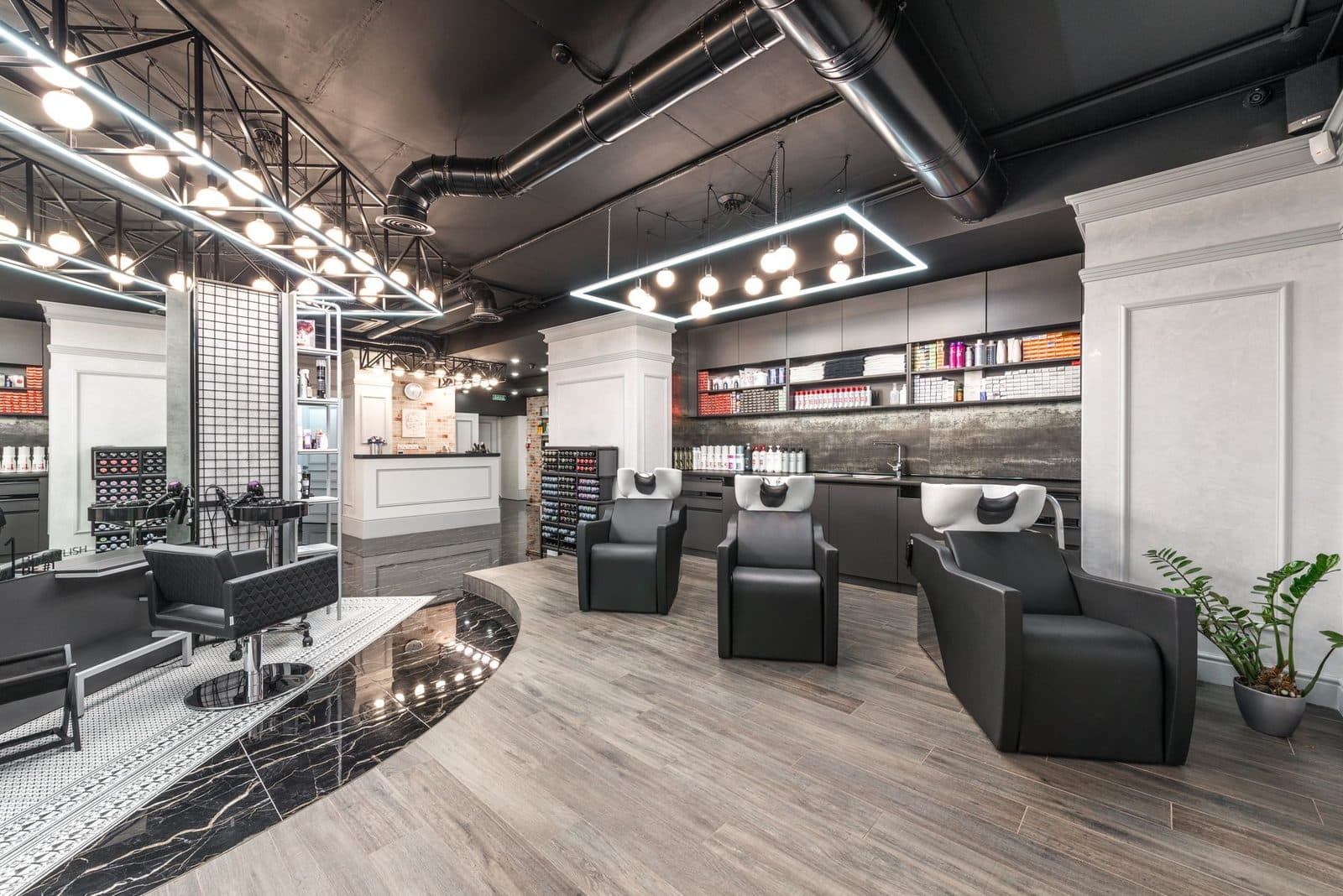
"We run a 58 m² hair salon in Levallois-Perret: six cutting stations, two wash basins, a barber area at the back. In 2022 an installer fitted two 5 kW wall-mounted splits, one at each end of the room. In summer, the clients under the dryers are too hot and the ones waiting by the entrance get a chill down their backs. In winter, the same unit blows hot air onto the cuts and the colour dries too fast. And for the past year, when we switch on in the morning, there's a smell of stale hairspray. We've been offered a third unit."
A third unit will fix nothing. A hair salon is not an air-conditioned shop: it is a space that simultaneously produces very localised dry heat, water vapour at the basins, aerosols of chemical products, and that hosts clients sitting motionless for forty-five minutes. Four conflicting heat loads across 50 or 60 m², with people sitting in the airflow. No pair of splits fitted "one at each end" can answer that.
This article does not revisit topics already covered on this blog — commercial leases and building-management consent, outdoor unit noise, the cost of a repair call, mandatory servicing. It describes the working method specific to the beauty and wellness trades in Île-de-France: hair salons with wash basins and a drying area, barbers, beauty institutes with treatment rooms, nail bars, laser hair-removal centres, urban spas with a wet room, massage studios. The enquiries all look alike: a retail-grade machine fitted to a space that produces heat and humidity.
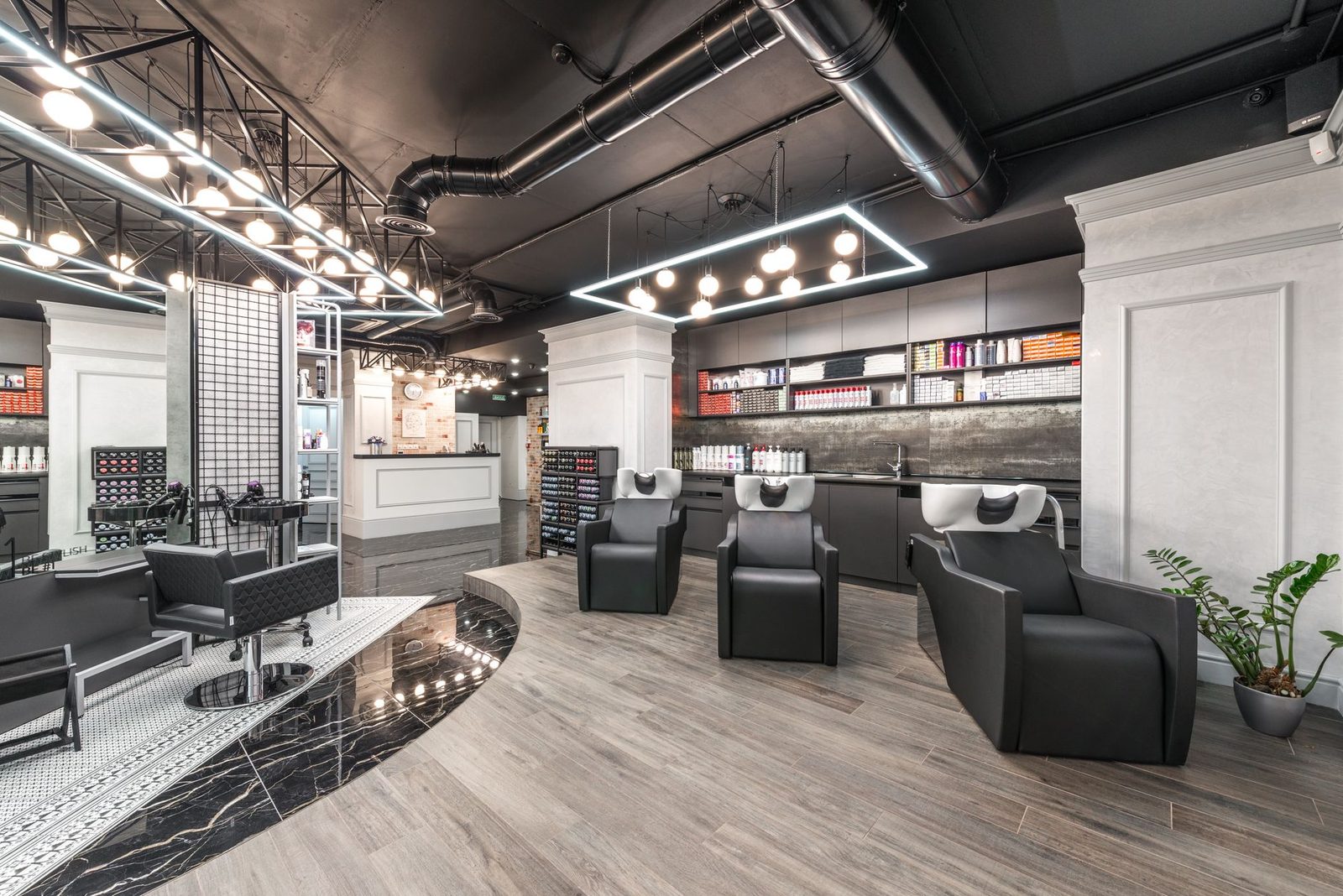
Four heat loads that don't play the same tune
In a 50 to 80 m² salon in the Paris region, heat gains are distributed very differently from what a standard quote assumes.
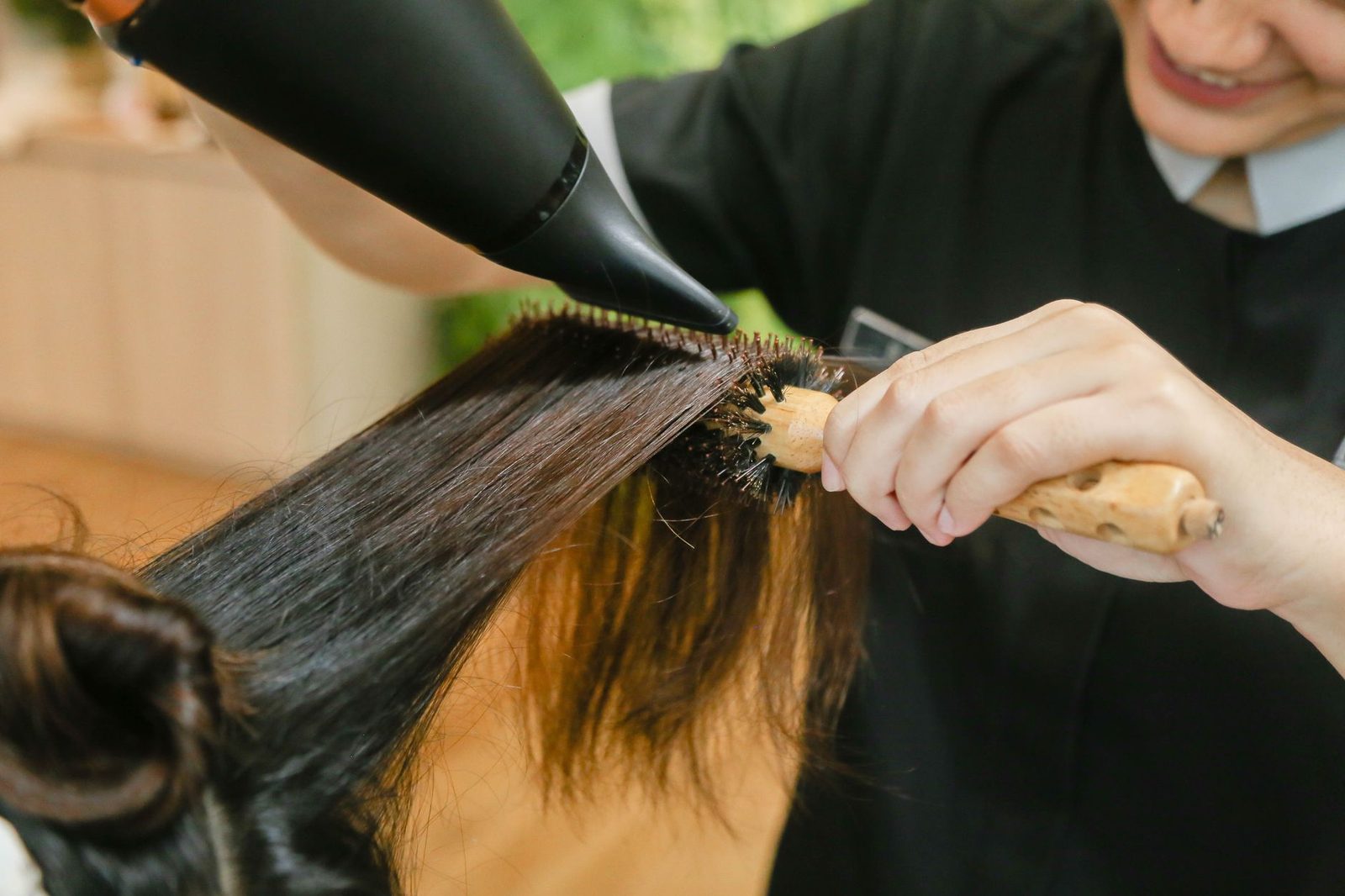
Dryers and styling appliances. This is the most underestimated load. A professional hairdryer draws 1.8 to 2.2 kW; a hood dryer 0.8 to 1.2 kW; a straightener or curling iron 0.2 kW each. In a six-station salon where three hairdryers are running at once at the end of the day, you have 4 to 6 kW of dry heat injected at head height, the equivalent of the solar load of an entire shopfront. And that heat arrives in three-minute bursts, not continuously.
The wash basins. Hot water, steam, damp towels: the basins are a permanent source of latent humidity. In summer, this vapour pushes relative humidity beyond 65%, which ruins any sense of coolness even at 24 °C. The air reads cool on the thermometer and feels clammy.
The products. Hairsprays, ammonia-based bleaches, nail polish, removers, extension adhesives, straightening products: these are volatile organic compounds. The INRS (French National Research and Safety Institute), in its guidance sheets on hairdressing and beauty professions, stresses ventilation as the first line of defence against staff respiratory exposure. Air conditioning never replaces ventilation: it recirculates the room's air without renewing it. That is the costliest confusion in this trade.
Motionless clients. A seated person gives off 80 to 100 W, but above all they cannot tolerate a draught. A standing customer in a shop passes through the airflow; a client having their colour done receives it on the back of the neck for forty minutes. That is where almost all the complaints come from.
Add lighting to this: salons are brightly lit, often with light bars around the mirrors. Even with LEDs, allow 10 to 15 W/m²; with halogens still in place, you climb to 25 W/m² or more.
The real calculation: why quotes are 40% off
The rule of thumb of "100 W/m²" gives 5 to 6 kW for a 55 m² salon. That is far too little. Here is how an honest estimate is built — always to be confirmed by a site visit, never over the phone.
| Item | Hair salon 55 m², 6 stations | Beauty institute 60 m², 3 treatment rooms |
|---|---|---|
| Building envelope (walls, shopfront, ceiling) | 2.5 to 3.5 kW | 2.5 to 3.5 kW |
| Occupants (clients + staff) | 0.8 to 1.2 kW | 0.5 to 0.8 kW |
| Lighting | 0.6 to 1.2 kW | 0.4 to 0.8 kW |
| Styling / drying appliances | 3 to 5 kW | 0.3 to 0.8 kW (treatment devices) |
| Latent load (basins, steam, wet room) | 0.8 to 1.5 kW | 1 to 2.5 kW with a steam room or steam cabin |
| Total estimated requirement | 8 to 12 kW | 5 to 8 kW |
Two lessons. First, a hair salon requires almost twice the cooling capacity of a clothing shop of the same floor area. Second, a beauty institute is an entirely different problem: less dry heat, far more humidity, and a need for different temperatures from one room to the next.
For the full room-by-room method, read our guide to sizing air conditioning in kW: it applies as it stands, provided you add the "trade appliances" line that quotes systematically leave out.
The real issue: where to put the air outlets, not how many kW
A correctly sized salon with badly directed airflow remains uncomfortable. Three mistakes come up in almost every space we visit.
Blowing along the line of the cutting stations. A wall-mounted split facing the row of chairs sends its airflow onto the clients' necks. In cooling mode, clients complain; in heating mode, colour and blow-drying suffer, and stylists cannot hold a style. The rule: the airflow must pass above head height, parallel to the row, never perpendicular to it.
Putting the unit above the waiting area. It's the free spot, so it's the chosen spot. But the waiting bench is where people stay fully dressed and inactive: that's where they feel cold first. The waiting area must be the furthest from any direct airflow.
Ignoring the basin corner. The basins are often at the back, in a poorly ventilated nook. The result: a permanent pocket of warm, humid air, a damp-towel smell, and mould on the ceiling within two years.
In practice, for a 50 to 80 m² salon, three configurations hold up:
- 4-way ceiling cassettes if the space has a suspended ceiling or one can be created: this is the most comfortable solution, because the airflow is diffuse, high up, and adjustable vane by vane (you close the vane blowing onto the chairs);
- ducted systems with linear grilles, ideal when the look of the space matters and you want multiple diffusion points; it is also the only solution that allows a treatment room to be handled separately. Our ducted versus wall-mounted split comparison sets out the trade-offs in height and cost;
- wall-mounted multi-split fitted high with deflectors, when budget or ceiling height rules out the rest. Acceptable, provided the units are placed on the end walls and not facing the stations.
In every case, plan for an anti-vibration wall bracket for the outdoor unit if it is fixed to a courtyard-facing wall: that is what prevents vibration being transmitted into the structure, and therefore letters from the building manager.
Beauty institutes, spas and treatment rooms: the requirement reverses
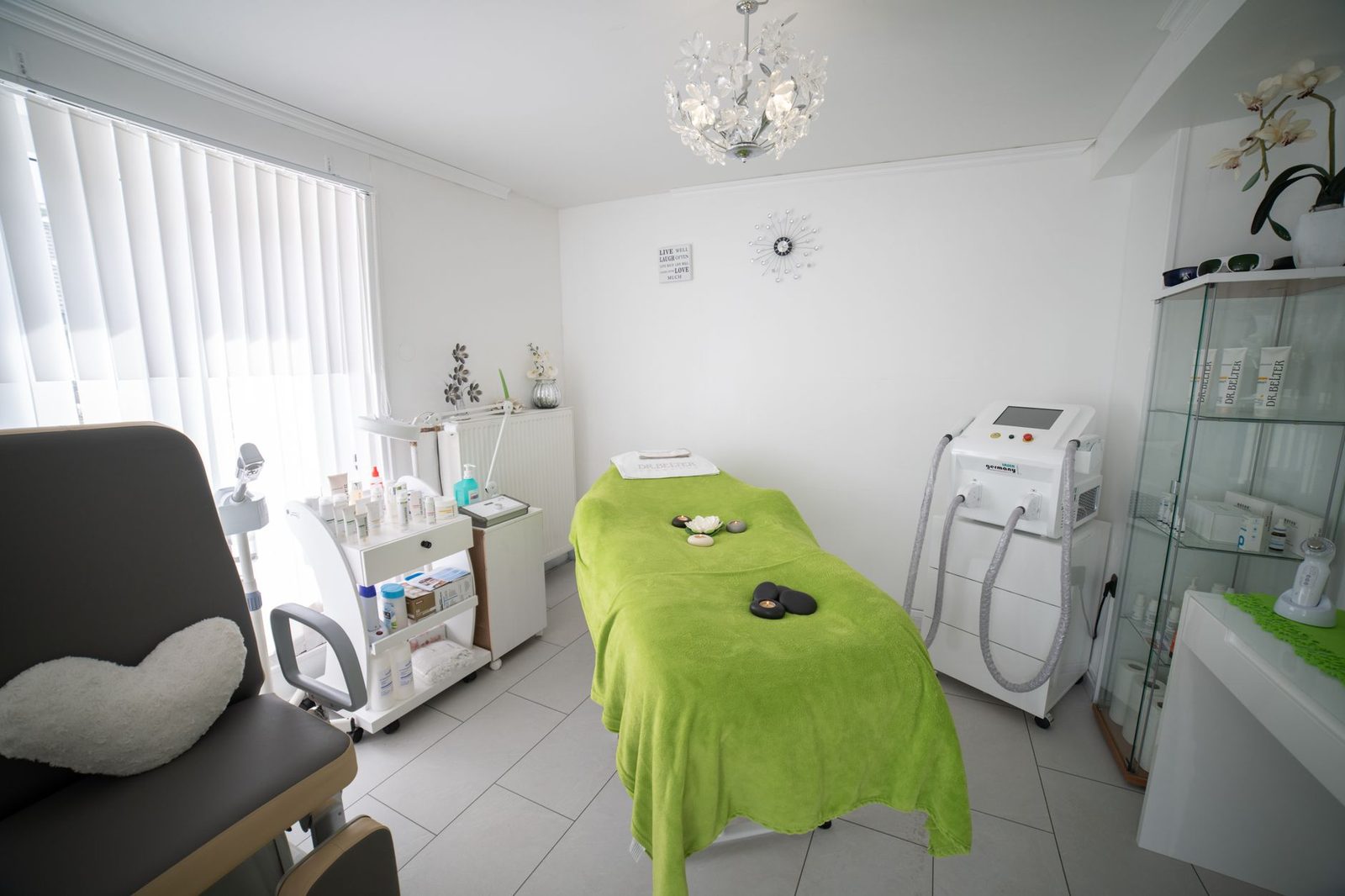
In a treatment room, the client is lying down, often undressed, motionless, sometimes covered in a product that cools the skin. Comfort temperature there is 24 to 26 °C, not 21 °C. And there must be no perceptible airflow at all.
Practical consequences:
- a treatment room cannot be served by the same unit as the reception area. You need either a dedicated low-capacity unit (1.5 to 2 kW), or a separately controlled ducted outlet;
- for laser or IPL hair removal, the requirement reverses again: the machines give off heat and the protocol calls for cool skin. There, a dedicated unit is essential;
- an urban spa with a steam room or steam shower requires that the wet zone be physically separated from the air-conditioned zone. Air conditioning must never attempt to treat a room at 45 °C and 100% humidity: it will destroy itself. The wet zone is a matter of mechanical ventilation and airtightness, not cooling.
For rest areas and changing rooms, a digital indoor hygrometer tucked discreetly behind reception is worth any amount of debate: in thirty seconds it shows whether the problem is temperature or humidity. Below 60% relative humidity and at 25 °C, a treatment room is comfortable; at 70%, it feels stifling even at 23 °C.
Product odours: the AC isn't the problem, but it exposes it
"It smells of stale hairspray in the morning" is a sentence we hear in one salon out of two. The mechanism is simple: hairspray aerosols, solvent vapours and hair dust settle on the filters and on the cooling coil of the indoor unit. Mixed with condensate, they form a greasy deposit that reloads with odour and releases it at start-up.
Three levels of action, in order:
- Renew the air. It is ventilation that removes VOCs, not air conditioning. French labour law (Code du travail) sets out the rules a hair salon must follow on ventilating premises with specific pollution; the INRS (French National Research and Safety Institute) also recommends source capture for the most emissive operations (bleaching, straightening). If your premises only have the original mechanical ventilation, have it measured before investing in cooling.
- Clean the filters far more often than elsewhere. In a salon, cut hair clogs filters in three to four weeks, not six months. A HEPA-filter vacuum cleaner kept on site lets you do the job cleanly without redispersing the dust. The exact protocol is described in our article on air conditioning filters.
- Have the coil and condensate tray disinfected by a professional. Once or twice a year in this type of space, against once every two years in an office. Why odours appear and how to get rid of them: see our piece on air conditioning that smells bad, and the matching service is our air conditioning servicing and cleaning.
Avoid the aerosol deodorising cans sold to "treat" an air conditioner: they mask the smell for a fortnight and leave an extra film on the coil. On the other hand, a set of compatible replacement filters kept in reserve avoids running the machine with no filters after a clean — which fouls the coil in a single season.
Condensate, hair and water: the breakdown you can see coming
In a salon, condensate faces two specific enemies: hair and product residues. The indoor unit's tray loads up with greasy deposit, the pipe clogs, and the water eventually overflows onto the suspended ceiling or onto a colour trolley.
What to insist on in the quote:
- a continuous fall on the gravity drain, or a condensate pump with a level safety switch that shuts the machine down before it overflows;
- an accessible trap, not buried in a sealed-up partition;
- a discharge connected to the premises' wastewater, never dripping into a shared courtyard.
The longer version sits in our piece on condensate drainage. Just remember that in a salon the inspection frequency must be doubled.
Opening hours, winter and the bill: the salon is a special case
A salon is often open Tuesday to Saturday, 9 am to 7 pm, sometimes late one evening. Two consequences.
In summer, the morning pull-down is the most expensive moment: the space has stored heat, and it has to be brought down before clients arrive. A timer set 45 minutes before opening, in moderate cooling mode, costs less than a full-power start at 9 am with the sun on the shopfront. Our settings benchmarks are in the article on setting your air conditioning during a heatwave.
In winter, a reversible system is valuable: it heats a space that the dryers are already partly warming, and it allows you to switch off overnight without dreading Monday's chill. Be careful, though, not to blow hot air onto the cutting stations: in winter, the airflow should be directed downwards around the perimeter of the space, along the windows, and not onto the working area.
On running costs, a properly equipped 55 m² salon uses the equivalent of 1,200 to 2,000 kWh in cooling over an average season in the Paris region, more after a season like the one we have just had. To run the numbers yourself, follow our guide to the electricity consumption of air conditioning.
Finally, one point that owners discover too late: equipment in commercial premises deserves a maintenance contract, not a visit when luck allows. A machine that fails on a Saturday in December in a fully booked salon costs a day's takings. That is exactly the purpose of our air conditioning servicing for businesses.
The checklist before you sign
- Does the quote include the load from styling or treatment appliances in its calculation?
- Is the layout of the air outlets drawn in relation to the chairs, the basins and the waiting bench?
- Do the treatment rooms have independent control?
- Has the ventilation of the premises been assessed separately from the cooling?
- Is the condensate drainage described, with a level safety device?
- Is the servicing frequency suited to premises full of hair and products (monthly filters, annual disinfection)?
- Does the outdoor unit location comply with the building façade rules and the building's management regulations? Our benchmarks are in the article on choosing the location of the outdoor unit.
Lease matters, building-management consent and contracts are covered in our article on commercial premises and restaurants: they apply in full to salons and institutes.
If your salon, barbershop or institute is already equipped and comfort is still poor, the useful diagnosis is not about capacity but about air distribution and air renewal. We carry out this on-site visit across Île-de-France: book an appointment and we'll start again from the floor plan of your premises, station by station.
Need an air conditioning solution?